Why do I need exponents to know when my coffee is drinkable?
A hot drink cools quickly at first, then slower and slower as it nears room temperature. That pattern is exponential decay: the temperature gap to the room shrinks by the same fraction every minute. The same math times cooling food for safety, fevers breaking, and medicine leaving the body.
- Drinkable after
- 15.6 min
- Temperature at your time
- 60.8 °C
Challenge: Make it drinkable within 5 minutes.
More settings
Play
Change the starting temperature and the cup. Watch the curve flatten toward room temperature.
Challenge: Make it drinkable within 5 minutes. The box under the picture turns green when you get it.
Stuck? Pick one of the examples from the “Try an example” menu, or press “New example.”
Understand
The gap between the drink and the room shrinks by the same fraction each minute. Shrinking by a fixed fraction is exponential decay:
After one half-life, the gap is half as big; after two, a quarter. To find when it reaches a target, undo the exponential with a logarithm:
Use
Every input has a unit menu, so you can type values in the units you already have. Results follow your units.
Show the work
- Cooling constant from the half-life
k = \frac{\ln 2}{20} = 0.03466\ \text{/min} - Temperature at your time
T = 18 + (90 - 18)e^{-0.03466 \cdot 15} = 60.81^\circ - Time to drinkable (take the log)
t = \frac{1}{k}\ln\frac{T_0 - T_a}{T_t - T_a} = 15.55\ \text{min}
Export
Set the start, room, and drinkable temperatures. The half-life (in "More settings") describes the cup: roughly 5–10 minutes for a thin cup, 15–30 for an insulated mug.
- Most people find coffee comfortable around 55–65 °C.
- Real cooling also depends on stirring, evaporation, and cream; this is the classic model.
For learning and estimation. Verify with applicable codes, standards, and a qualified professional before using in design, construction, or safety-critical work.
Cheat card
| Symbol | Meaning | Unit |
|---|---|---|
| starting temperature | °C | |
| room temperature | °C | |
| cooling constant | /min |
- Each half-life halves the gap to room temperature, not the temperature itself.
- It never quite reaches room temperature; it just gets closer and closer.
- Lids and thick mugs make the half-life longer.
Where it’s used
- Chemistry
Chemists model cooling, radioactive decay, and first-order reactions with the same exponential. - Medicine & Health
Drug levels in the blood fall exponentially, set by the drug's half-life. - Cooking
Food-safety rules limit how long cooked food can spend cooling through the danger zone.
Related exhibits
 Start here
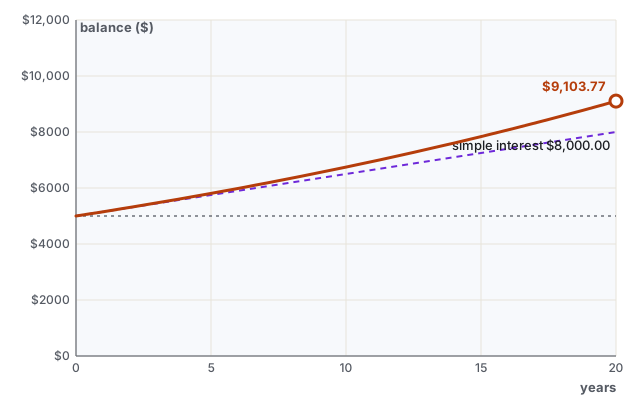
Compound interest: money that grows on itself
Interest earns interest. Exponents explain why saving early wins.
 Go further
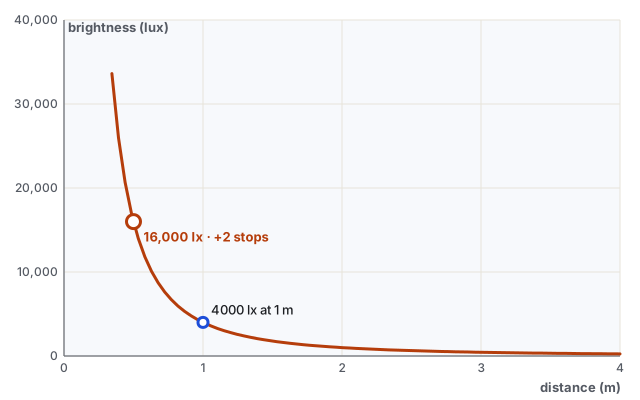
Brightness vs. distance: the inverse-square law
Move a light twice as far and it gives a quarter of the light. Photographers call that two stops.
 Also try
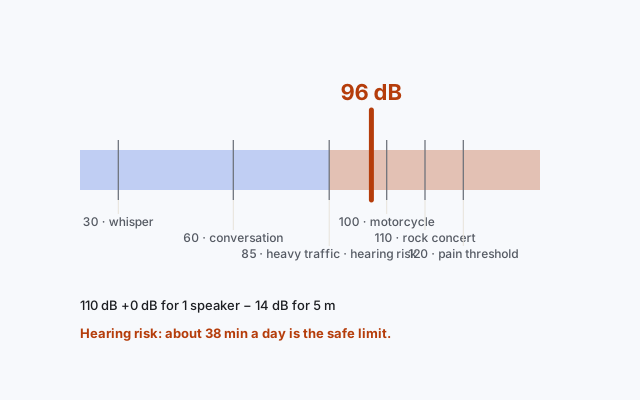
Decibels: why two speakers aren’t twice as loud
Sound is measured on a log scale. Double the speakers: +3 dB. Double the distance: −6 dB.
Questions people ask
What is Newton's law of cooling?
A hot object loses heat at a rate proportional to how much hotter it is than its surroundings, so the gap shrinks exponentially.
Why does coffee cool fast at first, then slowly?
The bigger the difference from room temperature, the faster heat escapes. As the coffee gets closer to room temperature, it cools more slowly.
Can coffee cool below room temperature?
Not by itself. It only approaches the room's temperature, so a target below that is never reached. The site shows