How do I figure out my running pace and predict a race time?
Pace is a ratio: your time divided by the distance, like 5 minutes per kilometer. Predicting a longer race takes an exponent, because you slow down as distance grows. Riegel's formula raises the distance ratio to the 1.06 power, so twice the distance takes about 2.08 times as long, not exactly twice.
- Pace
- 4:15 /km
- Average speed
- 14.1 km/h
- Predicted 10K
- 41 min
- Predicted half marathon
- 1 h 30 min
- Predicted marathon
- 3 h 7 min
Challenge: Find a 5K time that predicts a marathon under 4 hours. Done!
Play
Enter a 5K time, then shave off a minute. Watch the marathon prediction move.
Challenge: Find a 5K time that predicts a marathon under 4 hours. The box under the picture turns green when you get it.
Stuck? Pick one of the examples from the “Try an example” menu, or press “New example.”
Understand
Pace is a ratio: minutes per kilometer (or per mile). Speed is the same ratio upside down.
If you could hold your pace forever, a race twice as long would take exactly twice the time. You can't, so predictions use an exponent a little above 1:
The dots show the pace predicted for each race. They drift to the right, slower, as races get longer. That drift is the exponent at work.
Use
Every input has a unit menu, so you can type values in the units you already have. Results follow your units.
Show the work
- Pace is time per distance
\frac{89.5\ \text{min}}{21.1\ \text{km}} = 4.242\ \text{min/km} - Speed is the flip side
\frac{21.1\ \text{km}}{1.492\ \text{h}} = 14.14\ \text{km/h} - Riegel’s formula: twice as far takes a bit more than twice as long
T_2 = T_1\left(\frac{D_2}{D_1}\right)^{1.06} - Marathon
T_{\text{marathon}} = 89.5\left(\frac{42.195}{21.1}\right)^{1.06} = 186.6\ \text{min}
Export
Enter a recent race or time trial. Switch distance to miles or time to hours in the unit menus. Predicted times appear on the right.
- Use a race you ran hard. An easy run predicts easy-run times.
- Heat, hills, and wind all slow real races. Treat the prediction as a best case on a good day.
For learning and estimation. Verify with applicable codes, standards, and a qualified professional before using in design, construction, or safety-critical work.
Cheat card
| Symbol | Meaning | Unit |
|---|---|---|
| a race you ran: time and distance | ||
| the race you want to predict |
- To convert pace, multiply min/km by 1.609 for min/mile.
- The prediction assumes you train for the longer distance. Without long runs, marathons usually come out slower.
- Predictions from a nearby distance are the most accurate. A 10K predicts a half better than a mile does.
Where it’s used
- Medicine & Health
Exercise scientists model how speed falls with distance to study endurance. - Sports & Games
Runners use Riegel's formula to set a realistic goal pace for their next race. - Health & Fitness
Track your pace over weeks to see fitness improve, even on different routes.
Related exhibits
 Start here
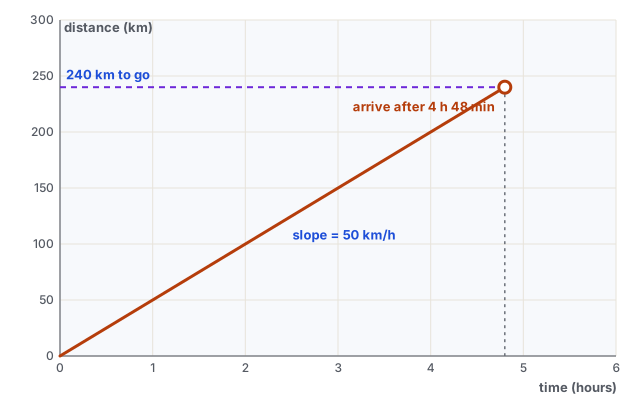
Speed, distance, time: how long is the drive?
Distance is speed times time. Rearrange it and you know when you’ll arrive.
 Go further
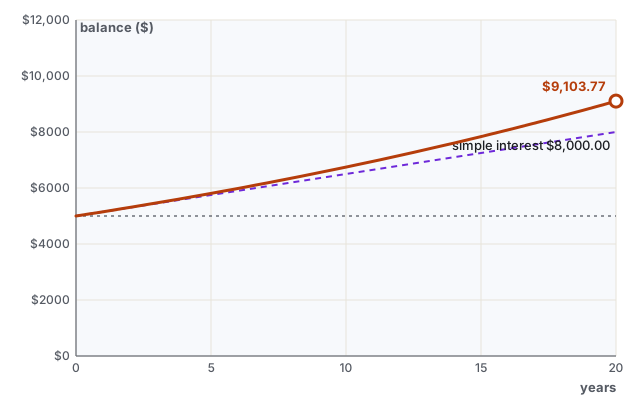
Compound interest: money that grows on itself
Interest earns interest. Exponents explain why saving early wins.
 Also try
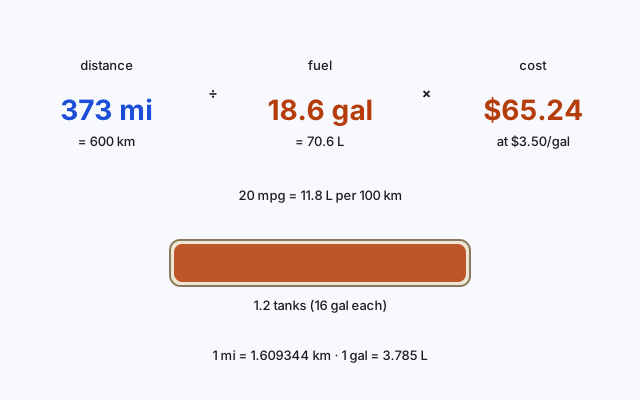
Road trip math: miles, liters, and dollars
Convert once and the trip adds up: how far, how much fuel, how much money.
 Also try
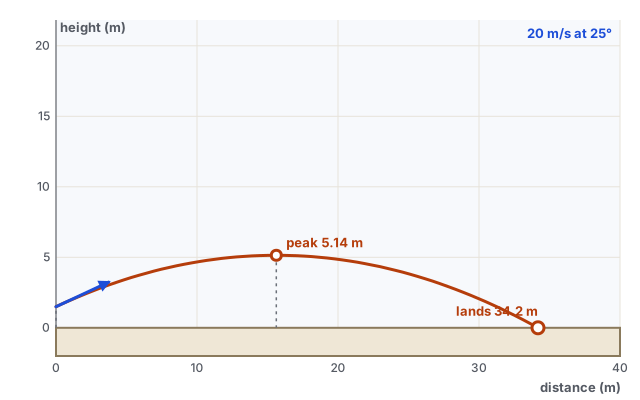
Throwing a ball: the quadratic arc
Every throw, jump, and fountain draws a parabola.
Questions people ask
How do you calculate running pace?
Divide your time by the distance. A 5K in 25 minutes is 25 ÷ 5 = 5 minutes per kilometer. Multiply by 1.609 for minutes per mile, here 8:03.
How do I predict my marathon time from a 5K?
Use Riegel's formula, marathon time = 5K time × (42.195 ÷ 5)^1.06. A 25-minute 5K predicts 3:59:48, just under 4 hours, if you've trained the long runs.
Why is the exponent 1.06 and not 1?
With an exponent of 1, you'd hold the same pace forever. Real runners tire, so time grows a little faster than distance. Peter Riegel fit 1.06 to race results in 1977.