Why do I need linear equations to plan a road trip?
At a steady speed, distance grows in a straight line with time: distance equals speed times time. That single linear equation answers the questions every trip raises. How long will the drive take? How fast must I go to arrive on time? How far can I get before dark?
- Time on the road
- 4 h 48 min
Challenge: Plan a trip that takes exactly 3 hours.
Play
Change the distance and the speed. See when you'd arrive.
Challenge: Plan a trip that takes exactly 3 hours. The box under the picture turns green when you get it.
Stuck? Pick one of the examples from the “Try an example” menu, or press “New example.”
Understand
The graph shows distance against time. At a steady speed the line is straight, because every hour adds the same distance. That is what makes a linear equation, and the speed is the line's slope.
The dashed line marks your trip's distance. Where the sloped line reaches it, you've arrived. Read the arrival time straight down on the time axis:
A faster speed makes a steeper line that reaches the distance sooner.
Use
Every input has a unit menu, so you can type values in the units you already have. Results follow your units.
Show the work
- Distance = speed × time
d = v\,t ;\Rightarrow; t = \frac{d}{v} - With your numbers
t = \frac{240}{50} = 4.8\ \mathrm{h} - In hours and minutes
\text{4 h 48 min}
Export
Pick km or miles and km/h or mph in the unit menus. The time is shown in hours and minutes.
- For a deadline, work backwards: gives the average speed you need.
- Add planned stops to the time separately. They don't belong in the speed.
For learning and estimation. Verify with applicable codes, standards, and a qualified professional before using in design, construction, or safety-critical work.
Cheat card
| Symbol | Meaning | Unit |
|---|---|---|
| distance | km or mi | |
| average speed | km/h or mph | |
| time | h |
- Use average speed, including slow stretches, not the speed limit.
- Keep units matched. Kilometers with km/h, miles with mph.
- 0.25 h is 15 minutes, not 25.
Where it’s used
- Physics
Physics starts with this equation for anything moving at constant velocity. - Driving & Travel
Drivers, cyclists, and pilots use it to estimate arrival times and fuel stops.
Related exhibits
 Start here
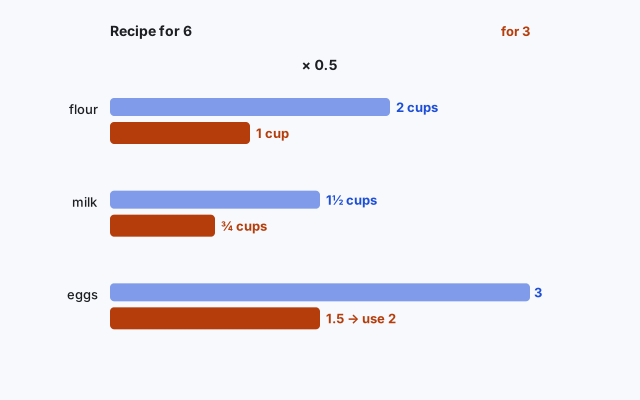
Scaling a recipe: more people, same taste
Double the guests? Every ingredient grows by the same factor.
 Go further
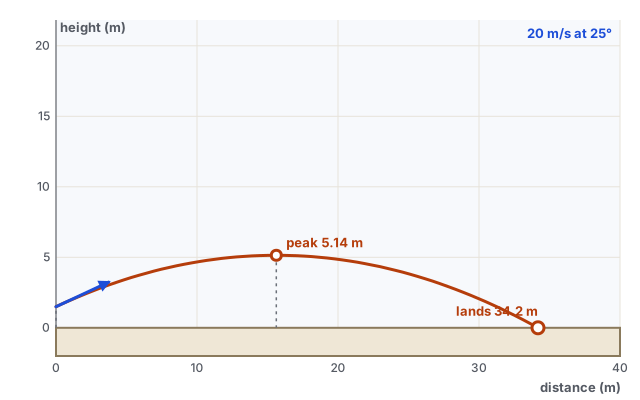
Throwing a ball: the quadratic arc
Every throw, jump, and fountain draws a parabola.
 Also try
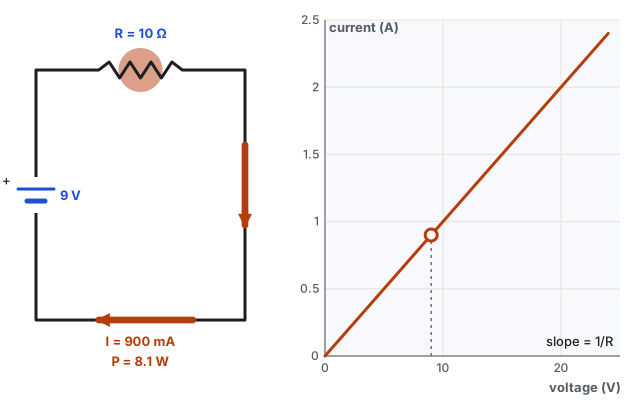
Ohm’s law: how much current flows?
Push harder (volts) or squeeze tighter (ohms), and watch the current change.
Questions people ask
How do I calculate travel time?
Divide the distance by your average speed. 300 km at 90 km/h is 300 ÷ 90 = 3.33 hours, or 3 hours 20 minutes.
Why is my real trip slower than the calculation?
Stops, traffic, and slow zones lower your average speed. Use a lower speed than the limit to get a realistic time.
Why is this called a linear equation?
Because the graph of distance against time is a straight line. Its slope is the speed.