How long will it take to pay off my credit card?
Solve the balance formula for the number of months and a logarithm appears: n = −ln(1 − iB/P) / ln(1 + i). It shows why small payments take so long. If your payment barely beats the monthly interest, most of it disappears into interest, and a little more each month cuts years off.
- Months to pay off
- 33
- Total interest
- $1,101.33
- Total paid
- $6,101.33
- Payment to be done in 3 years
- $173.33
Challenge: Pay the card off in 24 months or less.
Play
Slide the payment down toward the monthly interest. Watch the payoff time shoot up.
Challenge: Pay the card off in 24 months or less. The box under the picture turns green when you get it.
Stuck? Pick one of the examples from the “Try an example” menu, or press “New example.”
Understand
Each month the card multiplies your balance by and then subtracts your payment. Written out, the balance after months has in it. To find when it reaches zero, you have to solve for the exponent , and that takes a logarithm:
The fraction is the share of your first payment eaten by interest. As the payment falls toward the interest, that share approaches 1. The logarithm then heads toward , which has no value, and the payoff time runs off toward forever.
The dashed curve shows the same card with $50 more a month.
Use
Every input has a unit menu, so you can type values in the units you already have. Results follow your units.
Show the work
- Monthly rate
i = \frac{r}{12} = 0.0125 - Interest added in month one
iB = 0.0125 \times 5000 = \$62.50 - Solve the balance formula for n (take a logarithm)
n = -\frac{\ln\left(1 - \frac{iB}{P}\right)}{\ln(1 + i)} - With your numbers
n = -\frac{\ln\left(1 - \frac{0.0125\cdot 5000}{190}\right)}{\ln(1 + 0.0125)} - Result
n = 32.11 \;\Rightarrow\; 33\ \text{payments}
Export
Enter the balance, the APR from your statement, and what you plan to pay each month. The last readout is the payment that clears the balance in 3 years.
- This assumes no new purchases, a fixed APR, and interest charged monthly on the balance.
- Real cards compute interest on the average daily balance, so your statement can differ by a few dollars.
- Promotional 0% rates usually end. Check what the rate becomes afterward.
For learning and estimation. Verify with applicable codes, standards, and a qualified professional before using in design, construction, or safety-critical work.
Cheat card
| Symbol | Meaning | Unit |
|---|---|---|
| number of monthly payments | ||
| balance owed | $ | |
| monthly payment | $ | |
| monthly interest rate |
- Your payment has to beat the month's interest, iB, before the balance goes down at all.
- Every dollar above the interest goes to the balance, so small increases help a lot.
- Stop adding new charges while you pay it down, or the formula no longer applies.
Where it’s used
- Finance & Business
Credit counselors use this formula to build debt payoff plans and compare balance-transfer offers. - Money & Shopping
See what an extra $50 a month does to a credit card balance before you pick a budget.
Related exhibits
 Start here
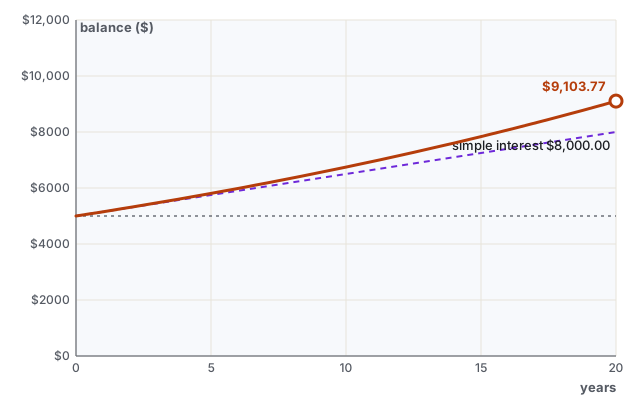
Compound interest: money that grows on itself
Interest earns interest. Exponents explain why saving early wins.
 Start here
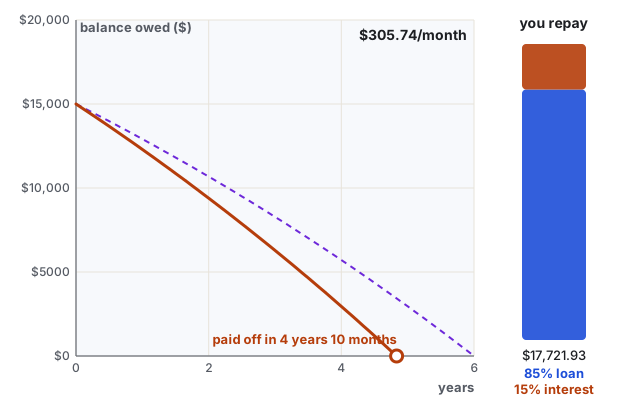
Loan payments: what a mortgage really costs
One formula sets every car, student, and home loan payment. See where the interest goes.
 Go further
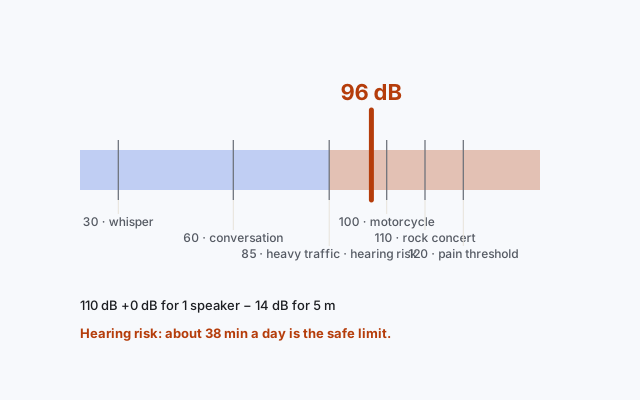
Decibels: why two speakers aren’t twice as loud
Sound is measured on a log scale. Double the speakers: +3 dB. Double the distance: −6 dB.
 Also try
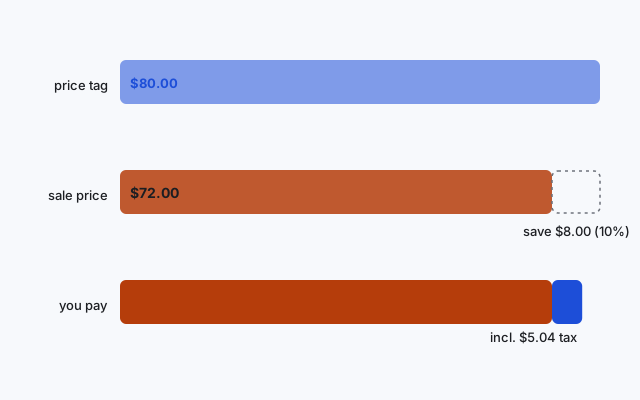
Sale price and tax: what you really pay
30% off, then tax on top. Percent math decides the number at the register.
Questions people ask
How do you calculate how long it takes to pay off a credit card?
Divide the APR by 12 to get the monthly rate i. Then n = −ln(1 − iB/P) / ln(1 + i), where B is the balance and P is the monthly payment. $5,000 at 24% paying $200 a month takes 35 months.
Why does paying the minimum take so long?
Minimum payments are set just above the monthly interest. Only the small part above the interest reduces the balance, so it shrinks slowly, and interest keeps being charged the whole time.
What if my payment is less than the interest?
Then the balance grows every month and the card is never paid off. The formula tries to take the logarithm of zero or a negative number, which has no real answer. That's the
Why is there a logarithm in this formula?
The balance changes by a multiplying factor, 1 + i, each month. A logarithm is how you solve for an exponent, and here the exponent is the number of months.