Why do I need percentages to know what I'll pay at a sale?
Sale signs and sales tax are both percentages, and they work by multiplying, not adding. Thirty percent off means you pay 70 percent of the price. Tax then adds a percentage of that new price. Knowing this lets you check the register, compare deals, and see the real total before you buy.
- Sale price
- $72.00
- You save
- $8.00
- Tax
- $5.04
- You pay
- $77.04
Challenge: Get the total down to half the price tag or less.
Play
Slide the discount up and down. Watch the savings grow and the tax shrink with it.
Challenge: Get the total down to half the price tag or less. The box under the picture turns green when you get it.
Stuck? Pick one of the examples from the “Try an example” menu, or press “New example.”
Understand
A percent is a fraction of 100, and percent changes multiply:
The top bar is the price tag. In the middle bar, the solid part is what you pay and the outlined part is what you save. The bottom bar adds tax to the sale price. Because tax is a percent of the sale price, a bigger discount shrinks the tax too.
Use
Every input has a unit menu, so you can type values in the units you already have. Results follow your units.
Show the work
- Take the discount off
80 \times (1 - 0.1) = \$72.00 - Add the tax
72.00 \times 0.07 = \$5.04 - Total
\$72.00 + \$5.04 = \$77.04
Export
Enter any price, discount, and tax rate to see the total at the register. For two stacked discounts, run the first one, then use its sale price as the new price tag.
- Round to the cent only at the end. Stores round the final total, not each step.
- Some items are tax-exempt. Set tax to 0% for those.
For learning and estimation. Verify with applicable codes, standards, and a qualified professional before using in design, construction, or safety-critical work.
Cheat card
| Symbol | Meaning | Unit |
|---|---|---|
| price on the tag | $ | |
| discount as a decimal (30% = 0.30) | ||
| tax rate as a decimal (8% = 0.08) |
- Percent off means multiply by what's left. 30% off is × 0.70.
- Two discounts of 20% are not 40% off. They're × 0.8 × 0.8 = × 0.64, which is 36% off.
- Tax is charged on the sale price, not the tag price.
Where it’s used
- Finance & Business
Retailers and accountants use percent change for markups, margins, and sales tax every day. - Money & Shopping
Shoppers use it to compare a percent-off sale with a dollars-off coupon.
Related exhibits
 Go further
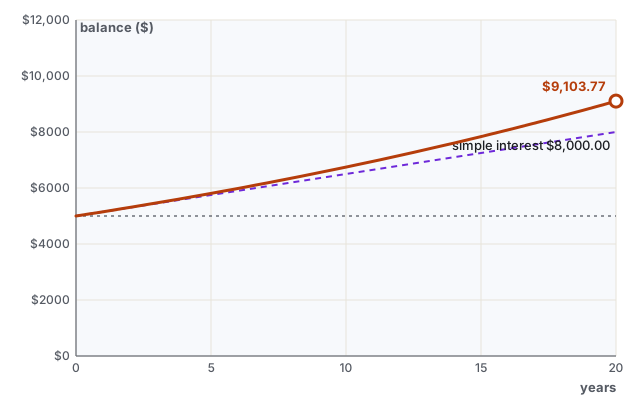
Compound interest: money that grows on itself
Interest earns interest. Exponents explain why saving early wins.
 Go further
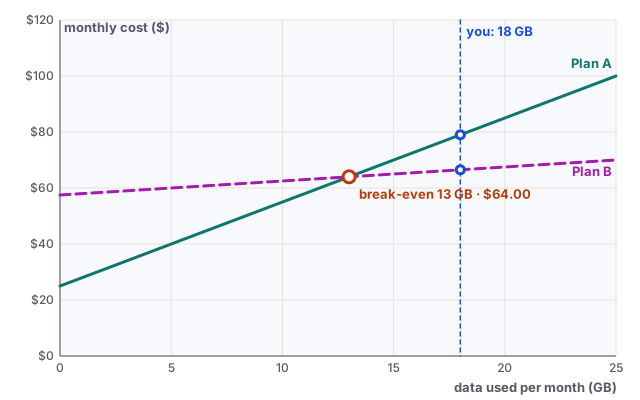
Phone plans: finding the break-even point
Two plans, two lines. Where they cross, the price is the same.
 Also try
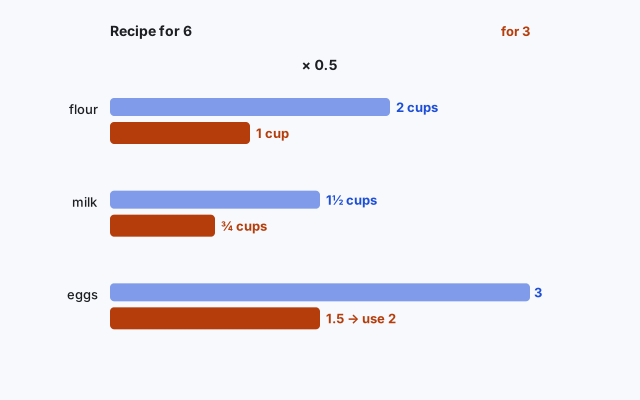
Scaling a recipe: more people, same taste
Double the guests? Every ingredient grows by the same factor.
Questions people ask
How do I calculate 30% off?
Multiply the price by 0.70, because you keep 70% of it. For an $80 jacket, that's $56.
Is tax added before or after the discount?
In most places tax is charged on the price you actually pay, after the discount. That's why a bigger discount also means less tax.
Are two 20% discounts the same as 40% off?
No. Each discount applies to what's left. 0.8 × 0.8 = 0.64, so you pay 64%, which is 36% off, not 40%.