How much paint do I need for a room?
Find the wall area: add up the room's perimeter and multiply by the wall height. Subtract about 20 square feet for each door and 15 for each window. Multiply by the number of coats and divide by the can's coverage, usually 350 to 400 square feet per gallon. Round up to whole cans.
- Area to paint
- 365 ft²
- Paint needed
- 2.09 gal
- Gallon cans to buy
- 2
- Plus quart cans
- 1
Real coverage varies 10–20% with texture and primer, and you’re close to the edge here, so an extra quart is cheap insurance.
Challenge: Find a room that needs exactly whole gallons, with less than a quarter gallon to spare.
More settings
Play
Add a window, then two. Watch the area drop, then raise the ceiling height.
Challenge: Find a room that needs exactly whole gallons, with less than a quarter gallon to spare. The box under the picture turns green when you get it.
Stuck? Pick one of the examples from the “Try an example” menu, or press “New example.”
Understand
A room's walls are four rectangles. Unfold them into one long strip and it is a single rectangle: the perimeter long and tall.
Paint is sold by volume, but it's used by area. The coverage on the can (square feet per gallon) is the ratio that converts one into the other.
Use
Every input has a unit menu, so you can type values in the units you already have. Results follow your units.
Show the work
- Walls: the perimeter times the height
2(L + W)H = 2(16 + 9) \times 9 = 450\ \mathrm{ft^2} - Subtract doors (20 ft²) and windows (15 ft²)
450 - 85 = 365\ \mathrm{ft^2} - Gallons
\frac{365 \times 2}{350} = 2.086\ \text{gal}
Export
Measure the room, count doors and windows, and read the coverage on the can. Open "More settings" for coats, coverage, and the ceiling.
- Switch the units to meters and the coverage to m²/L if your cans are metric.
- Trim and doors usually take a different paint. Buy a quart for those.
- Keep a little extra for touch-ups. Matching a color later is hard.
For learning and estimation. Verify with applicable codes, standards, and a qualified professional before using in design, construction, or safety-critical work.
Cheat card
| Symbol | Meaning | Unit |
|---|---|---|
| room length and width | ft | |
| wall height | ft | |
| number of doors and windows | ||
| area one gallon covers | ft²/gal |
- Two coats is the norm. Use three when covering a dark color with a light one.
- Three quarts cost about the same as a gallon, so round up to a gallon.
- Textured or unprimed walls soak up more paint. Use a lower coverage number.
Where it’s used
- Trades
Painters estimate materials and bid jobs from wall area and coverage. - Home Projects
Buy the right number of cans before a weekend painting project.
Related exhibits
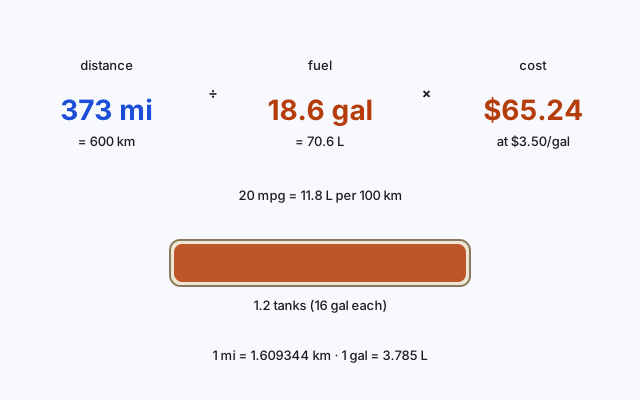 Start here
Road trip math: miles, liters, and dollars
Convert once and the trip adds up: how far, how much fuel, how much money.
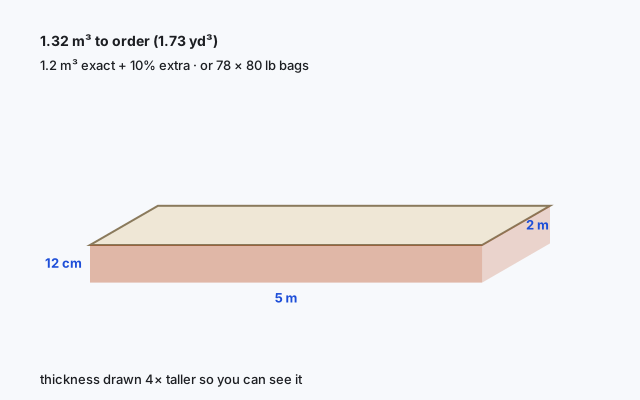 Go further
How much concrete for a slab?
Length × width × depth, plus a little extra. Get it right and you won’t run short mid-pour.
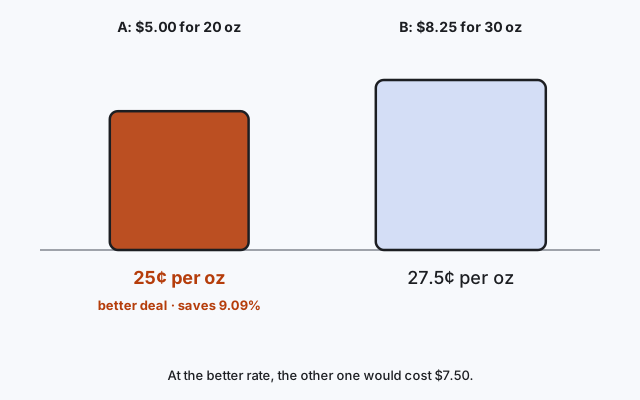 Also try
Unit price: is the big size really the better deal?
Divide price by size and the shelf tags stop lying. Bigger isn’t always cheaper.
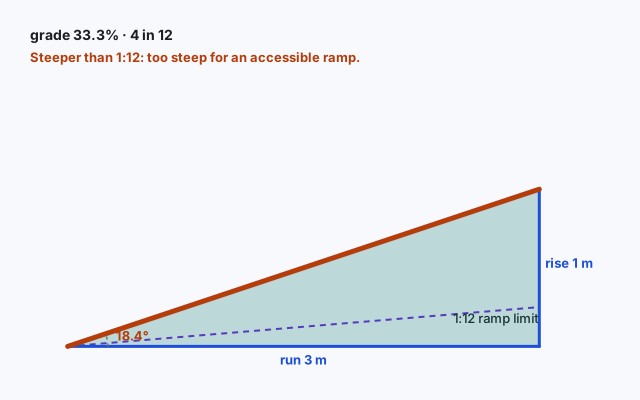 Also try
Roof pitch and ramp slope: rise over run
Slope is one number that decides whether a roof sheds water or a ramp is safe to roll up.
Questions people ask
How many gallons of paint for a 12 × 12 room?
With 8 ft walls, one door, and two windows, the walls are about 334 ft². Two coats at 350 ft² per gallon need about 1.9 gallons, so buy 2.
How much does a gallon of paint cover?
Most interior wall paint covers 350 to 400 ft² per gallon on smooth, primed walls. Rough or porous surfaces can drop that to 250.
Do I subtract doors and windows?
Yes, for an accurate count. A standard door is about 20 ft² and a window about 15 ft². For a small room with few openings, many painters skip this and keep the extra as touch-up paint.