How fast does hot food have to cool, and how do kitchens do it?
The US Food Code says cooked food must cool from 135 °F to 70 °F within 2 hours, then to 41 °F within 6 hours total. Cooling slows as food nears the fridge temperature, so the time comes from a logarithm. Shallow pans, ice baths, and blast chillers shrink the time constant enough to make it.
- 135 → 70 °F (limit 2 h)
- 47 min
- Until 41 °F
- 2 h 11 min
- Time constant τ
- 47 min
Real cooling depends on lids, stirring, pan material, and how full the cooler is. Always check with a probe thermometer and follow your local health code.
Challenge: Cool food at least 6 inches deep in time.
More settings
Play
Deepen the chili from 2 inches to 4 in the walk-in and watch it fail the 2-hour rule.
Challenge: Cool food at least 6 inches deep in time. The box under the picture turns green when you get it.
Stuck? Pick one of the examples from the “Try an example” menu, or press “New example.”
Understand
Food cools at a rate proportional to how much warmer it is than its surroundings, which is Newton's law of cooling:
To find how long a target takes, solve for with a logarithm:
The time constant is the lever. Shallower food (smaller ) or a stronger method (bigger : moving air, ice water) cools faster. The orange band is the 2-hour window for 135 → 70 °F, and the blue band is the 6-hour window to 41 °F.
Use
Every input has a unit menu, so you can type values in the units you already have. Results follow your units.
Show the work
- Time constant: deeper food and weaker cooling mean a bigger τ
\tau = \frac{62.4 \times 0.25\ \text{ft}}{20} = 0.78\ \text{h} - Newton’s law of cooling
T(t) = 33 + (165 - 33)\,e^{-t/\tau} - Solve for time with a logarithm: 135 → 70 °F
t = \tau\ln\frac{135 - 33}{70 - 33} = 0.791\ \text{h}\ (\le 2) - And to 41 °F
t = \tau\ln\frac{165 - 33}{41 - 33} = 2.187\ \text{h}
Export
Pick a cooling method and the food's depth. "More settings" changes the starting temperature.
- This is a planning estimate. The real check is a probe thermometer and a cooling log.
- The model treats food like water. Thick stews and dense foods cool more slowly.
For learning and estimation. Verify with applicable codes, standards, and a qualified professional before using in design, construction, or safety-critical work.
Cheat card
| Symbol | Meaning | Unit |
|---|---|---|
| temperature of the cooler or ice bath | °F | |
| time constant | h | |
| food depth | ft | |
| how well the method pulls heat out | BTU/h·ft²·°F |
- Halve the depth and you roughly halve the cooling time. Shallow pans are the cheapest fix.
- Never cool a full stockpot in the walk-in. Split it, or use an ice bath or ice paddle.
- Leave pans uncovered (or loosely covered) until cold, and don't stack them.
Where it’s used
- Biology
Bacteria like Clostridium perfringens grow fastest between about 70 °F and 125 °F, which is why the first 2 hours are strictest. - Physics
The same logarithm times anything cooling toward its surroundings, from engines to steel in a quench. - Cooking
At home, cool big batches of soup or chili in shallow containers before they go in the fridge.
Related exhibits
 Start here
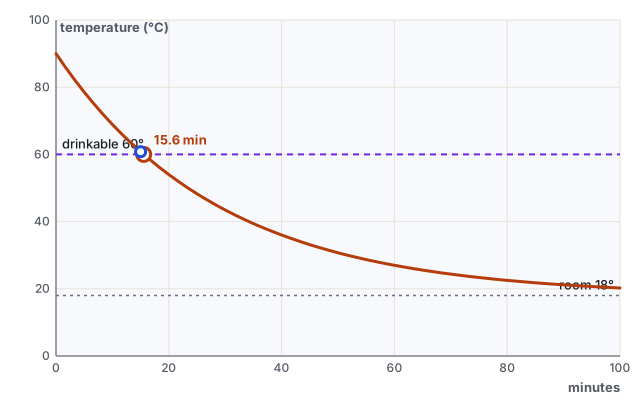
Cooling coffee: when is it drinkable?
Hot things cool fast, then slower and slower. Exponential decay predicts the sip.
 Go further
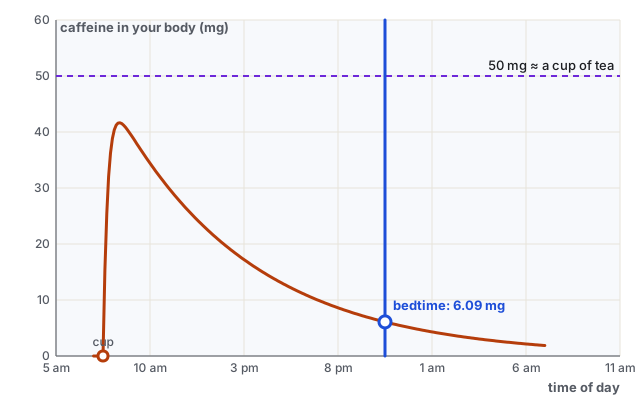
When will my coffee wear off?
Each cup rises, then fades by half every few hours. Cups stack, and the Laplace transform says why they simply add.
 Also try
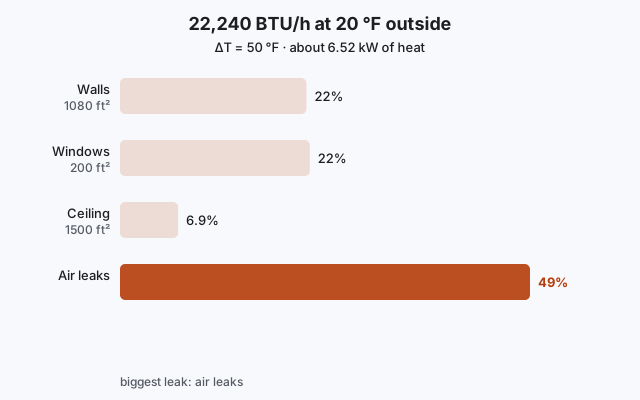
Home heat loss: where does the heat go?
Heat leaks through each surface in proportion to area and temperature difference, divided by R. Windows and drafts punch far above their size.
 Also try
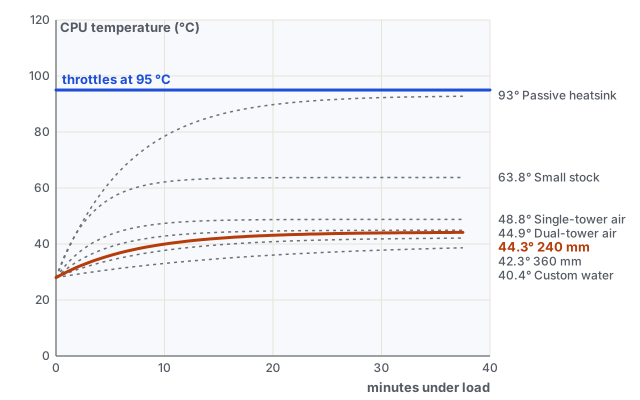
PC cooling: passive, air, or water?
Heat flows through the cooler like current through a resistor: temperature rise = watts × °C/W. Water adds mass, so it heats up slower.
Questions people ask
What is the 2-stage cooling rule?
Under the FDA Food Code (3-501.14), cooked food must go from 135 °F to 70 °F within 2 hours, and to 41 °F or below within 6 hours total. Your local health code may differ slightly.
Why are shallow pans so much faster?
The time constant grows with depth, because heat has farther to travel for the same surface area. A 2-inch layer cools in about half the time of a 4-inch one.
Why does cooling slow down near the end?
Heat flows in proportion to the temperature difference. As food approaches the fridge temperature, the difference shrinks and so does the flow. That's exponential decay, and solving it for time takes a logarithm.