How do you calculate a home's heat loss?
For each wall, window, and ceiling, multiply its area by the inside-outside temperature difference and divide by its R-value. That's BTUs per hour. Add the air leaking in: 0.018 × volume × air changes per hour × temperature difference. Windows and drafts often lose more than all the walls combined.
- Heat loss at design temperature
- 22,200 BTU/h
- Through windows
- 5000 BTU/h
- Through air leaks
- 10,800 BTU/h
This leaves out floors, basements, ducts, and heat from sun and people. Sizing a furnace or heat pump takes a full load calculation (Manual J).
Challenge: Get the heat loss under 12,000 BTU/h without changing the weather.
More settings
Play
Swap single-pane windows for triple-pane, then seal the drafts. Which cut helps more?
Challenge: Get the heat loss under 12,000 BTU/h without changing the weather. The box under the picture turns green when you get it.
Stuck? Pick one of the examples from the “Try an example” menu, or press “New example.”
Understand
Heat flows from warm to cold, and each part of the house resists it with its R-value. The flow is linear: proportional to area and temperature difference, and inversely proportional to R.
Air leaks carry heat out directly. Every cubic foot of cold air that sneaks in has to be warmed, at about 0.018 BTU per cubic foot per °F:
The bars show each part's share. The biggest one is where an upgrade pays most.
Use
Every input has a unit menu, so you can type values in the units you already have. Results follow your units.
Show the work
- Temperature difference
\Delta T = 70 - (20) = 50\ ^\circ\mathrm{F} - Walls
\frac{1080 \times 50}{11} = 4909\ \text{BTU/h} - Windows
\frac{200 \times 50}{2} = 5000\ \text{BTU/h} - Ceiling
\frac{1500 \times 50}{49} = 1531\ \text{BTU/h} - Air leaks: heat to warm the incoming air
0.018 \times 12{,}000 \times 1 \times 50 = 10{,}800\ \text{BTU/h} - Total
Q = 22{,}240\ \text{BTU/h}
Export
Pick the insulation and windows you have, and the coldest temperature you plan for. Open "More settings" to enter your own areas, volume, and indoor temperature.
- Design temperatures by city are published in ASHRAE tables and many HVAC references.
- R-values here are for the whole assembly. Framing and gaps make real walls a little worse than the insulation's label.
For learning and estimation. Verify with applicable codes, standards, and a qualified professional before using in design, construction, or safety-critical work.
Cheat card
| Symbol | Meaning | Unit |
|---|---|---|
| heat loss | BTU/h | |
| area of the surface | ft² | |
| R-value (resistance to heat flow) | ft²·°F·h/BTU | |
| air changes per hour |
- Heat loss is linear. Twice the temperature difference means twice the loss.
- A window at R-2 loses about 6 times as much per square foot as an R-13 wall.
- 1 kW = 3,412 BTU/h. Divide by 3,412 to compare with an electric heater.
Where it’s used
- Civil & Construction
Engineers and energy auditors estimate heating loads room by room this way before sizing equipment. - Trades
HVAC techs start from these same numbers, then refine them with a full Manual J calculation. - Home Projects
Find where your house loses the most heat before spending money on upgrades.
Related exhibits
 Start here
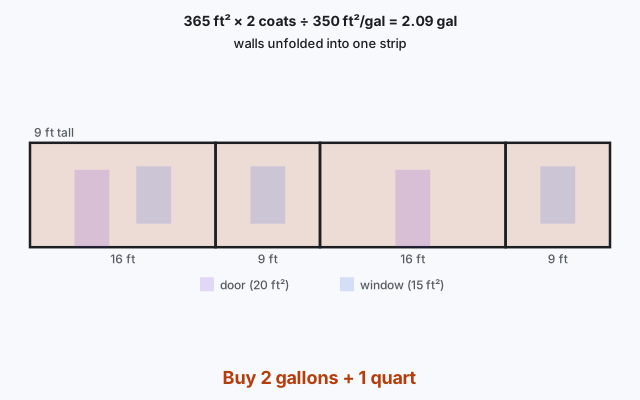
How much paint do I need for a room?
Unfold the walls into one long rectangle. Area, minus doors and windows, sets the gallons.
 Go further
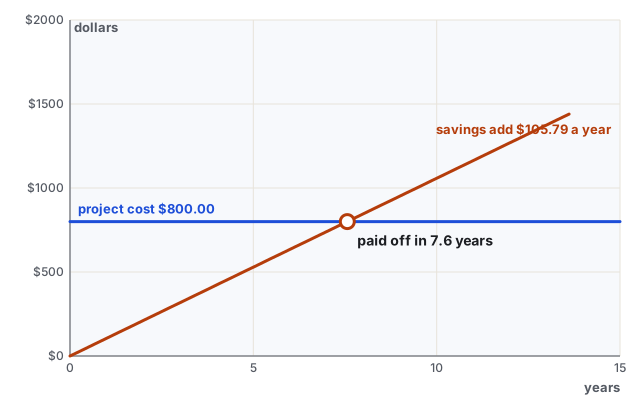
Insulation payback: how long until it pays for itself?
Heat saved goes as 1/R_before − 1/R_after, so the first few inches pay back fastest.
 Also try
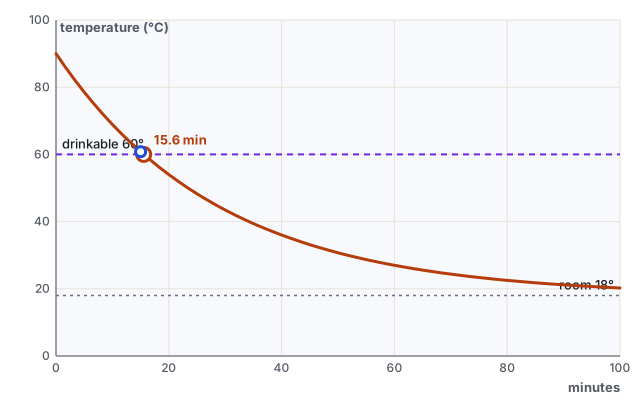
Cooling coffee: when is it drinkable?
Hot things cool fast, then slower and slower. Exponential decay predicts the sip.
 Also try
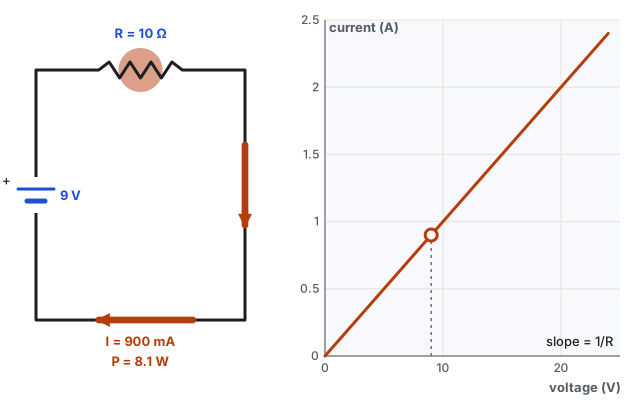
Ohm’s law: how much current flows?
Push harder (volts) or squeeze tighter (ohms), and watch the current change.
Questions people ask
How do you calculate heat loss through a wall?
Area × temperature difference ÷ R-value. A 1,000 ft² wall at R-13 with 60 °F between inside and outside loses 1,000 × 60 ÷ 13 ≈ 4,600 BTU/h.
How many BTU per square foot do I need to heat a house?
It varies a lot with climate and insulation, often 20 to 50 BTU/h per square foot. That's why a heat loss calculation beats a rule of thumb.
What is an R-value?
Resistance to heat flow. Higher R means less heat escapes. Its inverse, U = 1/R, is how much heat leaks per square foot per degree. Window labels usually list U instead of R.