Why do two slightly out-of-tune notes make a wobbling sound?
Two notes with nearly the same frequency drift in and out of step. When their peaks line up the sound gets louder, and when they cancel it gets quieter. The loudness pulses as many times per second as the difference between the frequencies, so tuning by ear means slowing the pulse until it stops.
- Beats per second
- 3.79 Hz
- Second note
- 326 Hz
- The pitch you hear
- 328 Hz
Challenge: Tune the second note until it beats less than once every two seconds.
Play
Press "Both together," then slide the detune toward zero and listen to the wobble slow down.
Challenge: Tune the second note until it beats less than once every two seconds. The box under the picture turns green when you get it.
Stuck? Pick one of the examples from the “Try an example” menu, or press “New example.”
Understand
Add two sine waves and a trig identity rewrites the sum as one sine inside an envelope:
You hear the average pitch, , and the slow cosine sets its loudness. The envelope peaks twice per cosine cycle, so the loudness pulses times a second. The top graph shows 20 milliseconds of the two waves slipping out of step. The bottom graph shows the loudness over a few beats.
Use
Every input has a unit menu, so you can type values in the units you already have. Results follow your units.
Show the work
- The second note, from cents (1200 per octave)
f_2 = 330 \times 2^{-20/1200} = 326.21\ \text{Hz} - Adding two sines makes one sine at the average pitch inside a slow cosine envelope
\sin a + \sin b = 2\cos\frac{a - b}{2}\,\sin\frac{a + b}{2} - The envelope peaks twice per cosine cycle, so the loudness pulses at the difference
\text{beats} = \lvert 326.21 - 330 \rvert = 3.79\ \text{per second}
Export
Pick a note and detune the second one in cents. The supersaw button stacks seven sawtooth waves spread across your detune and panned wide.
- Real instruments have many harmonics, and each pair of harmonics beats too, so the effect is richer than two pure tones.
For learning and estimation. Verify with applicable codes, standards, and a qualified professional before using in design, construction, or safety-critical work.
Cheat card
| Symbol | Meaning | Unit |
|---|---|---|
| the two notes | Hz | |
| detune | cents |
- Tune from slightly flat up to pitch. You'll hear the beats slow, stop, then start again if you go past.
- The same cents of detune beats faster on higher notes, so check tuning on a low string to hear it clearly.
- Synth players detune on purpose. A few cents of slow beating sounds wide and lush instead of out of tune.
Where it’s used
- Music & Sound
Chorus pedals and supersaw synth patches stack slightly detuned copies of a sound to make it wide. - Physics
Piano tuners count beats per second to set intervals exactly, without an electronic tuner. - Music
Guitarists tune with the 5th-fret method by listening for beats between two strings.
Related exhibits
 Start here
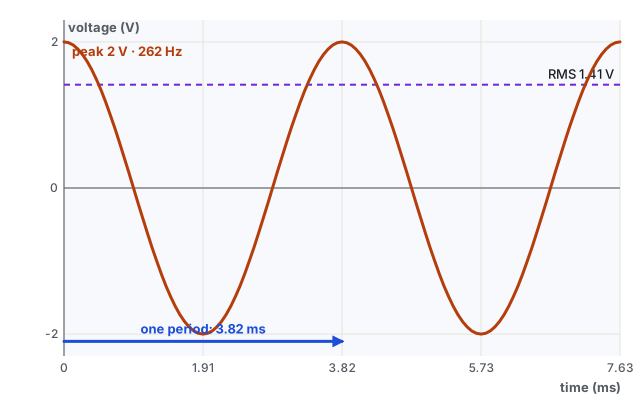
Sine waves: wall power and musical notes
The outlet and a tuning fork follow the same curve: amplitude, frequency, and phase.
 Go further
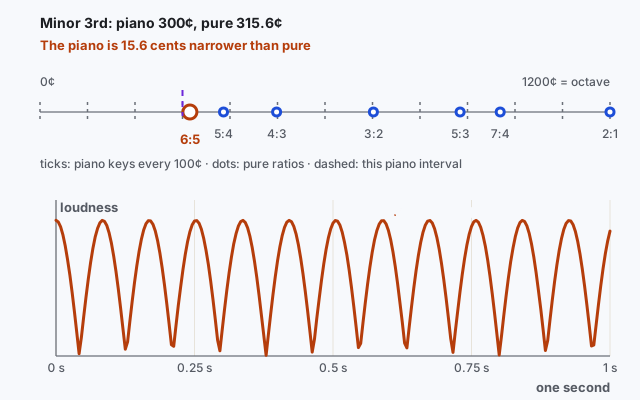
Equal temperament vs. pure intervals: why a piano’s 3rds shimmer
A piano splits the octave into 12 equal ratios. Pure intervals are whole-number ratios. The gap is small, and you can hear it as beats.
 Also try
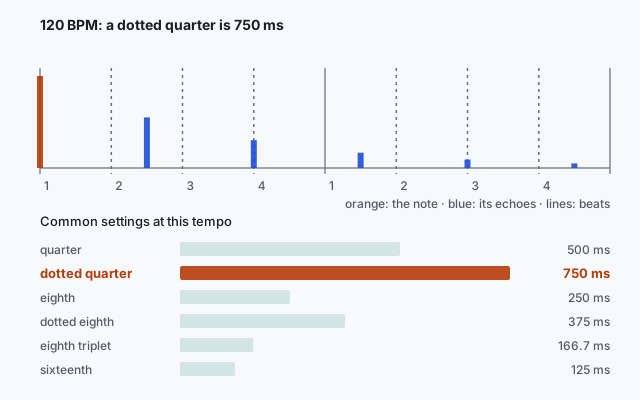
Delay times that lock to the beat: BPM to milliseconds
One beat lasts 60,000 ÷ BPM milliseconds. Every echo setting is a fraction of that beat.
Questions people ask
What causes beats?
Adding two sine waves gives a sine at their average pitch inside a slow cosine envelope. The envelope makes the loudness rise and fall at the difference between the two frequencies.
How many beats per second is out of tune?
There's no single line, but a beat every second or two on a held note is close. Several beats a second sounds clearly sour.
Why does a supersaw sound so wide?
Each pair of slightly detuned voices beats at its own rate, and the voices are spread left and right. The constantly shifting peaks sound like many players at once.
Updated : First published.