How do I set a delay time to match the tempo of a song?
Divide 60,000 by the tempo in BPM to get one beat in milliseconds. At 120 BPM a beat is 500 ms. Then scale it by the note value: an eighth is half a beat, a dotted note is one and a half times as long, and a triplet is two thirds. Set the pedal to that number.
- Delay time
- 750 ms
- One beat (quarter note)
- 500 ms
- As a rate (tremolo or LFO)
- 1.33 Hz
Challenge: Find the tempo where a dotted-eighth delay is exactly 450 ms.
More settings
Play
Press "Echoes in time," then "Echoes 40 ms off," and listen to the groove smear.
Challenge: Find the tempo where a dotted-eighth delay is exactly 450 ms. The box under the picture turns green when you get it.
Stuck? Pick one of the examples from the “Try an example” menu, or press “New example.”
Understand
A minute is 60,000 milliseconds, and the tempo says how many beats share it. So one beat, a quarter note, lasts
Every other note value is a ratio of that beat: an eighth is ½, a sixteenth ¼. A dot multiplies by 3/2, and a triplet fits three notes in the space of two, so it multiplies by 2/3. The top of the picture shows two bars with the note in orange and its echoes in blue. When the echo time is a clean fraction of the beat, every echo lands on a grid line.
Use
Every input has a unit menu, so you can type values in the units you already have. Results follow your units.
Show the work
- A minute is 60,000 ms, shared by every beat
\text{beat} = \frac{60{,}000}{120} = 500\ \text{ms} - A quarter is 1 of a beat
500 \times 1 = 500\ \text{ms} - A dot adds half again
500 \times \tfrac{3}{2} = 750\ \text{ms} - The same length as a rate
f = \frac{1000}{750} = 1.333\ \text{Hz}
Export
Set the tempo, the note value, and the feel, then dial that number into your delay. Press the sound buttons to hear in-time echoes against echoes that miss by 40 ms.
- Tap-tempo pedals do this math for you. Knowing it lets you set a plugin by hand, or pick a deliberate off-grid time.
For learning and estimation. Verify with applicable codes, standards, and a qualified professional before using in design, construction, or safety-critical work.
Cheat card
| Symbol | Meaning | Unit |
|---|---|---|
| tempo, beats per minute | BPM | |
| delay time | ms | |
| the same length as a rate | Hz |
- Halve the time for each shorter note value, double it for each longer one.
- A dotted-eighth echo fills the gaps between eighth notes, which makes a single guitar part sound like two.
- Reverb pre-delay set to a 1/64 or 1/32 note keeps the reverb in time without blurring the attack.
Where it’s used
- Music & Sound
Producers set delay, reverb pre-delay, and tremolo rates from the song tempo so effects groove with the track. - Music
Guitarists dial in the dotted-eighth echo that makes one part sound like a fast rhythm. - Hobbies & Crafts
Drum machines and DAWs show the same ms values when you sync an effect to the grid.
Related exhibits
 Start here
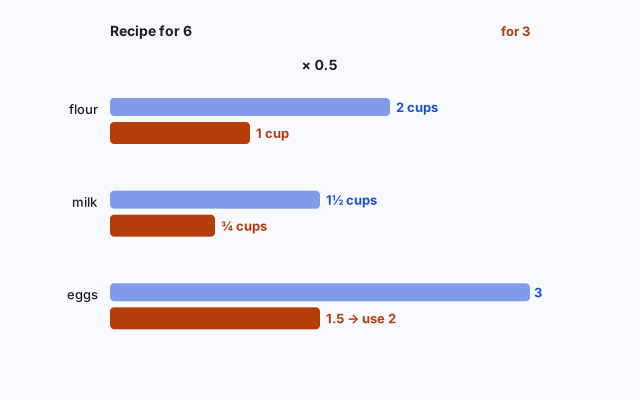
Scaling a recipe: more people, same taste
Double the guests? Every ingredient grows by the same factor.
 Go further
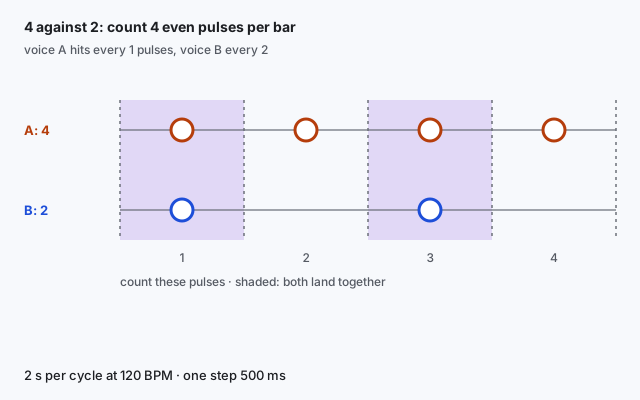
Polyrhythms: when 3 against 4 lines up again
Two patterns meet again after the least common multiple. Count that grid and any polyrhythm becomes playable.
 Also try
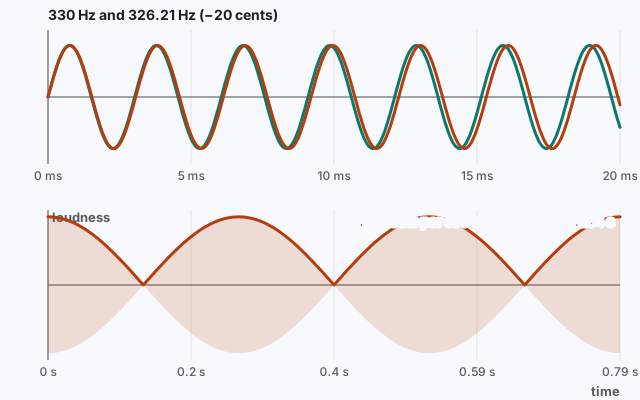
Beats and detune: hearing two notes go out of tune
Two almost-equal notes add into one that throbs. The throb rate is their difference in hertz, which is how you tune by ear and how a supersaw gets wide.
 Also try
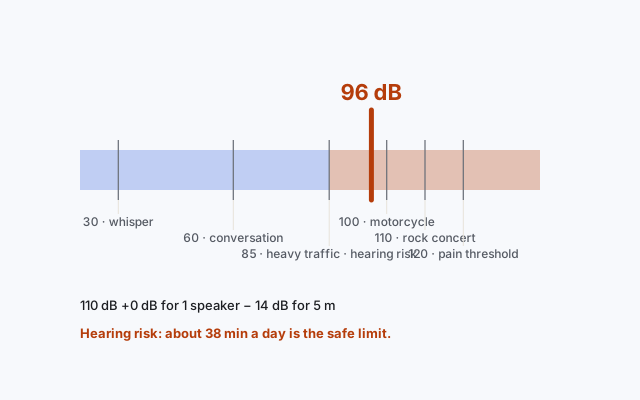
Decibels: why two speakers aren’t twice as loud
Sound is measured on a log scale. Double the speakers: +3 dB. Double the distance: −6 dB.
Questions people ask
What is a dotted-eighth delay?
An echo three quarters of a beat after each note. Played over steady eighth notes, the echoes land in between, so you hear sixteenth notes that you never played.
Why does an echo that's a little off sound messy?
Your ear expects echoes on the beat grid. A few tens of milliseconds off and they rub against the rhythm instead of reinforcing it.
How do I turn a delay time into a rate?
Divide 1,000 by the time in milliseconds. A 250 ms pulse is 4 Hz, the setting for a tremolo or LFO that throbs in eighth notes at 120 BPM.
Updated : First published.