What is the difference between equal temperament and just intonation?
Just intonation tunes intervals to simple whole-number ratios, like 3:2 for a fifth and 5:4 for a major third. Equal temperament makes every semitone the twelfth root of 2, so every key works the same. The cost is that most intervals land a few cents off pure, and the piano's thirds beat audibly.
- Piano minus pure
- -15.6 ¢
- Beats per second on a piano
- 11.9 Hz
- Upper note, piano
- 262 Hz
- Upper note, pure
- 264 Hz
Challenge: Find an interval where the piano is within 2.5 cents of pure (not the octave).
Play
Pick the major 3rd and press "Back and forth." Listen for the shimmer that comes and goes.
Challenge: Find an interval where the piano is within 2.5 cents of pure (not the octave). The box under the picture turns green when you get it.
Stuck? Pick one of the examples from the “Try an example” menu, or press “New example.”
Understand
A piano splits the octave into 12 equal ratios, so moving up keys multiplies the frequency by . A pure interval is a small whole-number ratio such as . Compare them on a log scale, cents:
The top ruler shows the piano's keys every 100 cents and the pure ratios as dots. Because they miss, harmonic of the upper note and harmonic of the lower note almost meet, and their loudness pulses at the difference. The lower graph shows that pulse over one second.
Use
Every input has a unit menu, so you can type values in the units you already have. Results follow your units.
Show the work
- The piano: 12 equal ratios per octave, so each step is the 12th root of 2
2^{3/12} = 1.1892\ \text{vs.}\ \frac{6}{5} = 1.2 - In cents (a log scale, 1200 per octave)
100 \times 3 = 300\ \text{vs.}\ 1200\log_2\frac{6}{5} = 315.64 - Harmonic q of the upper note nearly meets harmonic p of the lower note. The difference is the beat rate
\lvert 5 \times 261.63 - 6 \times 220 \rvert = 11.9\ \text{beats/s}
Export
Pick a note and an interval, then compare the piano and pure tunings by ear.
- Real piano strings are slightly stiff, so their upper harmonics run a little sharp. Tuners stretch the octaves to match, which shifts these numbers a bit.
For learning and estimation. Verify with applicable codes, standards, and a qualified professional before using in design, construction, or safety-critical work.
Cheat card
| Symbol | Meaning | Unit |
|---|---|---|
| pure interval ratio | ||
| the two notes | Hz |
- Fifths and fourths are only 2 cents off, so they barely beat. Thirds and sixths are 14 to 16 cents off and shimmer.
- Beats speed up as you go higher, because the same cents gap is more hertz.
- Singers, string players, and brass sections drift toward pure intervals when they hold a chord. That's why an a cappella chord can ring brighter than a piano.
Where it’s used
- Music & Sound
Piano tuners count beats per second between notes to set equal temperament by ear. - Physics
Two nearly equal frequencies add into a tone whose loudness pulses at their difference. - Music
Guitarists notice that a major chord tuned to sound sweet in one key sounds sour in another.
Related exhibits
 Start here
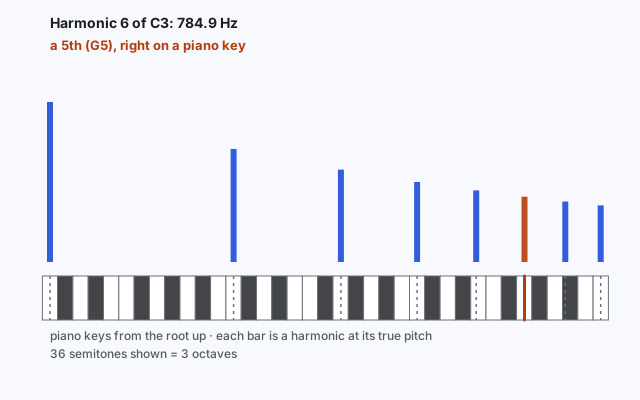
The harmonic series: the chord hiding inside every note
Every note also rings at 2, 3, 4, 5 … times its frequency. Those overtones spell out octaves, fifths, and a whole dominant 7th chord.
 Go further
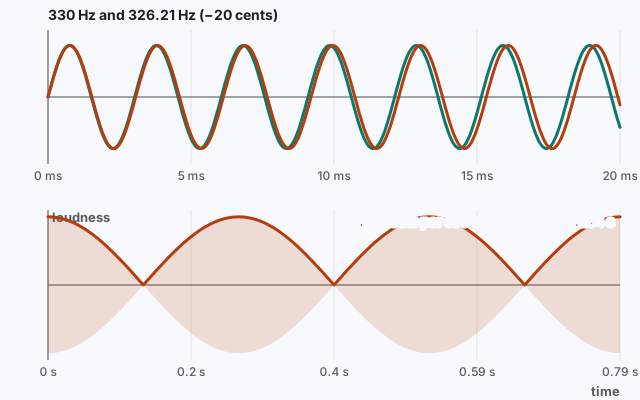
Beats and detune: hearing two notes go out of tune
Two almost-equal notes add into one that throbs. The throb rate is their difference in hertz, which is how you tune by ear and how a supersaw gets wide.
 Also try
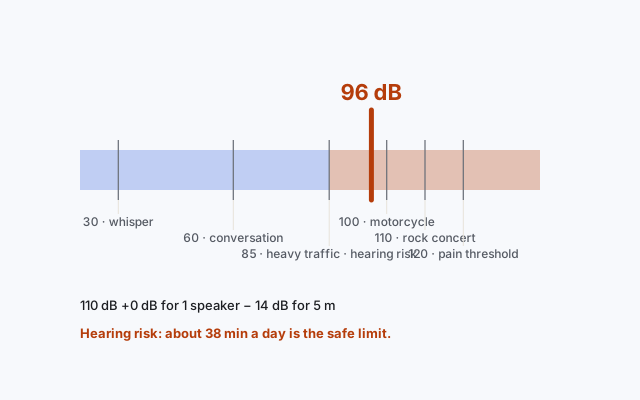
Decibels: why two speakers aren’t twice as loud
Sound is measured on a log scale. Double the speakers: +3 dB. Double the distance: −6 dB.
Questions people ask
Why don't pianos use pure intervals?
Pure intervals don't stack into a closed system. Twelve pure fifths overshoot seven octaves by about a quarter of a semitone. Equal temperament spreads that error evenly so every key works.
What are beats?
When two harmonics are almost the same frequency, they drift in and out of step. You hear the loudness pulse at the difference between them.
Is equal temperament out of tune?
Every interval except the octave is slightly off pure, by design. Most listeners grew up with it and hear it as normal.
Updated : First published.