What is the harmonic series in music, and why does it matter for chords?
A plucked string or a sung note vibrates at its own frequency and also at 2, 3, 4, and more times that frequency. These harmonics land on an octave, then a fifth, a fourth, a major third, and so on. Harmonics 4 to 7 make a dominant 7th chord, which is why that chord sounds so natural.
- Frequency of that harmonic
- 785 Hz
- Off the nearest piano key
- 1.96 ¢
- The note itself (harmonic 1)
- 131 Hz
Challenge: Find the harmonic that's almost a quarter tone away from every piano key.
Play
Press "Climb the harmonics," then compare the pure 7th chord with the piano version.
Challenge: Find the harmonic that's almost a quarter tone away from every piano key. The box under the picture turns green when you get it.
Stuck? Pick one of the examples from the “Try an example” menu, or press “New example.”
Understand
A vibrating string or air column moves in its whole length, halves, thirds, quarters, and so on all at once. Each part adds a harmonic at a whole-number multiple of the note:
How far above the root is harmonic ? Pitch works by ratios, so we measure it with a logarithm: cents, where 100 cents is one piano key. The bars sit at each harmonic's true pitch over a strip of piano keys. Notice how they crowd together higher up, and how most sit slightly off the keys.
Use
Every input has a unit menu, so you can type values in the units you already have. Results follow your units.
Show the work
- Harmonic n vibrates n times as fast as the note
f_{6} = 6 \times 130.8\ \text{Hz} = 784.9\ \text{Hz} - Its distance above the root, in cents (100 per piano key)
1200 \log_2 6 = 3102\ \text{cents} - The nearest piano key, and how far off it is
31 \times 100 = 3100,\quad 3102 - 3100 = 1.96\ \text{cents}
Export
Pick a note and slide "Look closer" to inspect any harmonic. The sound buttons let you climb the series, compare a pure dominant 7th with the piano's, and hear one harmonic beat against the nearest piano key.
- Real instruments vary in how loud each harmonic is. That mix is their timbre. Stiff piano strings also run slightly sharp up high.
For learning and estimation. Verify with applicable codes, standards, and a qualified professional before using in design, construction, or safety-critical work.
Cheat card
| Symbol | Meaning | Unit |
|---|---|---|
| the note you play (the fundamental) | Hz | |
| harmonic number | ||
| frequency of harmonic n | Hz |
- Each doubling of n is an octave: harmonics 1, 2, 4, 8, 16 are all the same note name.
- Harmonic 3 is almost exactly a piano fifth, which is why power chords ring so cleanly.
- Harmonic 7 is 31 cents flatter than the piano's minor 7th. Barbershop singers tune to the harmonic, not the piano.
Where it’s used
- Music & Sound
Brass players move between harmonics of a single tube length; that is all a bugle can play. - Physics
A string vibrates in halves, thirds, and quarters at once. Each mode is one harmonic. - Music
Touch a guitar string at the 12th, 7th, or 5th fret and you hear harmonics 2, 3, and 4.
Related exhibits
 Start here
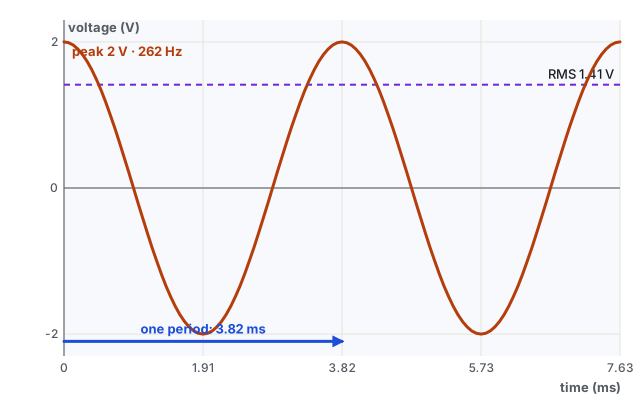
Sine waves: wall power and musical notes
The outlet and a tuning fork follow the same curve: amplitude, frequency, and phase.
 Go further
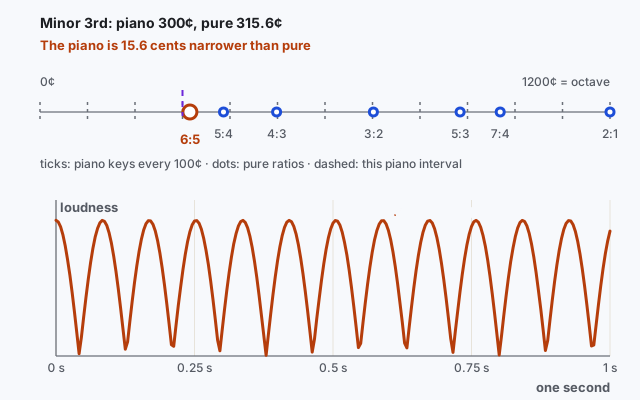
Equal temperament vs. pure intervals: why a piano’s 3rds shimmer
A piano splits the octave into 12 equal ratios. Pure intervals are whole-number ratios. The gap is small, and you can hear it as beats.
 Also try
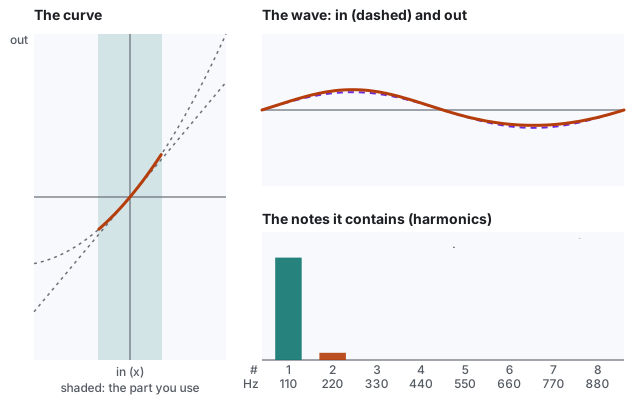
Why a distortion pedal changes the sound: polynomials make harmonics
Push a pure note through a curve like x − x³/3 and new notes appear. The cube is where the extra harmonics come from.
 Also try
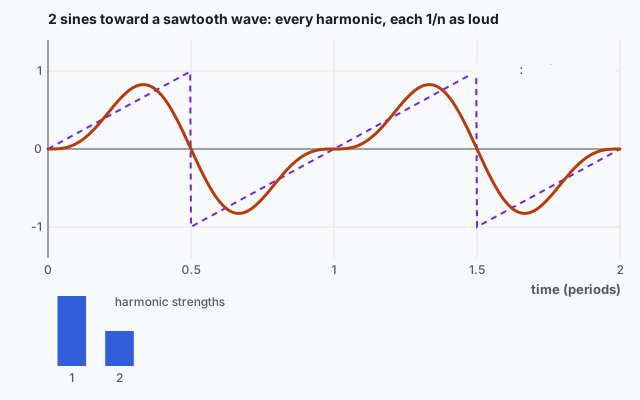
Building a square wave out of sine waves
Add sines at 1, 3, 5, 7 … times the pitch, each a little quieter, and a square wave appears. That’s how synths and your ear think about timbre.
Questions people ask
Why do harmonics make chords?
Harmonics 4, 5, and 6 are in the ratio 4 to 5 to 6, which is a major triad. Add harmonic 7 and you have a dominant 7th. The chord is already inside each note you play.
What is a cent?
One hundredth of a piano semitone. Because pitch works by ratios, cents use a logarithm, 1200 times log base 2 of the frequency ratio.
Why don't harmonics match the piano exactly?
The piano divides the octave into 12 equal steps, so its notes are powers of the 12th root of 2. Harmonics are whole-number ratios. Only the octaves match exactly.
Updated : First published.