How does a guitar distortion pedal change the sound?
It bends the wave with a curve like y = x − x³/3. A pure note is a sine wave, and the cube of a sine contains a sine three times as fast. So the pedal adds a new note an octave and a fifth higher. Hit it harder and more harmonics pile up, which is the grit of overdrive.
- Share of the sound in new harmonics
- 0.488%
- 2nd harmonic (octave up)
- 0.028
- 3rd harmonic (octave and a fifth)
- 0
- Original note’s level
- 0.4
Challenge: Make the 3rd harmonic louder than the original note.
More settings
Play
Start with light overdrive, then slide the drive past 1. Try the lopsided curve for even harmonics.
Challenge: Make the 3rd harmonic louder than the original note. The box under the picture turns green when you get it.
Stuck? Pick one of the examples from the “Try an example” menu, or press “New example.”
Understand
A pure note is a sine wave. A pedal sends it through a curve that bends the loud parts more than the quiet parts, such as the soft clipper .
The key is a trig identity:
The cube of a sine contains a sine three times as fast, a new note an octave and a fifth up. Each power of brings its own harmonics, and the bars show how strong each one is.
Use
Every input has a unit menu, so you can type values in the units you already have. Results follow your units.
Show the work
- The input is a pure note: a sine wave
x = 0.4\sin\theta - Pass it through the curve
y = x + 0.35x^2 - A square of a sine contains a sine twice as fast (and a shift)
\sin^2\theta = \tfrac{1}{2} - \tfrac{1}{2}\cos 2\theta - So the output gets an octave-up harmonic
y = 0.028 + 0.4\sin\theta - 0.028\cos 2\theta - Measured levels of harmonics 1–4
h_1 = 0.4,\ h_2 = 0.028,\ h_3 = 0,\ h_4 = 0
Export
Pick a curve and slide the drive. "More settings" changes the note, which sets the frequencies of the harmonics.
- Real pedals also filter the sound before and after the curve, so this shows the idea, not a specific pedal.
For learning and estimation. Verify with applicable codes, standards, and a qualified professional before using in design, construction, or safety-critical work.
Cheat card
| Symbol | Meaning | Unit |
|---|---|---|
| input wave | ||
| output wave | ||
| drive: how hard the note hits the curve |
- An x² term adds the octave (2nd harmonic). An x³ term adds the octave and a fifth (3rd).
- A symmetric curve makes only odd harmonics. A lopsided one adds even ones.
- The harder you drive, the more the high-power terms matter, so distortion grows fast.
Where it’s used
- Music & Sound
Guitar pedals, tube amps, and tape saturation all bend the wave with a curve. - Electrical & Electronics
Audio engineers measure harmonic distortion to keep hi-fi gear clean. - Music
Hear why a softly played note stays clean while a hard strum crunches.
Related exhibits
 Start here
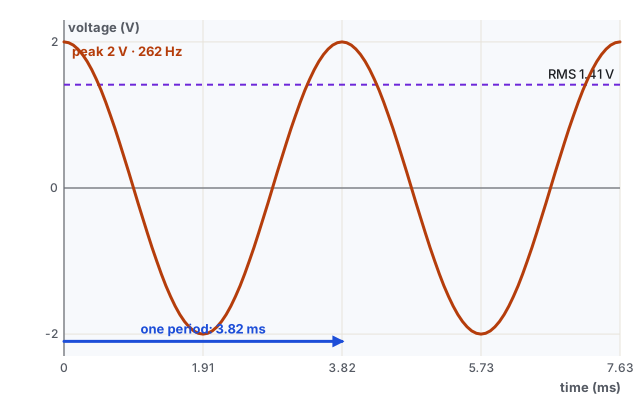
Sine waves: wall power and musical notes
The outlet and a tuning fork follow the same curve: amplitude, frequency, and phase.
 Start here
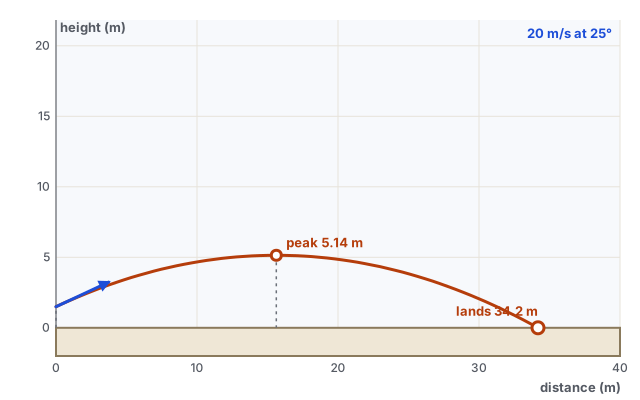
Throwing a ball: the quadratic arc
Every throw, jump, and fountain draws a parabola.
 Also try
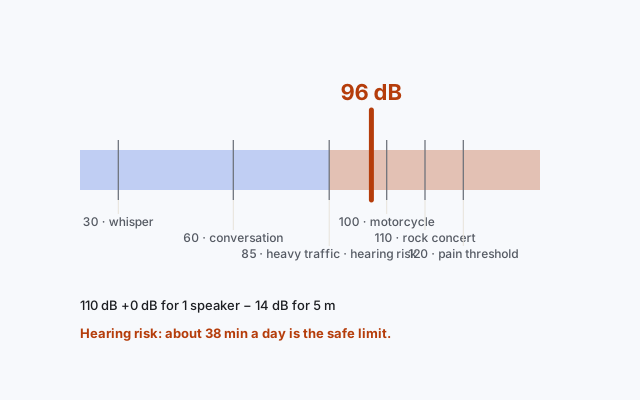
Decibels: why two speakers aren’t twice as loud
Sound is measured on a log scale. Double the speakers: +3 dB. Double the distance: −6 dB.
Questions people ask
What does distortion actually do to the sound?
It reshapes the wave, which adds new notes at whole-number multiples of the one you played. Those harmonics are what make it sound gritty or warm.
Why do tubes sound "warm"?
A slightly lopsided curve adds even harmonics, especially the octave, which blends smoothly with the note. Symmetric clipping adds odd harmonics, which sound harder.
What is a Chebyshev waveshaper?
A polynomial built so that feeding in a cosine gives a cosine exactly n times as fast. Synthesizers use them to add precise harmonics.