How do you calculate percent increase or decrease?
Subtract the old value from the new one, divide by the old value, and multiply by 100. The key word is "old": a percent change is always measured against where you started. That is why a 50% drop needs a 100% gain to recover, and why up 10% then down 10% leaves you behind.
- Percent change
- -50%
- Change
- -125
- Change needed to get back
- 100%
Challenge: Find a drop where getting back takes at least twice the percent. Done!
Play
Set a price, then drop it by half. Check what gain it takes to get back.
Challenge: Find a drop where getting back takes at least twice the percent. The box under the picture turns green when you get it.
Stuck? Pick one of the examples from the “Try an example” menu, or press “New example.”
Understand
A percent change compares the change to the starting value:
Because the bottom of the fraction is where you started, the same change in dollars is a different percent depending on your starting point. Going from 40 to 50 is +25%, but going from 50 back to 40 is only −20%, since that 10 is compared to 50.
The dashed line carries the "before" level across so you can see the gap. The note at the bottom is the percent it would take to get back.
Use
Every input has a unit menu, so you can type values in the units you already have. Results follow your units.
Show the work
- Percent change
\frac{\text{new} - \text{old}}{\text{old}} \times 100\% - With your numbers
\frac{125 - 250}{250} \times 100\% = -50\% - As a multiplier
125 = 250 \times 0.5 - Back again (divide by the new value)
\frac{250 - 125}{125} \times 100\% = 100\%
Export
Type any old and new values: prices, salaries, populations, test scores. The result is negative for a decrease.
- For two changes in a row, multiply the factors: up 10% then down 10% is 1.1 × 0.9 = 0.99, a 1% loss.
- To find the new value from a percent, use new = old × (1 + p/100).
For learning and estimation. Verify with applicable codes, standards, and a qualified professional before using in design, construction, or safety-critical work.
Cheat card
| Symbol | Meaning | Unit |
|---|---|---|
| percent change (negative for a decrease) |
- Always divide by the starting (old) value.
- A drop of p% needs a bigger gain than p% to recover.
- "Percentage points" is different: a rate going from 4% to 5% is 1 point but a 25% increase.
Where it’s used
- Finance & Business
Investors report returns and losses as percent changes, and learn that a 50% loss needs a 100% gain to recover. - Money & Shopping
See how much a price, rent, or bill really went up.
Related exhibits
 Start here
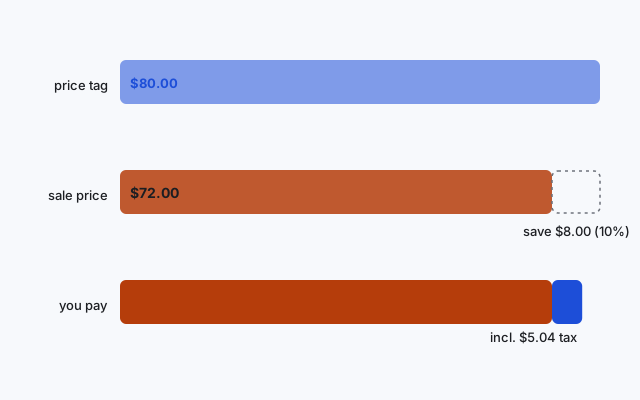
Sale price and tax: what you really pay
30% off, then tax on top. Percent math decides the number at the register.
 Go further
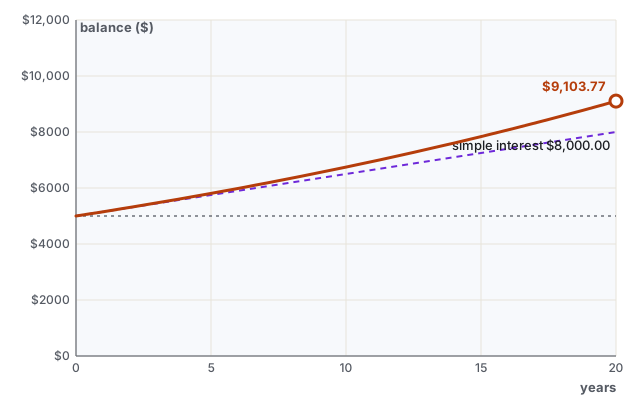
Compound interest: money that grows on itself
Interest earns interest. Exponents explain why saving early wins.
 Also try
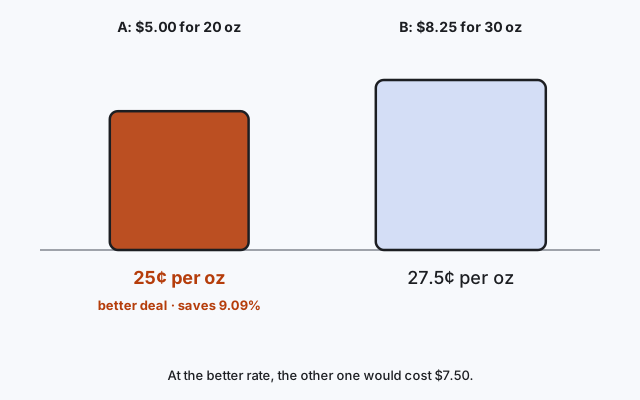
Unit price: is the big size really the better deal?
Divide price by size and the shelf tags stop lying. Bigger isn’t always cheaper.
Questions people ask
What is the formula for percent change?
(new − old) ÷ old × 100. From 40 to 50 is (50 − 40) ÷ 40 × 100 = 25%. A negative answer is a decrease.
Why doesn't a 50% gain undo a 50% loss?
The two percents are of different amounts. $100 down 50% is $50. Up 50% from $50 adds only $25, landing at $75. To get back to $100 you need +100%.
What is the difference between percent change and percentage points?
Percentage points subtract two percents. Percent change divides. An interest rate going from 4% to 5% rose 1 percentage point, which is a 25% increase in the rate.
Can you have a percent change from zero?
No. Percent change divides by the starting value, and dividing by zero has no answer, so the result is