How high could you jump on the Moon?
About six times higher than on Earth, and you'd stay up six times longer. A jump is a parabola, and gravity g sits on the bottom of its peak-height formula, h = (v sin θ)² / 2g. The Moon's gravity is about one-sixth of Earth's, so a half-meter hop on Earth becomes a three-meter leap.
- Peak height
- 2.87 m
- Jump distance
- 9.98 m
- Time in the air
- 6.09 s
- Times longer than on Earth
- ×15.8
Challenge: Stay in the air for 5 seconds or more. Done!
More settings
Play
Pick the Moon and watch both balls jump at real speed. Then try Ceres.
Challenge: Stay in the air for 5 seconds or more. The box under the picture turns green when you get it.
Stuck? Pick one of the examples from the “Try an example” menu, or press “New example.”
Understand
A jump is a parabola, just like a thrown ball. Gravity is the number that bends it back down:
Make smaller and the term shrinks, so the arc stretches wider and taller. The peak height, the landing distance, and the hang time all have on the bottom, so they all grow by the same factor: .
The balls move in real time, so you can feel the difference. The dashed arc is the same jump on Earth. Longer hops (like on Ceres) play faster to fit a 20-second loop.
Use
Every input has a unit menu, so you can type values in the units you already have. Results follow your units.
Show the work
- The arc (a parabola)
y = x\tan\theta - \frac{g\,x^2}{2v^2\cos^2\theta} - With your numbers
y = x\tan 49^\circ - \frac{0.62\,x^2}{2(2.5)^2\cos^2 49^\circ} - Peak height: g is on the bottom
h = \frac{(v\sin\theta)^2}{2g} = \frac{1.887^2}{2 \times 0.62} = 2.871\ \mathrm{m} - Time in the air
t = \frac{2v\sin\theta}{g} = 6.086\ \mathrm{s} - Compared with Earth
\frac{g_{\text{Earth}}}{g} = \frac{9.807}{0.62} = 15.82\times\ \text{higher, farther, and longer}
Export
Choose a world, then set your takeoff speed and angle. A standing vertical jump for most people leaves the ground at 2.5–3 m/s.
- There's no air resistance here. That's exactly right on the Moon, which has no air.
- Gravity for Jupiter is at its cloud tops. There is no surface to jump from.
- Your legs might not push as hard on a low-gravity world without solid footing.
For learning and estimation. Verify with applicable codes, standards, and a qualified professional before using in design, construction, or safety-critical work.
Cheat card
| Symbol | Meaning | Unit |
|---|---|---|
| takeoff speed | m/s | |
| takeoff angle | ||
| gravity where you are | m/s² |
- Height, distance, and hang time all scale with 1/g. One-sixth the gravity means six times each.
- Your legs push the same, and your mass is the same everywhere. Only your weight changes.
- Astronauts on the Moon hopped instead of walked. Stiff suits made big jumps hard.
Where it’s used
- Aerospace
Engineers design landers and rovers for the Moon's and Mars's gravity, from leg springs to wheel traction. - Physics
The same parabola describes any thrown object once you know g. - Sports & Games
Your standing vertical jump on Earth, times six, is your Moon jump.
Related exhibits
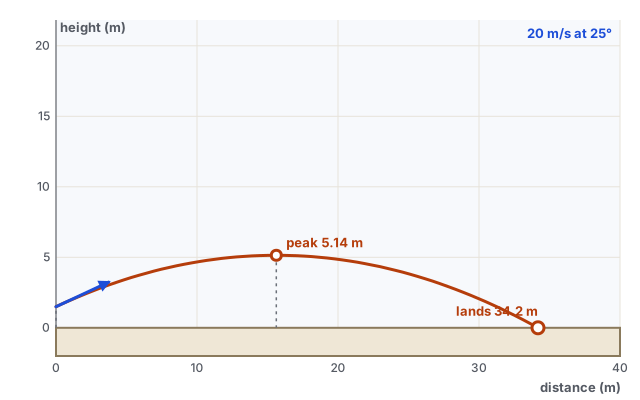 Start here
Throwing a ball: the quadratic arc
Every throw, jump, and fountain draws a parabola.
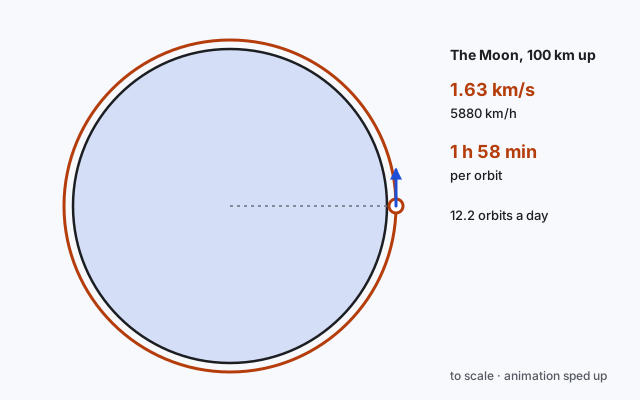 Go further
Orbits: how fast to go around and never come down
An orbit is falling and missing the ground. Square roots and a 3/2 power set the speed and the period.
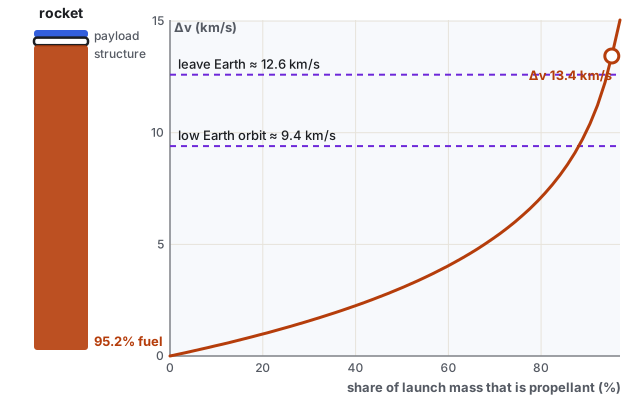 Also try
The rocket equation: why rockets are almost all fuel
Speed grows with the logarithm of the fuel. Double the tank and you get far less than double the speed.
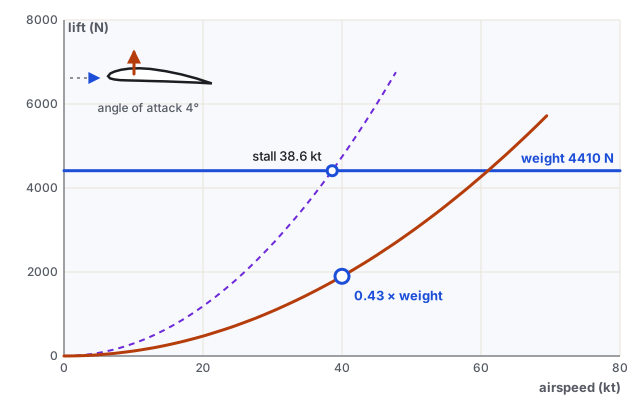 Also try
Wing lift: why twice the speed means four times the lift
Lift grows with airspeed squared. Bernoulli, angle of attack, thin air, and the stall, all on one curve.
Questions people ask
How high could you jump on the Moon?
About 6 times higher than on Earth, because the Moon's gravity is 1.62 m/s², about one-sixth of Earth's 9.81. A 45 cm vertical jump on Earth would be roughly 2.7 m on the Moon, in light clothes. Spacesuits cut that down a lot.
How long would you stay in the air on the Moon?
Also about 6 times longer. Hang time is 2v sin θ ÷ g, and g is 6 times smaller. A half-second hop on Earth lasts about 3 seconds on the Moon.
What is the gravity on Mars?
3.71 m/s², about 38% of Earth's. You could jump about 2.6 times higher there.
Would you weigh less on the Moon?
Yes, about one-sixth as much, but your mass is the same. It would still take the same push to start moving sideways or to stop.