How do airplane wings create lift?
A wing tilted into the airflow turns the air downward, and the air pushes the wing up. The air over the curved top speeds up, and by Bernoulli's principle faster air has lower pressure. The lift formula L = ½ρv²SC_L has speed squared, so twice the speed gives four times the lift.
- Lift
- 1.9 kN
- Lift ÷ weight
- ×0.43
- Stall speed
- 38.6 kt
- Air speed over the wing (Bernoulli)
- 51.5 kt
The stall speed comes from a simplified wing. Flaps, loading, and banking change it, so use the aircraft’s handbook for real flying.
Challenge: Set lift exactly equal to weight (within 2%), the condition for level flight.
More settings
Play
Slow the plane down until lift drops below the weight line. Then raise the nose to hold it up.
Challenge: Set lift exactly equal to weight (within 2%), the condition for level flight. The box under the picture turns green when you get it.
Stuck? Pick one of the examples from the “Try an example” menu, or press “New example.”
Understand
Lift comes from the air's dynamic pressure, , the energy per volume of moving air. The wing turns part of it into an upward force:
Because is squared, lift as a function of speed is a parabola (the orange curve). Twice the speed means four times the lift. The dashed curve is the most lift the wing can make, right before the stall. Where it crosses the weight line is the stall speed. Fly slower and no angle of attack can hold the plane up.
Bernoulli's principle links pressure and speed: stays constant along a streamline. The wing speeds up the air over its top, which lowers the pressure there. The "air speed over the wing" readout is the average speed that pressure difference implies.
Use
Every input has a unit menu, so you can type values in the units you already have. Results follow your units.
Show the work
- Lift coefficient from the angle of attack
C_L \approx 0.3 + 0.09\,\alpha = 0.66 - Dynamic pressure (the v² part)
q = \tfrac12\rho v^2 = \tfrac12(0.905)(20.58)^2 = 191.6\ \mathrm{Pa} - Lift
L = qSC_L = 191.6 \times 15 \times 0.66 = 1897\ \mathrm{N} - Bernoulli: faster air on top means lower pressure
\Delta p = \tfrac12\rho(v_{\text{top}}^2 - v^2) = \frac{L}{S} \Rightarrow v_{\text{top}} = 26.51\ \mathrm{m/s} - Stall speed (solve the quadratic for v)
v_s = \sqrt{\frac{2W}{\rho S C_{L,\max}}} = 19.85\ \mathrm{m/s}
Export
Set the airspeed and angle of attack, then the wing area and mass for your aircraft. Change altitude in "More settings."
- The lift curve here is simplified: up to a 15° stall. Real wings, flaps, and slats differ.
- The formula assumes air doesn't compress, which works below roughly Mach 0.3 and is close enough for airliner cruise.
- Airspeed here is true airspeed. Pilots read indicated airspeed, which already accounts for air density.
For learning and estimation. Verify with applicable codes, standards, and a qualified professional before using in design, construction, or safety-critical work.
Cheat card
| Symbol | Meaning | Unit |
|---|---|---|
| lift force | N | |
| air density | kg/m³ | |
| airspeed | m/s | |
| wing area | m² | |
| lift coefficient (grows with angle of attack) |
- Speed is squared. Half the speed means a quarter of the lift, so slow flight needs a higher angle of attack.
- Thin air at altitude means less lift at the same speed. Airliners cruise fast to make up for it.
- Past about 15° the wing stalls and lift drops suddenly. Stalls depend on angle, not speed.
Where it’s used
- Aerospace
Engineers size wings and pick takeoff and landing speeds with this equation. - Physics
Bernoulli's principle trades pressure for speed along a streamline: faster air, lower pressure. - Driving & Travel
It's why hot, high-altitude airports need longer runways: thinner air, less lift at the same speed.
Related exhibits
 Start here
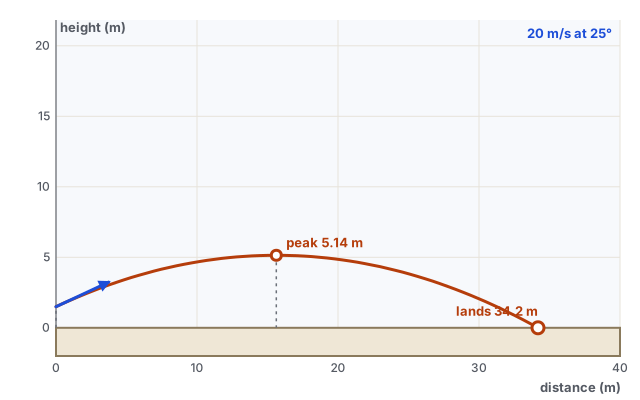
Throwing a ball: the quadratic arc
Every throw, jump, and fountain draws a parabola.
 Go further
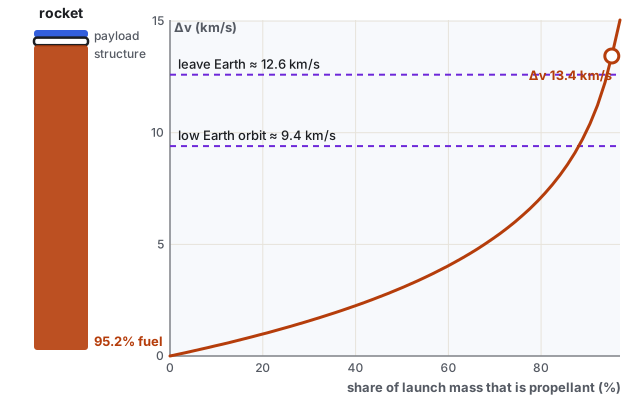
The rocket equation: why rockets are almost all fuel
Speed grows with the logarithm of the fuel. Double the tank and you get far less than double the speed.
 Also try
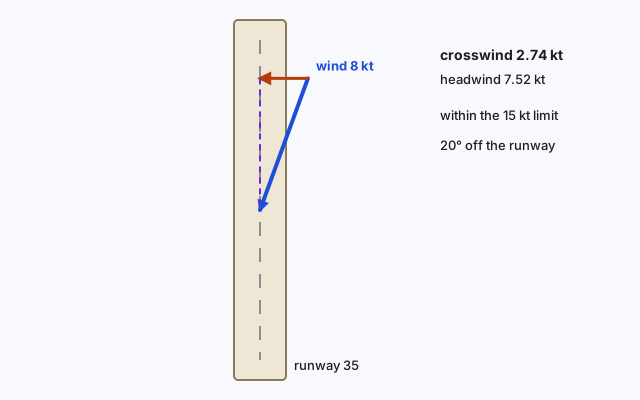
Crosswind landing: splitting the wind into two parts
Pilots break the wind into “along the runway” and “across it.” That’s vector math at 60 knots.
 Also try
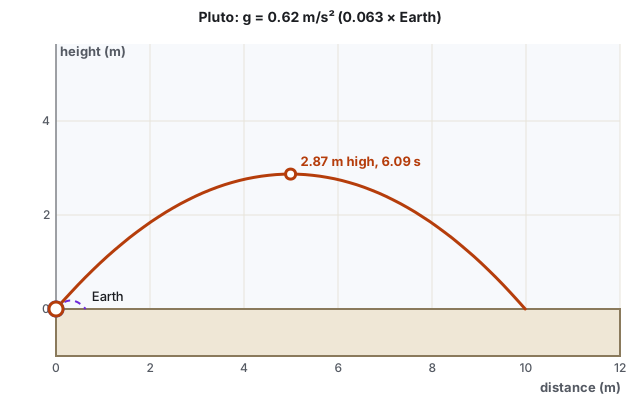
Jumping on the Moon: the same leap on other worlds
Same legs, same launch. Weaker gravity stretches the parabola, and the motion plays in real time.
Questions people ask
How do wings create lift?
The wing is angled and curved so it turns oncoming air downward. By Newton's third law the air pushes the wing up. The same flow speeds up over the top, lowering the pressure there (Bernoulli), so the pressure below pushes up harder than the pressure above pushes down.
Is it Bernoulli or Newton?
Both. They are two ways of describing the same airflow. The "equal transit time" story, where air over the top must meet up with air underneath, is a myth. Air over the top actually arrives first.
Why does lift depend on speed squared?
Moving air carries kinetic energy per volume of ½ρv², called dynamic pressure. Lift is a fraction of that pressure acting on the wing area, so doubling the speed quadruples the lift.
What is a stall?
When the angle of attack gets too steep, about 15° for many wings, air can't follow the curved top and breaks away. Lift drops sharply. It's about angle, not speed, although flying slowly forces a steeper angle.
Could a plane fly on Mars?
Mars's air is about 60 times thinner than Earth's, so a wing needs huge speed or area. NASA's Ingenuity helicopter flew there by spinning its rotors about 2,500 times a minute.