How fast does a satellite have to go to stay in orbit?
Fast enough that it falls around the Earth instead of into it. For a circular orbit the speed is v = √(GM/r), about 7.7 km/s for the Space Station. Higher orbits are slower, and the time for one lap grows as the radius to the 3/2 power, so a geostationary orbit takes exactly one day.
- Orbital speed
- 1.63 km/s
- Time for one orbit
- 1 h 58 min
- Escape speed from there
- 2.31 km/s
- Orbits per day
- 12.2
Challenge: Find the orbit that takes one day, so the satellite hangs over one spot.
Play
Drag the height up from the Space Station to the Moon. Watch the speed drop and the period grow.
Challenge: Find the orbit that takes one day, so the satellite hangs over one spot. The box under the picture turns green when you get it.
Stuck? Pick one of the examples from the “Try an example” menu, or press “New example.”
Understand
In a circular orbit, gravity supplies exactly the inward pull that circular motion needs. Setting them equal gives a square root:
The time for one lap is the circle's length divided by the speed, which turns into a 3/2 power (Kepler's third law):
So going higher does two things at once: the path gets longer and the speed drops. That's why the Moon, 60 Earth radii away, takes a month to go around.
The planet and orbit are drawn to scale. The satellite moves faster in low orbits, but the animation is sped up so the slow ones still move.
Use
Every input has a unit menu, so you can type values in the units you already have. Results follow your units.
Show the work
- Distance from the center
r = R + h = 1737 + 100 = 1837\ \mathrm{km} - Speed: gravity supplies exactly the pull a circle needs
\frac{v^2}{r} = \frac{GM}{r^2} \Rightarrow v = \sqrt{\frac{GM}{r}} = 1634\ \mathrm{m/s} - Period: one lap of the circle
T = \frac{2\pi r}{v} = 2\pi\sqrt{\frac{r^3}{GM}} = 7066\ \mathrm{s} - Kepler’s third law: T grows as r to the 3/2 power
T \propto r^{3/2} - Escape speed
v_{\text{esc}} = \sqrt{2}\,v = 2311\ \mathrm{m/s}
Export
Pick a planet or the Moon and set the height above its surface.
- These are circular orbits. Real orbits are slightly oval, and the formulas use the average distance.
- Below about 200 km, Earth's thin upper air drags satellites down within weeks.
- The Moon's distance preset treats the Moon as a tiny satellite. Its own mass changes the period slightly.
For learning and estimation. Verify with applicable codes, standards, and a qualified professional before using in design, construction, or safety-critical work.
Cheat card
| Symbol | Meaning | Unit |
|---|---|---|
| the planet's gravity strength (G times its mass) | m³/s² | |
| distance from the planet's center (radius + height) | m | |
| time for one orbit | s |
- Measure r from the center, not the surface. Add the planet's radius to the height.
- Higher is slower. To catch up with something ahead of you in orbit, you drop lower.
- Escape speed is always √2 times orbital speed at the same height.
Where it’s used
- Aerospace
Engineers choose altitudes for GPS, weather, and TV satellites from these formulas. - Physics
Kepler found T² ∝ r³ from planet data in 1619. Newton later explained why. - Hobbies & Crafts
Stargazers use pass times to spot the Space Station crossing the sky every 90 minutes.
Related exhibits
 Start here
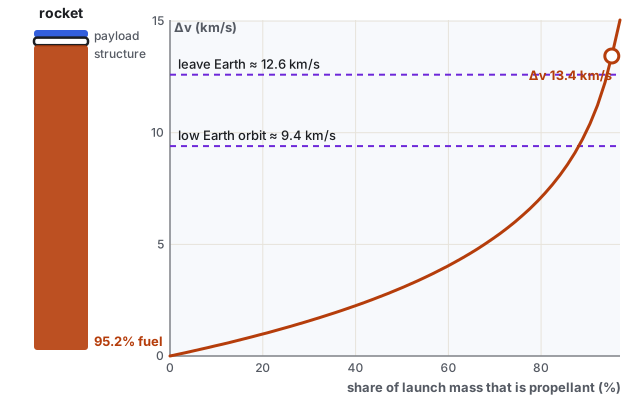
The rocket equation: why rockets are almost all fuel
Speed grows with the logarithm of the fuel. Double the tank and you get far less than double the speed.
 Start here
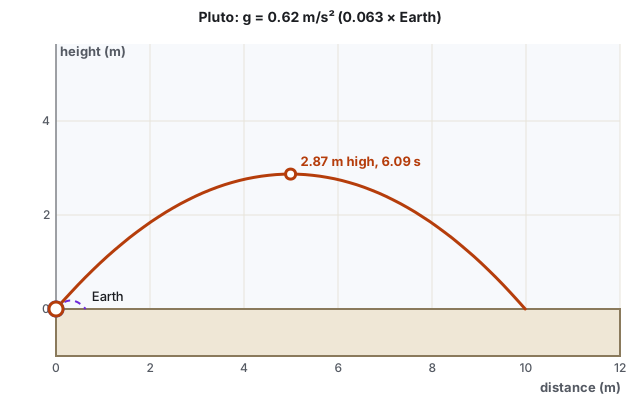
Jumping on the Moon: the same leap on other worlds
Same legs, same launch. Weaker gravity stretches the parabola, and the motion plays in real time.
 Also try
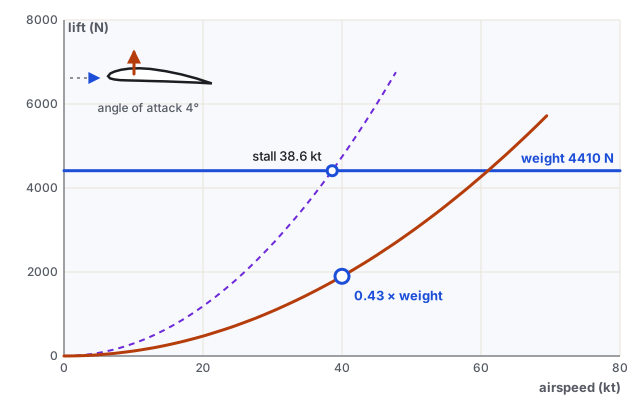
Wing lift: why twice the speed means four times the lift
Lift grows with airspeed squared. Bernoulli, angle of attack, thin air, and the stall, all on one curve.
 Also try
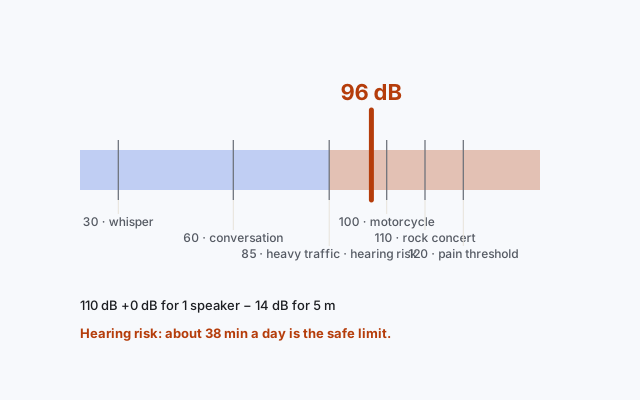
Decibels: why two speakers aren’t twice as loud
Sound is measured on a log scale. Double the speakers: +3 dB. Double the distance: −6 dB.
Questions people ask
How fast does the International Space Station go?
About 7.66 km/s, or 27,600 km/h (17,100 mph). It circles Earth about every 93 minutes, roughly 15.5 times a day.
Why don't satellites fall down?
They do fall, all the time. They're moving sideways so fast that the ground curves away as quickly as they fall toward it. That endless falling-and-missing is an orbit.
What is a geostationary orbit?
An orbit about 35,786 km above the equator, 42,164 km from Earth's center. Its period matches Earth's rotation (23 h 56 min), so the satellite stays over one spot. That's why satellite dishes can point in one fixed direction.
What is Kepler's third law?
The square of the orbital period is proportional to the cube of the orbit's radius, so T grows as r^(3/2). Quadruple the distance and one orbit takes 8 times as long.