Why do rockets need so much fuel?
A rocket's speed change depends on the logarithm of its mass ratio: Δv = Isp·g₀·ln(full mass ÷ empty mass). Logarithms grow slowly, so each extra tonne of fuel adds less speed than the one before, partly because it has to push all the other fuel too. Reaching orbit takes a rocket that is about 90% propellant or more.
- Speed change (Δv)
- 13.4 km/s
- Mass ratio (full ÷ empty)
- ×21
- Share that is propellant
- 95.2%
- Exhaust speed
- 4.41 km/s
Challenge: Reach low Earth orbit (9.4 km/s) with a single stage. Done!
More settings
Play
Pile on propellant and watch the curve flatten. Then switch the engine to hydrogen.
Challenge: Reach low Earth orbit (9.4 km/s) with a single stage. The box under the picture turns green when you get it.
Stuck? Pick one of the examples from the “Try an example” menu, or press “New example.”
Understand
A rocket speeds up by throwing mass (exhaust) backward. The catch: it has to carry all the fuel it hasn't burned yet. Adding up every small push, from full tanks to empty, gives a logarithm:
The curve rises slowly at first and then steeply. Going from 80% to 90% propellant adds exactly as much speed as going from 0% to 50%, because both double the mass ratio. Near 100% the curve shoots up, but that would be a rocket with no structure at all, which is impossible.
Flip the equation around and you get an exponent: . Every extra km/s multiplies the launch mass. That's the "tyranny of the rocket equation."
The column on the left is the rocket drawn to scale by mass. Blue is payload, the outlined block is structure, and orange is propellant.
Use
Every input has a unit menu, so you can type values in the units you already have. Results follow your units.
Show the work
- Exhaust speed
v_e = I_{sp}\,g_0 = 450 \times 9.807 = 4413\ \mathrm{m/s} - Mass ratio: full ÷ empty
\frac{m_0}{m_f} = \frac{420}{20} = 21 - Rocket equation
\Delta v = v_e \ln\frac{m_0}{m_f} = 4413 \times \ln 21 = 13{,}440\ \mathrm{m/s} - Propellant share needed for orbit (solve for the mass ratio)
1 - e^{-9400/4413} = 88.12\%
Export
Set the propellant, the empty structure, and the payload, and pick an engine in "More settings." The dashed lines mark the Δv for orbit and for escaping Earth.
- This is the ideal Δv. Real launches lose some to gravity and drag, which the 9.4 km/s figure already includes.
- It treats the rocket as one stage. For more stages, compute each one and add the Δv values.
- An ion engine's thrust is far too small to lift off Earth. Its huge Δv only works once already in space.
For learning and estimation. Verify with applicable codes, standards, and a qualified professional before using in design, construction, or safety-critical work.
Cheat card
| Symbol | Meaning | Unit |
|---|---|---|
| change in speed the rocket can make | m/s | |
| specific impulse, engine efficiency | s | |
| standard gravity, 9.807 | m/s² | |
| full and empty mass | kg |
- Reaching low Earth orbit takes about 9.4 km/s once you count gravity and air drag.
- Stages help because you drop empty tanks, so each stage starts with a fresh, high mass ratio.
- Solving for mass gives an exponent. Each extra km/s multiplies the fuel you need.
Where it’s used
- Aerospace
Mission planners add up the Δv for every burn and use this equation to size each stage. - Physics
It comes straight from conservation of momentum: throw mass backward, move forward. - Hobbies & Crafts
Model-rocket and space-game players (like Kerbal Space Program) plan flights with the same Δv budget.
Related exhibits
 Start here
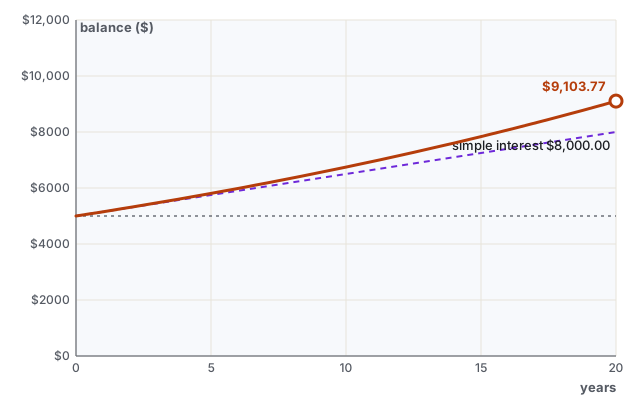
Compound interest: money that grows on itself
Interest earns interest. Exponents explain why saving early wins.
 Go further
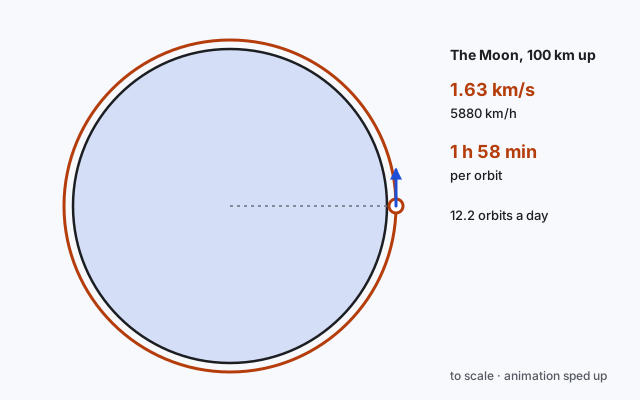
Orbits: how fast to go around and never come down
An orbit is falling and missing the ground. Square roots and a 3/2 power set the speed and the period.
 Also try
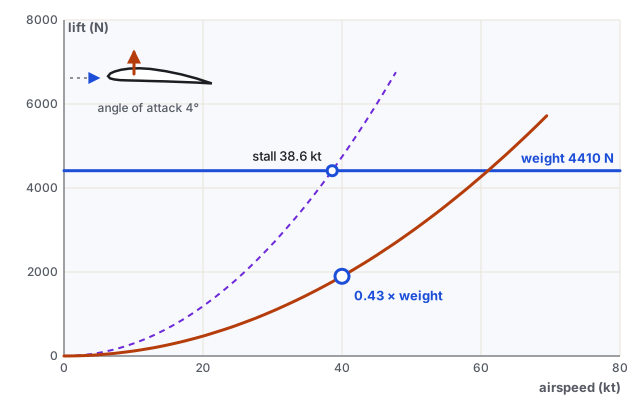
Wing lift: why twice the speed means four times the lift
Lift grows with airspeed squared. Bernoulli, angle of attack, thin air, and the stall, all on one curve.
 Also try
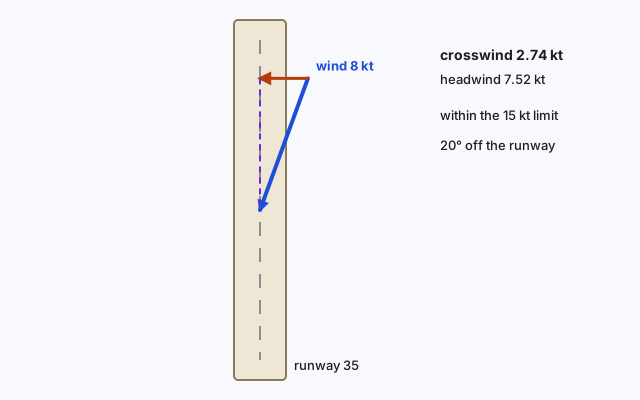
Crosswind landing: splitting the wind into two parts
Pilots break the wind into “along the runway” and “across it.” That’s vector math at 60 knots.
Questions people ask
What is the rocket equation?
Δv = Isp × g₀ × ln(m₀ / m_f). It gives the change in speed a rocket can make from its engine efficiency and the ratio of its full mass to its empty mass. Konstantin Tsiolkovsky published it in 1903.
Why do rockets use stages?
After a stage burns out, its empty tanks and engines are dead weight. Dropping them lets the next stage start over with a good mass ratio. Adding up two or three stages beats one giant stage.
What is specific impulse?
A measure of engine efficiency, in seconds. Multiply by 9.807 to get the exhaust speed in m/s. Hydrogen engines reach about 450 s, kerosene about 311 s, and ion engines 3,000 s or more but with tiny thrust.
Why is there a logarithm?
Each bit of fuel pushes the rocket and all the fuel still on board. Early on it pushes a lot of fuel. Late in the burn it pushes almost none. Adding up those shrinking pushes gives a natural log.