Why do I need ratios to scale a recipe?
A recipe is a set of ratios. When you cook for more or fewer people, every ingredient has to grow or shrink by the same factor: new servings divided by old servings. Multiply each amount by that one number and the dish tastes the same, whether you feed two people or twenty.
- Scale factor
- ×0.5
- Flour
- 1 cup
- Milk
- 0.75 cup
- Eggs (exact)
- 1.5
Challenge: Triple the recipe.
More settings
Play
Change how many people you need to feed. Watch every ingredient grow or shrink together.
Challenge: Triple the recipe. The box under the picture turns green when you get it.
Stuck? Pick one of the examples from the “Try an example” menu, or press “New example.”
Understand
A recipe's taste depends on the ratios between ingredients: how much flour per cup of milk, how many eggs per cup of flour. To keep those ratios, every ingredient must be multiplied by the same number, the scale factor:
In the picture, the pale bars are the original recipe and the bold bars are the scaled one. Every bold bar is the same multiple, , of its pale bar.
Use
Every input has a unit menu, so you can type values in the units you already have. Results follow your units.
Show the work
- Scale factor
k = \frac{b}{a} = \frac{3}{6} = 0.5 - Flour
2 \times 0.5 = 1\ \text{cups} - Milk
1.5 \times 0.5 = 0.75\ \text{cups} - Eggs
3 \times 0.5 = 1.5 \approx 2
Export
Enter the recipe's serving count and your own, then the ingredient amounts. Switch between cups, mL, tablespoons, and teaspoons in the unit menus.
- Scale by weight when you can. Grams scale more accurately than cups.
- Leavening, salt, and spices sometimes need a little less than straight scaling in very large batches.
For learning and estimation. Verify with applicable codes, standards, and a qualified professional before using in design, construction, or safety-critical work.
Cheat card
| Symbol | Meaning | Unit |
|---|---|---|
| scale factor | ||
| servings the recipe makes | ||
| servings you need |
- Find the factor once, then multiply every ingredient by it.
- Eggs don't split nicely. Round to the nearest whole egg, or beat one and use part of it.
- Pan size, baking time, and seasoning don't always scale straight. Check as you go.
Where it’s used
- Cooking
Home cooks double cookie batches, halve soups, and turn a family recipe into party food.
Related exhibits
 Go further
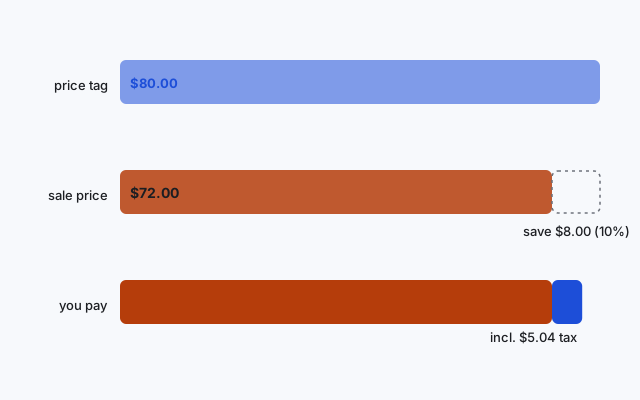
Sale price and tax: what you really pay
30% off, then tax on top. Percent math decides the number at the register.
 Go further
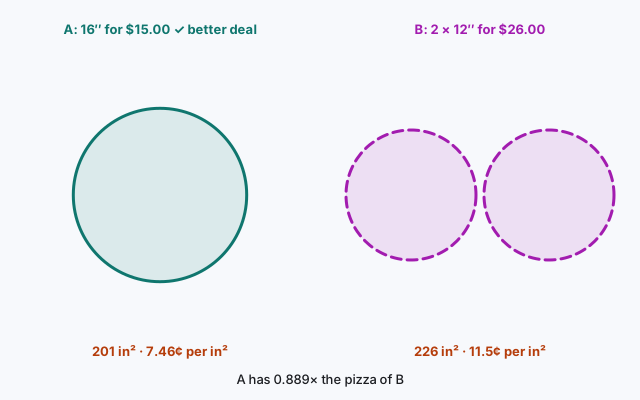
Pizza value: one large or two mediums?
Area grows with the square of the size. That changes which pizza is the deal.
 Also try
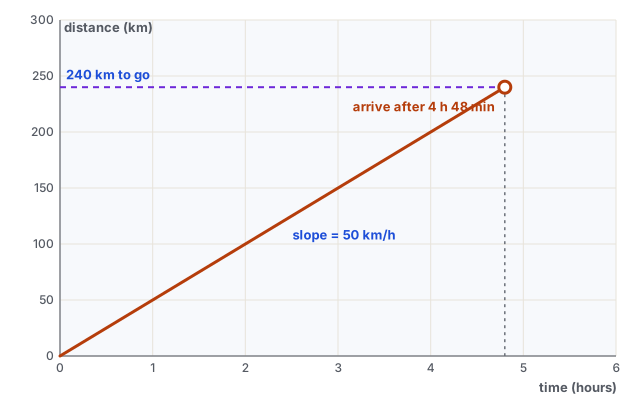
Speed, distance, time: how long is the drive?
Distance is speed times time. Rearrange it and you know when you’ll arrive.
Questions people ask
How do I double a recipe?
Multiply every ingredient by 2. The scale factor is new servings divided by old servings, so going from 4 to 8 servings is a factor of 2.
What if the numbers come out messy, like 1.875 cups?
Round to the nearest measure you own, such as 1¾ or 2 cups. Small rounding in most ingredients won't change the result. Be more careful with baking powder, salt, and yeast.
Why can't I just add the same amount to every ingredient?
Because ratios are about multiplying, not adding. Adding a cup to everything would change the balance between ingredients, and the dish would taste different.