What does the damping ratio do, and why does a door slam or crawl?
A door closer is a spring that pulls the door shut and a damper that slows it down. Their balance is the damping ratio. Below 1 the door overshoots, and since the frame stops it, it slams. Above 1 it crawls. Exactly 1 is the fastest close with no slam. The Laplace transform shows why.
- Time to close
- 4.34 s
- Speed at the latch
- 1.3 °/s
- Slowest pole (real part)
- -1.5 /s
Challenge: Close the door in under 3 seconds without slamming.
More settings
Play
Start at a slam, then turn up the damping until the door just glides shut. Watch the two poles meet.
Challenge: Close the door in under 3 seconds without slamming. The box under the picture turns green when you get it.
Stuck? Pick one of the examples from the “Try an example” menu, or press “New example.”
Understand
The door obeys a differential equation: the spring's pull and the damper's drag balance the door's inertia.
The Laplace transform turns each derivative into a power of , so calculus becomes algebra:
The poles are where the bottom is zero, and they describe the whole motion:
- Complex pair (): the door would swing past shut and back. The frame stops it: a slam.
- One double pole (): the fastest close with no overshoot.
- Two real poles (): no overshoot, but the slower pole drags it out.
The small box plots the poles. Slide the damping and watch them move together, meet, then split along the axis.
Use
Every input has a unit menu, so you can type values in the units you already have. Results follow your units.
Show the work
- The motion: spring pulls, closer resists
\theta'' + 2\zeta\omega\,\theta' + \omega^2\theta = 0 - Laplace transform: derivatives become powers of s
\Theta(s) = \frac{90\,(s + 3)}{s^2 + 3\,s + 2.25} - Poles: where the bottom equals zero
s = -\zeta\omega \pm \omega\sqrt{\zeta^2 - 1} = -1.5,\ -1.5 - Reading the poles
\text{one double real pole } \Rightarrow \text{ fastest with no overshoot}
Export
Set the damping and spring strength. Open "More settings" to change how far the door starts open.
- "Closed" means within 1° of the frame for a door that doesn't slam, which is when the latch catches.
- A real closer also has a separate "latch speed" valve for the last few degrees. This model treats the damping as constant.
For learning and estimation. Verify with applicable codes, standards, and a qualified professional before using in design, construction, or safety-critical work.
Cheat card
| Symbol | Meaning | Unit |
|---|---|---|
| damping ratio: 1 is critical | ||
| natural frequency (spring strength) | /s | |
| Laplace variable; the poles are its special values |
- Poles off the real axis (a complex pair) mean oscillation. For a door, that's a slam.
- Two real poles mean no oscillation. The one closer to zero sets how slow it is.
- Real door closers have a valve screw for this. Turn it until the door just latches without banging.
Where it’s used
- Mechanical
Engineers tune car shock absorbers, building sway dampers, and robot arms by placing the same two poles. - Physics
Any spring with friction, from a guitar string to a bathroom scale needle, follows this equation. - Home Projects
Adjust a door closer, a soft-close drawer, or a screen door the same way.
Related exhibits
 Start here
Hooke’s law: how far does the car sag when you load it?
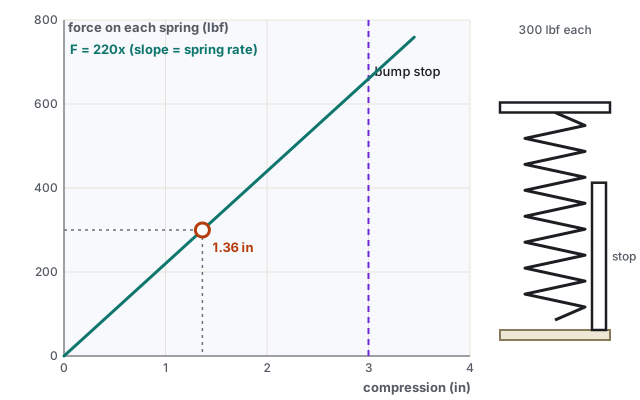
A spring squeezes in a straight line with the load: twice the weight, twice the sag, until it hits the stops.
 Start here
Sine waves: wall power and musical notes
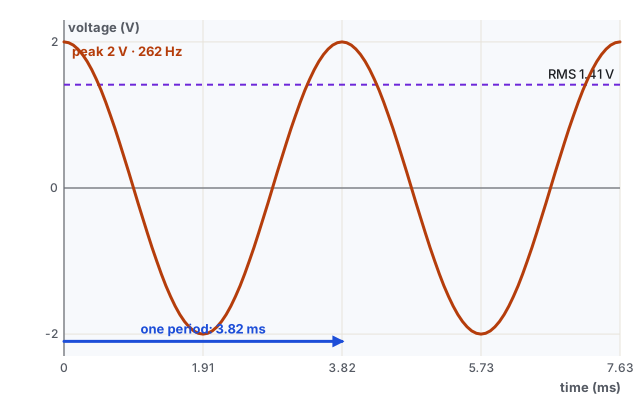
The outlet and a tuning fork follow the same curve: amplitude, frequency, and phase.
 Start here
Cooling coffee: when is it drinkable?
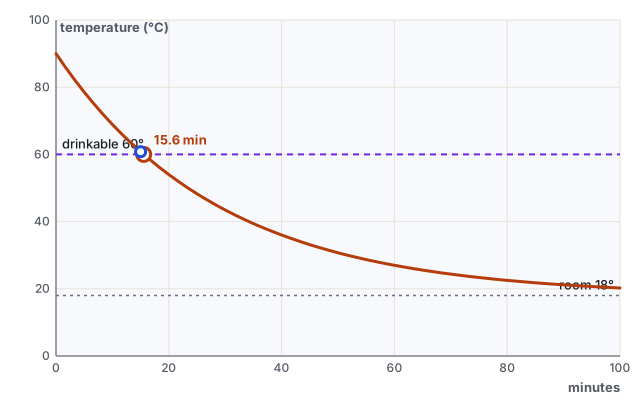
Hot things cool fast, then slower and slower. Exponential decay predicts the sip.
 Go further
Why the shower goes hot, then cold
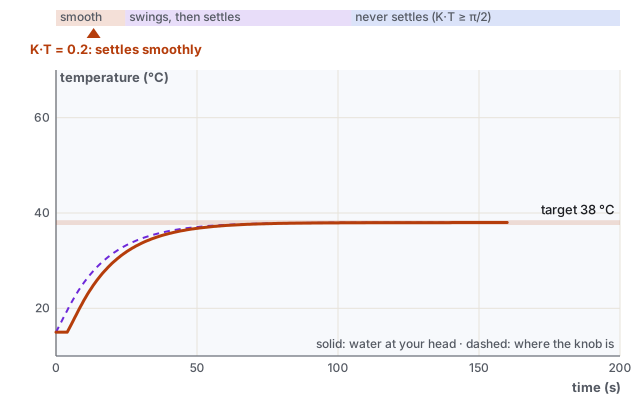
You react to water that left the tap seconds ago. Delay plus impatience makes the swing, and one number predicts it.
 Also try
When will my coffee wear off?
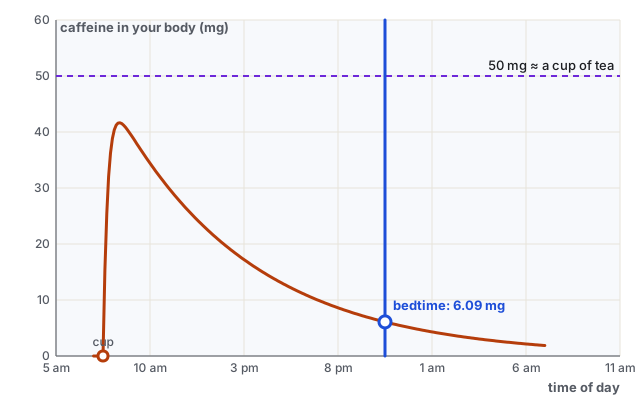
Each cup rises, then fades by half every few hours. Cups stack, and the Laplace transform says why they simply add.
Questions people ask
What is the damping ratio?
A number that compares the damping to the amount needed to stop oscillation. Below 1 the system bounces (underdamped), exactly 1 is critically damped, and above 1 it's sluggish (overdamped).
Why use the Laplace transform here?
It turns the differential equation into algebra. The derivatives become powers of s, and the behavior is set by the roots of s² + 2ζωs + ω², the poles. Where they sit tells you bounce or no bounce, fast or slow, without solving anything over time.
Why is critical damping the fastest without overshoot?
Less damping and the door overshoots. More damping and the slower of the two real poles moves toward zero, dragging the motion out. The two poles meet exactly at ζ = 1, the sweet spot.