Mechanical
The math behind machines and motion
13 live exhibits. Each one already works. Change a number and see what happens.
Open as board Play with these together. Solving one grows related exhibits.
 Linear Equations
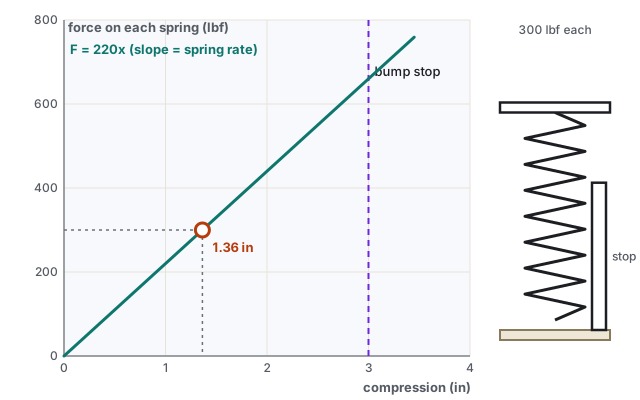
Hooke’s law: how far does the car sag when you load it?
A spring squeezes in a straight line with the load: twice the weight, twice the sag, until it hits the stops.
 Ratios & Proportions
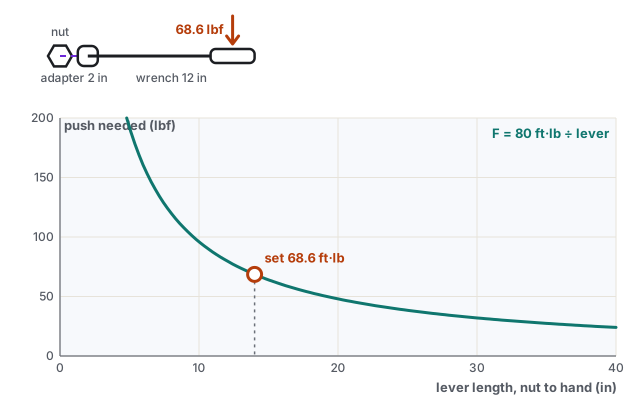
Torque: how hard to pull the wrench, and what an adapter changes
Torque is force times distance. A longer handle takes less push, and an adapter that adds length means you must set the wrench lower.
 Linear Equations
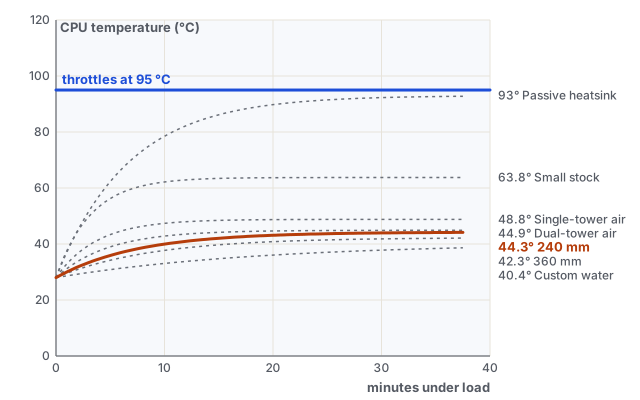
PC cooling: passive, air, or water?
Heat flows through the cooler like current through a resistor: temperature rise = watts × °C/W. Water adds mass, so it heats up slower.
 Linear Equations
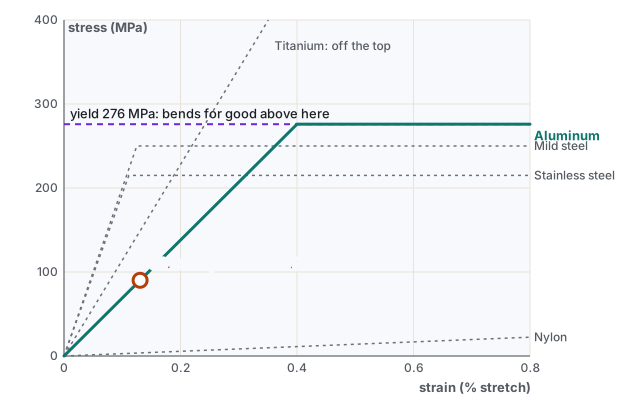
Stress and strain: how much does a rod stretch under a load?
Stress is force per area. Divide by the material’s stiffness and you get the stretch, until it yields and stays bent.
 Ratios & Proportions
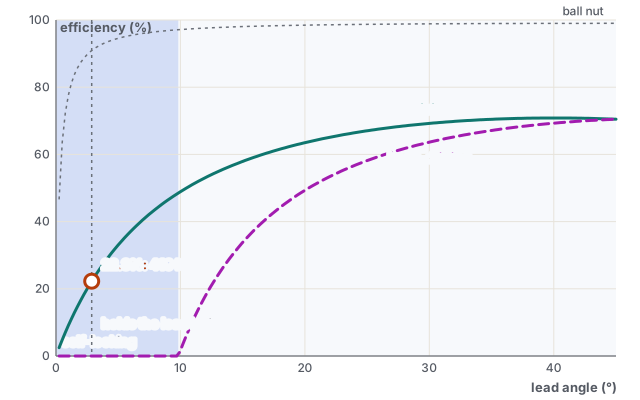
Lead screw vs. ball screw: turning torque into a push
A screw trades turns for force: F = 2π × efficiency × torque ÷ lead. Friction decides whether it also holds the load with the power off.
 Trigonometry
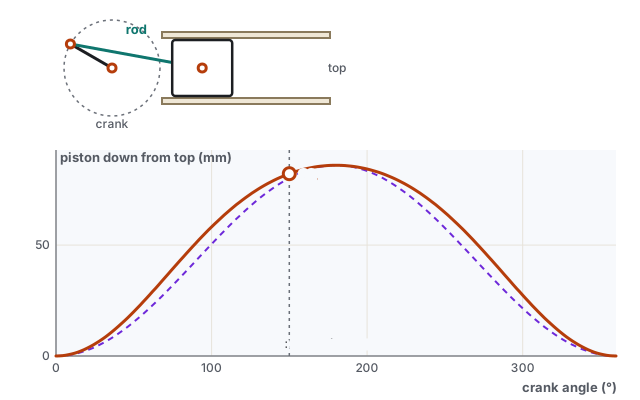
Crank and piston: turning rotation into back-and-forth
A crank turns a circle into a straight-line stroke. The connecting rod bends the motion away from a pure sine wave.
 Linear Equations
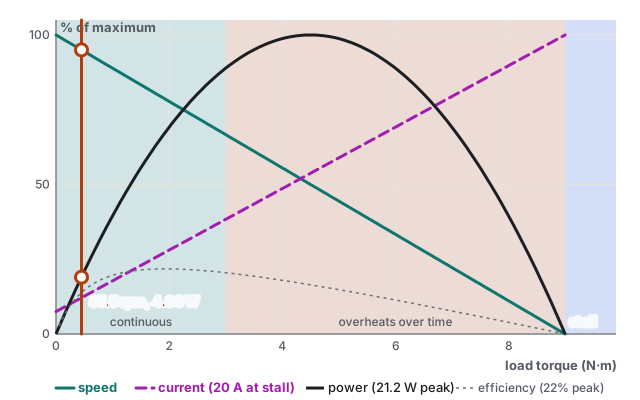
DC motor torque–speed curve: where it runs, peaks, and stalls
Load a DC motor and its speed falls in a straight line to stall. Power peaks at half speed, and efficiency peaks at light load.
 Differential Equations & Transforms
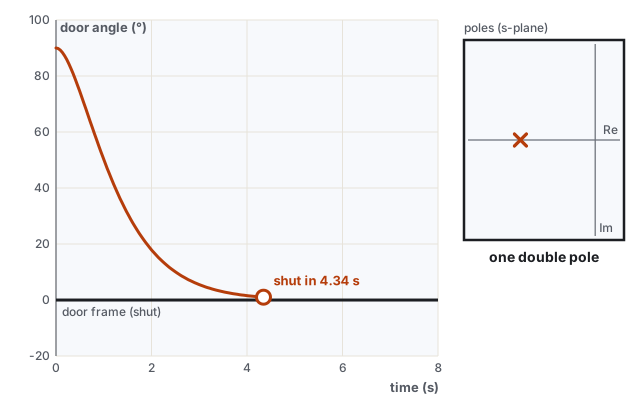
Door closer: slam, bounce, or glide
One damping knob turns a slam into a glide. Where two dots (the poles) sit tells you which.
 Differential Equations & Transforms
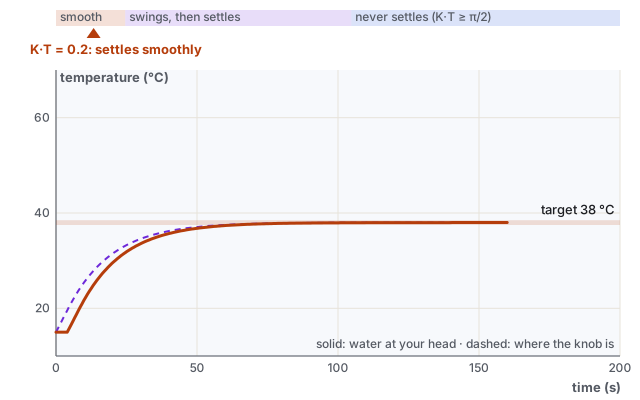
Why the shower goes hot, then cold
You react to water that left the tap seconds ago. Delay plus impatience makes the swing, and one number predicts it.
 Exponents & Logarithms
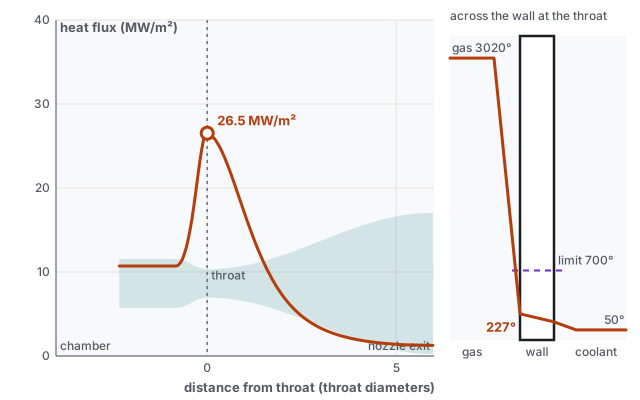
The Bartz equation: how regenerative cooling keeps a rocket throat from melting
Heating grows with chamber pressure to the 0.8 power and peaks at the throat. The fuel flows through the wall to carry it away.
 Calculus (intro)
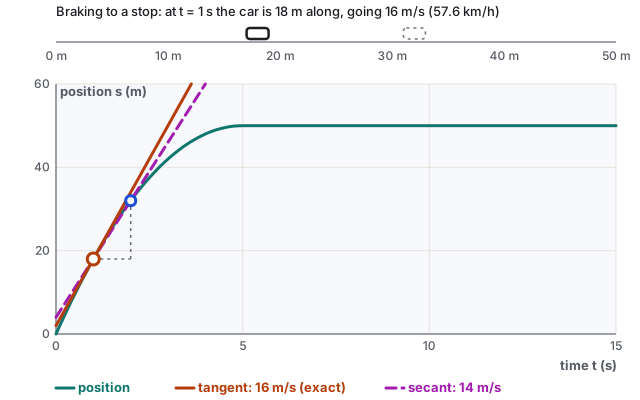
Speed from a position graph: the derivative
The steepness of a position graph is the speed. Shrink a secant line down to a tangent, and you have the derivative.
 Calculus (intro)
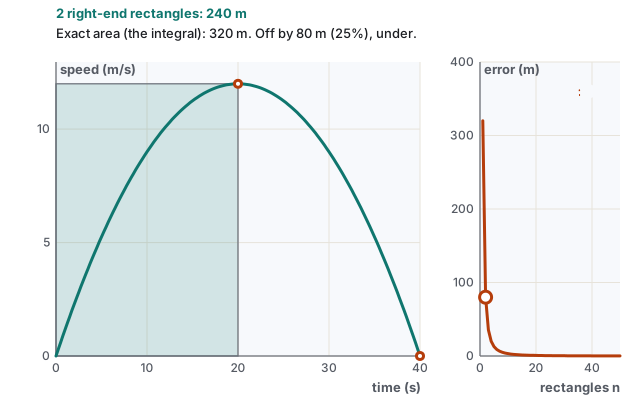
Distance from a speed graph: area under the curve
Speed times time is distance, one thin rectangle at a time. Add more rectangles and the total closes in on the exact area: the integral.
 Calculus (intro)
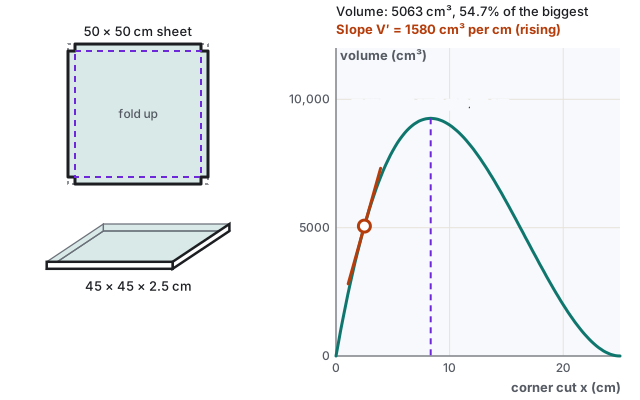
The biggest box from a sheet of cardboard: optimization
Cut a square from each corner and fold up the sides. Too small a cut makes a flat tray, too big a skinny tower. The derivative finds the best cut.