How far will my car's suspension sag when I load it?
Hooke's law says a spring compresses in proportion to the force: x = F ÷ k. Split the load between the springs carrying it, then divide by the spring rate. Five hundred pounds on two 150 lb/in rear springs sags each about 1.7 inches. Twice the load gives twice the sag, until the bump stops.
- Sag
- 1.36 in
- Travel used
- 45.5%
- Travel left for bumps
- 1.64 in
Challenge: Carry 1,000 lb or more while using no more than half the travel. Done!
More settings
Play
Load the overloaded compact car, then find the spring rate that keeps it off the stops.
Challenge: Carry 1,000 lb or more while using no more than half the travel. The box under the picture turns green when you get it.
Stuck? Pick one of the examples from the “Try an example” menu, or press “New example.”
Understand
A spring pushes back in proportion to how far you squeeze it. That's Hooke's law:
The spring rate is the slope of the line. Split the load between the springs that carry it, then divide by to get the sag.
The dashed line is the bump stop. Past it, the spring has nothing left for potholes.
Use
Every input has a unit menu, so you can type values in the units you already have. Results follow your units.
Show the work
- Share the load between the springs
F = \frac{1200}{4} = 300\ \text{lbf} - Hooke’s law: force = rate × compression
F = kx - Solve for the compression
x = \frac{F}{k} = \frac{300}{220} = 1.364\ \text{in} - Share of the travel used
\frac{1.364}{3} = 45.45\%
Export
Set the load, how many springs share it, and the spring rate. "More settings" changes the travel left before the bump stops.
- Spring rates here are measured at the wheel. Rates on the spring itself are usually higher, because the spring sits closer to the pivot.
- Real loads rarely split evenly. A trunk load sits mostly on the rear axle.
For learning and estimation. Verify with applicable codes, standards, and a qualified professional before using in design, construction, or safety-critical work.
Cheat card
| Symbol | Meaning | Unit |
|---|---|---|
| force on one spring | lbf | |
| spring rate | lb/in | |
| compression (sag) | in | |
| number of springs sharing the load |
- The graph is a straight line through zero. Its slope is the spring rate.
- Springs share the load. Four springs each carry a quarter.
- A stiffer spring sags less but rides harsher over bumps.
Where it’s used
- Mechanical
Suspension engineers pick spring rates so a loaded car keeps enough travel for bumps. - Physics
Hooke's law is the first model of any spring, from bathroom scales to atomic bonds. - Driving & Travel
Check how much a trailer or a loaded trunk will squat the back of the car.
Related exhibits
 Start here
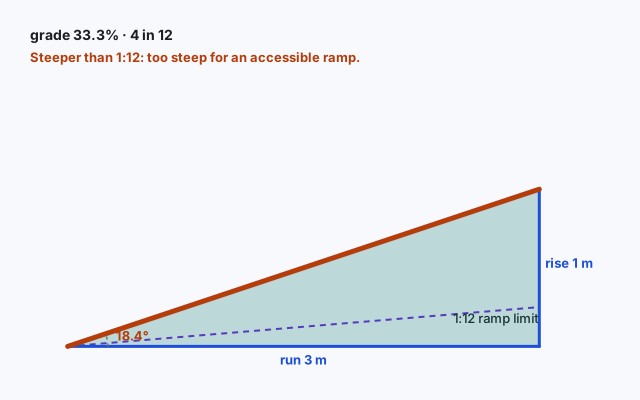
Roof pitch and ramp slope: rise over run
Slope is one number that decides whether a roof sheds water or a ramp is safe to roll up.
 Start here
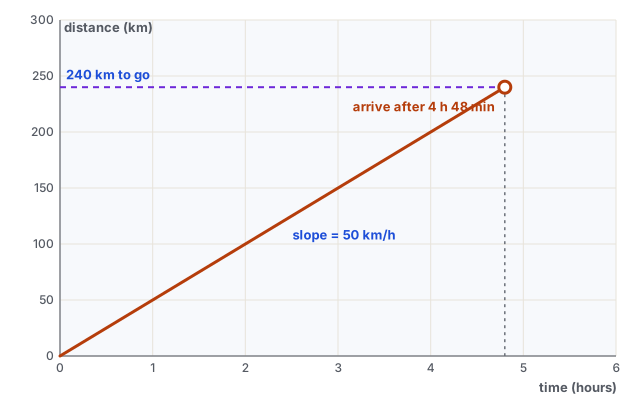
Speed, distance, time: how long is the drive?
Distance is speed times time. Rearrange it and you know when you’ll arrive.
 Go further
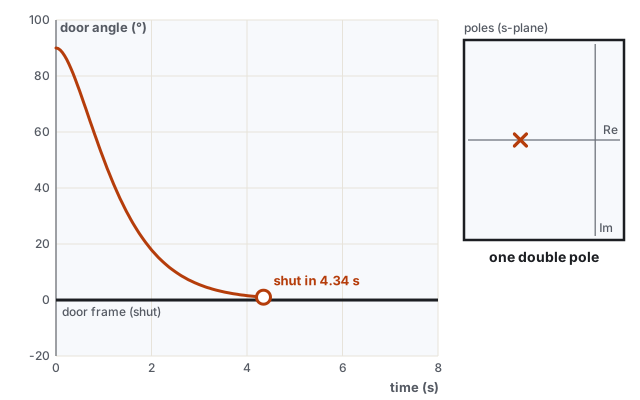
Door closer: slam, bounce, or glide
One damping knob turns a slam into a glide. Where two dots (the poles) sit tells you which.
 Go further
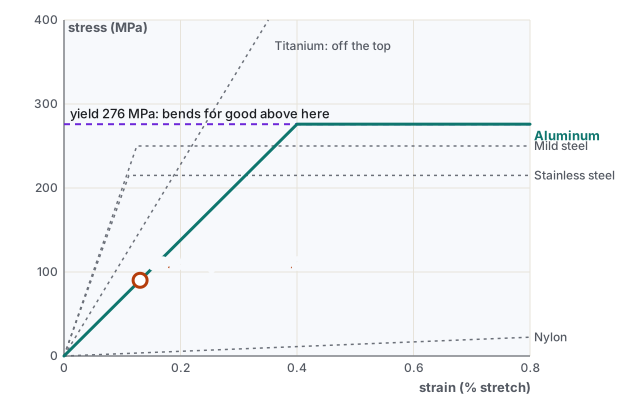
Stress and strain: how much does a rod stretch under a load?
Stress is force per area. Divide by the material’s stiffness and you get the stretch, until it yields and stays bent.
 Also try
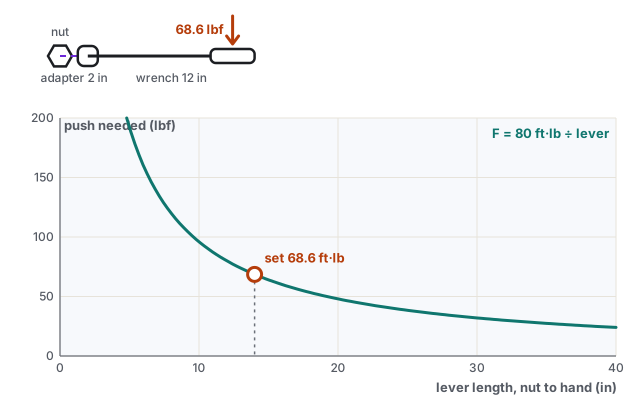
Torque: how hard to pull the wrench, and what an adapter changes
Torque is force times distance. A longer handle takes less push, and an adapter that adds length means you must set the wrench lower.
Questions people ask
What is Hooke's law?
The force on a spring equals its rate times how far it compresses or stretches, F = kx. It holds until the spring runs out of travel or is bent past its limit.
What is a spring rate?
How much force it takes to compress the spring by one unit, such as 150 lb per inch. Higher is stiffer.
Why does the back of my car squat when towing?
The tongue weight sits behind the rear axle and pushes those springs down. It also lifts the front a little, so the rear often carries a bit more than the tongue weight itself.