Why do I need linear equations to check my paycheck?
Hourly pay is a straight line: rate times hours. Overtime bends that line upward after 40 hours, because each extra hour pays one and a half times the rate. Writing the pay as two linear pieces lets you check a paycheck, compare job offers, and see exactly what a few extra hours are worth.
- Pay this week
- $704.00
- Overtime pay
- $0.00
- Average per hour
- $22.00
Challenge: Earn at least $1,000 in a week with no more than 5 overtime hours.
More settings
Play
Slide the hours past 40 and watch the line bend upward.
Challenge: Earn at least $1,000 in a week with no more than 5 overtime hours. The box under the picture turns green when you get it.
Stuck? Pick one of the examples from the “Try an example” menu, or press “New example.”
Understand
Pay grows in a straight line with a slope equal to your hourly rate. At the overtime threshold the slope changes to , so the graph has a bend. A function made of straight pieces like this is called piecewise linear:
Use
Every input has a unit menu, so you can type values in the units you already have. Results follow your units.
Show the work
- Regular hours
32\ \text{h} \times \$22 = \$704.00 - Overtime hours
0\ \text{h} \times 1.5 \times \$22 = \$0.00 - Total
\$704.00 + \$0.00 = \$704.00
Export
Enter your rate and hours. In "More settings," change when overtime starts or switch to double time. The average per hour shows how overtime raises your effective rate.
- Check your local labor law: some places also pay overtime after 8 hours in a day.
- Salaried workers are often exempt from overtime.
For learning and estimation. Verify with applicable codes, standards, and a qualified professional before using in design, construction, or safety-critical work.
Cheat card
| Symbol | Meaning | Unit |
|---|---|---|
| hourly rate | $/h | |
| hours worked in the week | h | |
| weekly pay before taxes | $ |
- Overtime usually starts after 40 hours in a week, not 8 hours in a day, but some places count both.
- The slope of the line is your pay per hour. It jumps at 40 hours.
- Taxes come out after this, so take-home pay is lower.
Where it’s used
- Finance & Business
Payroll departments and small businesses compute overtime every pay period. - Money & Shopping
Workers use it to decide whether an extra shift is worth it.
Related exhibits
 Start here
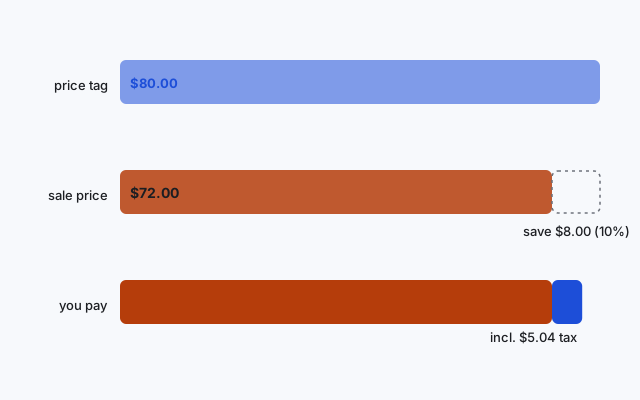
Sale price and tax: what you really pay
30% off, then tax on top. Percent math decides the number at the register.
 Go further
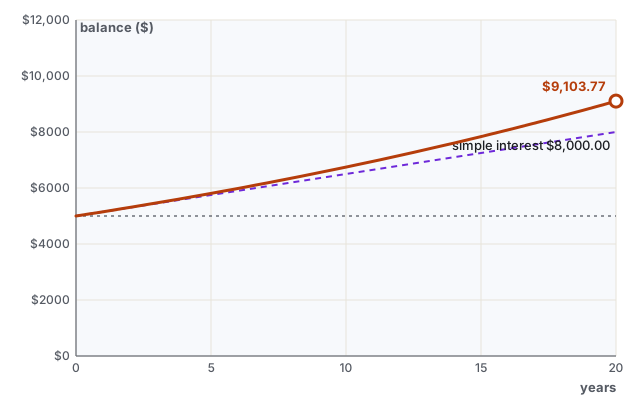
Compound interest: money that grows on itself
Interest earns interest. Exponents explain why saving early wins.
 Also try
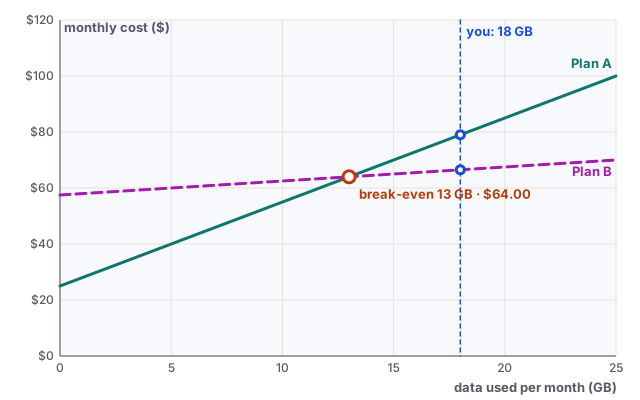
Phone plans: finding the break-even point
Two plans, two lines. Where they cross, the price is the same.
Questions people ask
How is time and a half calculated?
Multiply your hourly rate by 1.5 for each hour over 40. At $20 an hour, overtime pays $30 an hour.
Why is this called piecewise linear?
The pay line is made of two straight pieces with different slopes, joined at 40 hours.
Does overtime change my regular hours' pay?
No. The first 40 hours are paid at the regular rate; only the hours after that get the higher rate.