Why do pilots need vectors to land in a crosswind?
Wind rarely blows straight down the runway. Pilots split it into two components: the part along the runway, which slows the landing, and the part across it, which pushes the plane sideways. Sine and cosine give each part, and the crosswind must stay under the aircraft's limit for a safe landing.
- Crosswind
- 2.74 kt
- Headwind (− is tailwind)
- 7.52 kt
- Wind angle off the runway
- 20°
Challenge: Land in at least 20 knots of wind with a headwind and a crosswind within the limit.
More settings
Play
Turn the wind and the runway. The orange arrow is the push across the runway.
Challenge: Land in at least 20 knots of wind with a headwind and a crosswind within the limit. The box under the picture turns green when you get it.
Stuck? Pick one of the examples from the “Try an example” menu, or press “New example.”
Understand
A vector has a size and a direction. Any vector can be split into two perpendicular parts. Here the wind (blue) splits into a part along the runway (dashed) and a part across it (orange):
is the angle between where the wind comes from and where the runway points. Straight down the runway, : no crosswind. Straight across, : all crosswind.
Use
Every input has a unit menu, so you can type values in the units you already have. Results follow your units.
Show the work
- Angle between wind and runway
\Delta = 10^\circ - 350^\circ = 20^\circ - Crosswind (across)
X = 8\sin 20^\circ = 2.736\ \text{kt} - Headwind (along)
H = 8\cos 20^\circ = 7.518\ \text{kt}
Export
Enter the wind as reported (direction it blows from, speed in knots) and the runway heading. Set your aircraft's crosswind limit in "More settings."
- Gusts count: use the gust speed for the crosswind check.
- This is for learning. Use your aircraft's handbook and official weather for real flights.
For learning and estimation. Verify with applicable codes, standards, and a qualified professional before using in design, construction, or safety-critical work.
Cheat card
| Symbol | Meaning | Unit |
|---|---|---|
| wind speed | kt | |
| angle between wind and runway | ° | |
| crosswind component | kt | |
| headwind component (negative = tailwind) | kt |
- At 30° off, the crosswind is half the wind. At 60°, it's about 87%.
- Runway numbers are headings divided by 10. Runway 27 points to 270°.
- Pilots prefer the runway with the most headwind and the least crosswind.
Where it’s used
- Aerospace
Pilots compute crosswind before every landing; aircraft manuals list a maximum demonstrated crosswind. - Physics
Splitting any force into perpendicular parts is the first step in mechanics. - Driving & Travel
It explains why flights divert or pick a different runway on gusty days.
Related exhibits
 Start here
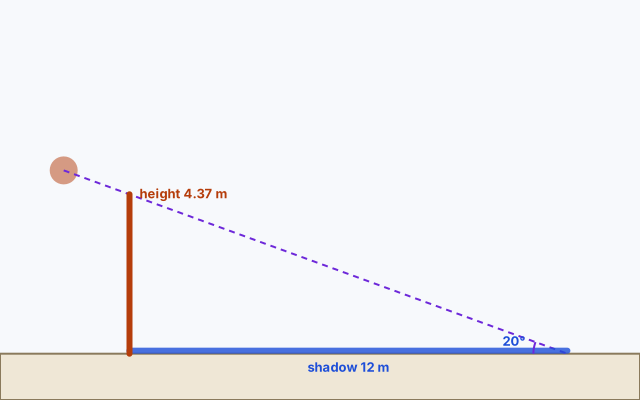
How tall is that tree? Measure its shadow
One shadow and the sun’s angle give you the height, no climbing needed.
 Go further
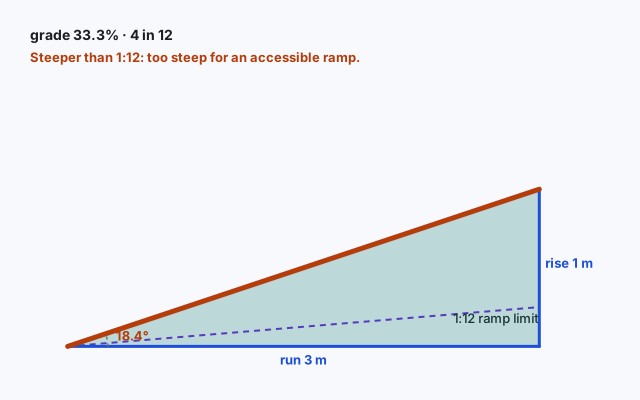
Roof pitch and ramp slope: rise over run
Slope is one number that decides whether a roof sheds water or a ramp is safe to roll up.
 Also try
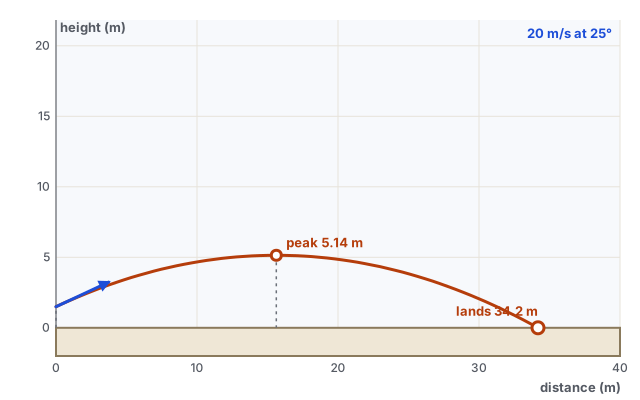
Throwing a ball: the quadratic arc
Every throw, jump, and fountain draws a parabola.
Questions people ask
How do you calculate a crosswind component?
Multiply the wind speed by the sine of the angle between the wind and the runway. 20 knots at 30° off gives 10 knots of crosswind.
What is a headwind component?
The part of the wind blowing straight down the runway toward the plane. It's the wind speed times the cosine of the angle.
Why do pilots like headwinds?
A headwind lowers the speed over the ground, so the plane lands slower and stops in less distance.