What is a Euclidean rhythm, and why do so many folk rhythms follow it?
A Euclidean rhythm spreads a number of hits as evenly as possible across a bar. Three hits in eight steps gives the tresillo; five in eight gives the cinquillo; seven in twelve gives the West African bell. Even spreading leaves only two gap sizes, which is why these patterns feel balanced but never stiff.
- Hits
- 5
- Short gap (steps)
- 2
- Long gap (steps)
- 3
Challenge: Find the West African bell pattern.
More settings
Play
Pick 3 hits in 8 steps, then rotate it. Press "Over a steady beat" to hear it against the pulse.
Challenge: Find the West African bell pattern. The box under the picture turns green when you get it.
Stuck? Pick one of the examples from the “Try an example” menu, or press “New example.”
Understand
Walk around the bar one step at a time, adding to a counter and wrapping it at . Every time it wraps, place a hit. That's the same as
The circle is a rhythm necklace, with step 1 at the top. The hits form a nearly regular polygon. When isn't a multiple of , the gaps can't all be equal, so they come in just two sizes, and . That uneven-but-balanced spacing is the groove.
Use
Every input has a unit menu, so you can type values in the units you already have. Results follow your units.
Show the work
- Even spreading: walk through the steps, adding k each time and wrapping at n. A hit lands whenever you wrap
\text{hit at step } i \iff (i \times 5) \bmod 12 < 5 - The steps between hits come in at most two sizes
\left\lfloor \frac{12}{5} \right\rfloor = 2,\quad \left\lceil \frac{12}{5} \right\rceil = 3 - The gaps, going around the bar
2 + 3 + 2 + 2 + 3 = 12
Export
Set the hits and steps, then rotate to try each starting point. Use it as a sequencer idea: put a kick on one pattern and a hi-hat or clave on another.
- Named patterns match wherever they start. Real players also add accents and swing.
For learning and estimation. Verify with applicable codes, standards, and a qualified professional before using in design, construction, or safety-critical work.
Cheat card
| Symbol | Meaning | Unit |
|---|---|---|
| hits | ||
| steps in the bar | ||
| step number, from 0 |
- Write a pattern as its gaps. The tresillo is 3 + 3 + 2. The bossa nova is 3 + 3 + 3 + 3 + 4.
- Rotating the pattern keeps the gaps but changes which hit lands on the downbeat. That changes the feel a lot.
- Layer two Euclidean patterns with different hit counts for an instant interlocking groove.
Where it’s used
- Music & Sound
Drum machines and sequencers include Euclidean generators because two numbers make a usable groove. - Computer Science
The same even-spreading rule draws straight lines on a pixel grid and spaces pulses in particle accelerators. - Music
The tresillo under countless pop, reggaeton, and dancehall songs is 3 hits spread over 8.
Related exhibits
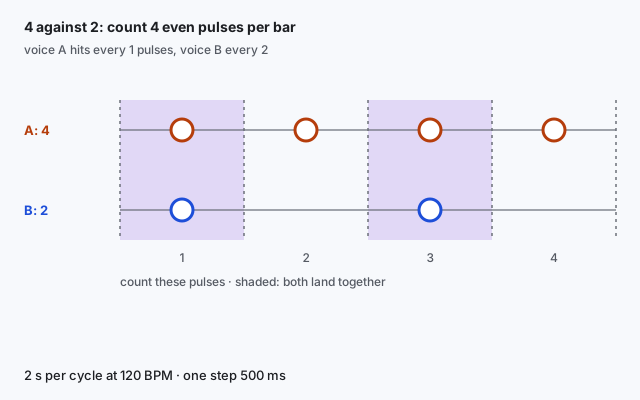 Start here
Polyrhythms: when 3 against 4 lines up again
Two patterns meet again after the least common multiple. Count that grid and any polyrhythm becomes playable.
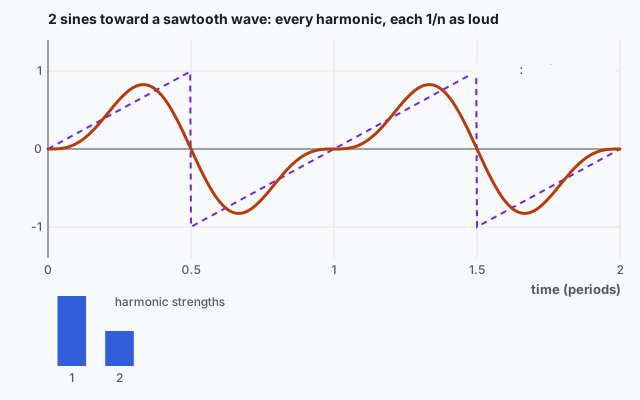 Go further
Building a square wave out of sine waves
Add sines at 1, 3, 5, 7 … times the pitch, each a little quieter, and a square wave appears. That’s how synths and your ear think about timbre.
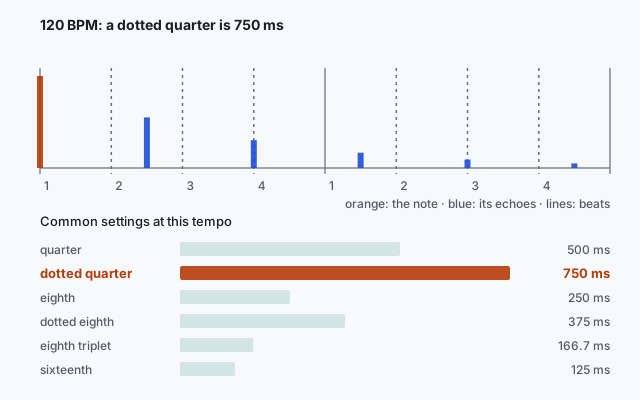 Also try
Delay times that lock to the beat: BPM to milliseconds
One beat lasts 60,000 ÷ BPM milliseconds. Every echo setting is a fraction of that beat.
Questions people ask
Why is it called Euclidean?
Spreading the hits works just like Euclid's algorithm for the greatest common divisor, which repeatedly divides the leftovers. Godfried Toussaint showed in 2005 that it rebuilds many traditional rhythms.
Why do these rhythms sound good?
The hits are as evenly spread as they can be, so the pattern feels balanced. Because the steps don't divide evenly, the gaps can't all match, and the mix of short and long gaps gives it a push.
Is every Euclidean rhythm a real traditional rhythm?
No. Many are, but plenty of combinations are simply new. Those are just as useful when you compose.
Updated : First published.