How do you count a polyrhythm like 3 against 4?
Find the least common multiple of the two numbers and count that many even pulses. For 3 against 4 that's 12. One hand plays every 4 pulses, giving 3 notes, and the other plays every 3 pulses, giving 4 notes. Both land together only on the first pulse, then the pattern repeats.
- Counting grid (least common multiple)
- 4
- Times they land together per cycle
- 2
- Until the pattern repeats
- 2 s
- One grid step
- 500 ms
Challenge: Find a polyrhythm with a counting grid of 20 pulses or more that only lines up on beat one.
More settings
Play
Press "With the counting grid," then "Both voices," and try tapping along.
Challenge: Find a polyrhythm with a counting grid of 20 pulses or more that only lines up on beat one. The box under the picture turns green when you get it.
Stuck? Pick one of the examples from the “Try an example” menu, or press “New example.”
Understand
Two patterns line up whenever both have reached a whole number of notes. The first time that happens is the least common multiple:
For a polyrhythm, divide the bar into that many pulses. Voice A plays every pulses and voice B every . For a polymeter, the loops share a beat and start together again after beats. The shaded columns show where both land together. That happens times per bar in a polyrhythm.
Use
Every input has a unit menu, so you can type values in the units you already have. Results follow your units.
Show the work
- The largest number that divides both
\gcd(4, 2) = 2 - The smallest count both fit into evenly
\operatorname{lcm}(4, 2) = \frac{4 \times 2}{\gcd(4, 2)} = \frac{8}{2} = 4 - Spacing in grid pulses
A: \frac{4}{4} = 1,\quad B: \frac{4}{2} = 2 - One grid pulse at this tempo
\frac{2000\ \text{ms}}{4} = 500\ \text{ms}
Export
Pick the two numbers and the kind. Press "With the counting grid" and count the pulses, then switch to "Both voices" and try to hear it without the grid.
- Start slow. Change the tempo in "More settings."
For learning and estimation. Verify with applicable codes, standards, and a qualified professional before using in design, construction, or safety-critical work.
Cheat card
| Symbol | Meaning | Unit |
|---|---|---|
| pulses (or loop length) of voice A | ||
| pulses (or loop length) of voice B |
- Say the grid out loud: for 3 against 2, "one-two-three-four-five-six," with one hand on 1, 3, 5 and the other on 1 and 4.
- When the two numbers share no factor, they meet only on the downbeat. 4 against 6 meets twice, because both divide by 2.
- A polymeter loop sounds like it is drifting. It isn't. It comes home after the least common multiple.
Where it’s used
- Music & Sound
Drummers learn polyrhythms by counting the least common multiple, then dropping the grid once it feels natural. - Music & Sound
West African and Afro-Cuban music layer 3 and 2 feels together as the core of the groove. - Music
Classical pianists meet 3 against 2 constantly; progressive rock and math rock loop 7-beat riffs over 4/4.
Related exhibits
 Start here
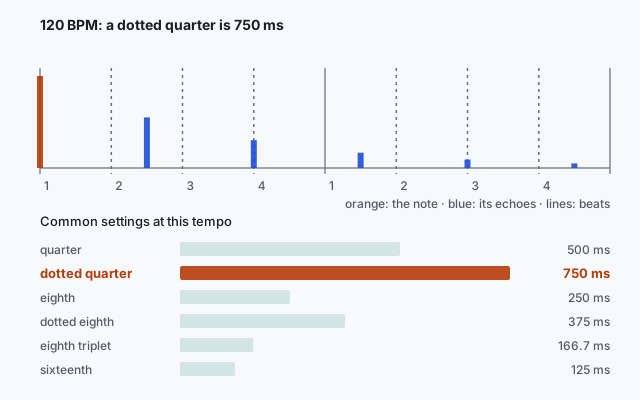
Delay times that lock to the beat: BPM to milliseconds
One beat lasts 60,000 ÷ BPM milliseconds. Every echo setting is a fraction of that beat.
 Go further
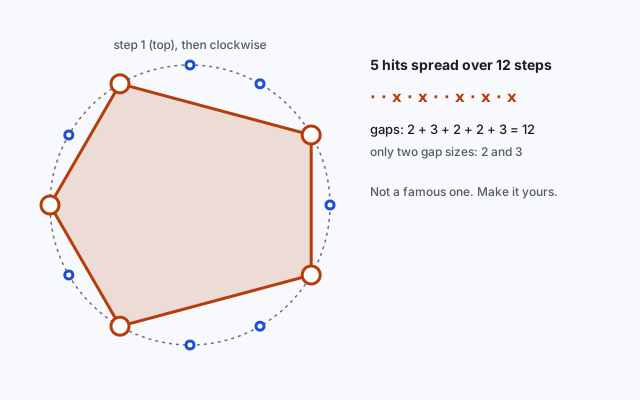
Euclidean rhythms: world grooves from one rule
Spread a few hits over a bar as evenly as you can. That one rule rebuilds the tresillo, the bossa nova, and the West African bell.
 Also try
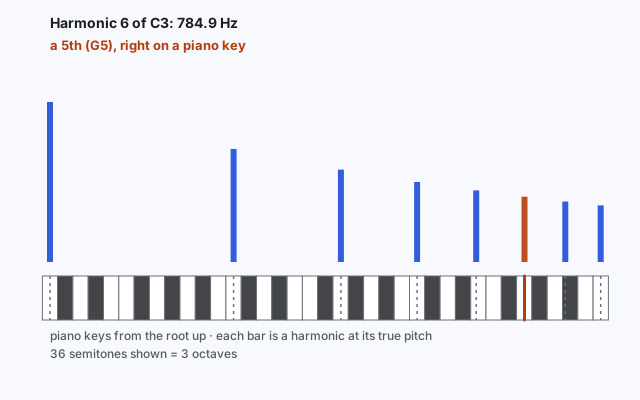
The harmonic series: the chord hiding inside every note
Every note also rings at 2, 3, 4, 5 … times its frequency. Those overtones spell out octaves, fifths, and a whole dominant 7th chord.
Questions people ask
What is the difference between a polyrhythm and a polymeter?
In a polyrhythm both patterns fill the same bar, so 3 notes and 4 notes take the same time. In a polymeter the beats are the same speed but the loops are different lengths, so they drift and realign.
Why do 3 and 4 need 12 pulses?
Twelve is the smallest number both 3 and 4 divide evenly. Any smaller grid would put one voice between pulses.
How long until a 7-beat riff lines up with 4/4 again?
After 28 beats, the least common multiple of 7 and 4. That's seven bars of 4/4, or four times through the riff.
Updated : First published.