How does a tone knob work, and what does the cutoff frequency mean?
A treble-cut tone control is a resistor feeding a capacitor. The capacitor passes high frequencies to ground more easily than low ones. The cutoff, 1 divided by 2π times R times C, is where the level is down 3 dB. Above it, each octave loses about 6 dB, so turning up the resistance makes the sound darker.
- Cutoff frequency (−3 dB)
- 1540 Hz
- Level at the frequency you picked
- -6.81 dB
- Share of the signal that gets through
- 45.6%
A guitar’s own tone knob also works against the pickup’s inductance and the cable, which adds a peak near the cutoff. This shows the basic RC idea that pedals and amps use.
Challenge: Set the cutoff between 400 and 500 Hz.
More settings
Play
Press "Turn the knob down" to hear the cutoff sweep from bright to muffled.
Challenge: Set the cutoff between 400 and 500 Hz. The box under the picture turns green when you get it.
Stuck? Pick one of the examples from the “Try an example” menu, or press “New example.”
Understand
A capacitor passes high frequencies more easily than low ones. Put a resistor in front of it and send the capacitor to ground, and the treble drains away. The crossover point is the cutoff:
How much gets through at frequency is . Measured in decibels, a logarithm, the curve is flat below the cutoff, −3 dB at it, and then a straight line down, 6 dB per octave. The graph uses log scales on both axes, which is why the slope looks straight.
Use
Every input has a unit menu, so you can type values in the units you already have. Results follow your units.
Show the work
- The cutoff: where the capacitor starts shorting the treble to ground
f_c = \frac{1}{2\pi \times 22{,}000\,\Omega \times 4.7\times10^{-9}\,\mathrm{F}} = 1539\ \text{Hz} - How much of a frequency gets through
\lvert H \rvert = \frac{1}{\sqrt{1 + (3000/1539)^2}} = 0.456 - In decibels (a log scale)
20\log_{10} 0.456 = -6.81\ \text{dB} - Far above the cutoff, doubling the frequency halves the gain: about −6 dB per octave
20\log_{10}\tfrac{1}{2} = -6.02\ \text{dB}
Export
Slide the resistance like a knob and pick a capacitor. "More settings" checks the level at any frequency. The sound buttons play an E power chord through the filter, bypassed, and with the cutoff sweeping down.
- Real guitar tone circuits interact with the pickup and cable. Pedals and amps are closer to this simple filter.
For learning and estimation. Verify with applicable codes, standards, and a qualified professional before using in design, construction, or safety-critical work.
Cheat card
| Symbol | Meaning | Unit |
|---|---|---|
| resistance | Ω | |
| capacitance | F | |
| cutoff frequency | Hz |
- Doubling R or C halves the cutoff, an octave lower.
- A single resistor and capacitor always slopes at 6 dB per octave. Synth filters stack several for 12 or 24 dB.
- The pick attack and the "bite" of a guitar live around 2 to 5 kHz. Cut there and the tone turns smooth.
Where it’s used
- Electrical & Electronics
Every audio input uses an RC filter to block hiss and radio interference above hearing. - Music & Sound
Synthesizer low-pass filters are the same idea, with the cutoff swept by an envelope for the classic "wow." - Music
Guitarists roll back the tone knob for a warmer, rounder sound on solos.
Related exhibits
 Start here
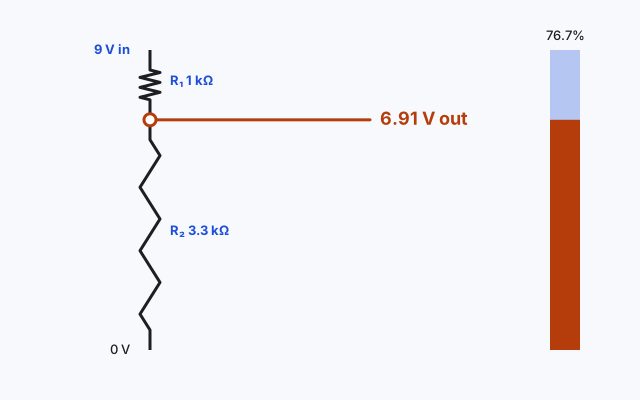
Voltage divider: two resistors make a new voltage
The output is the input times a ratio of resistors, until you connect a load.
 Start here
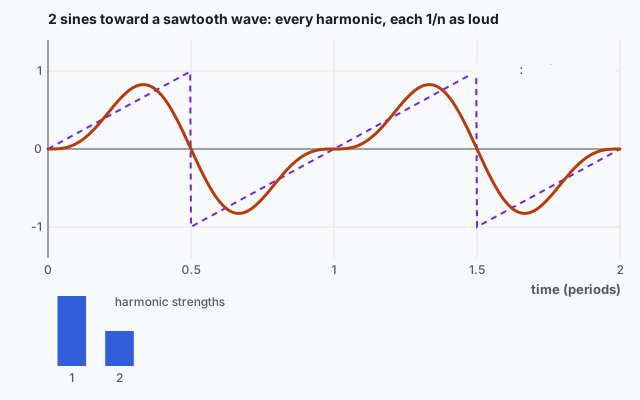
Building a square wave out of sine waves
Add sines at 1, 3, 5, 7 … times the pitch, each a little quieter, and a square wave appears. That’s how synths and your ear think about timbre.
 Go further
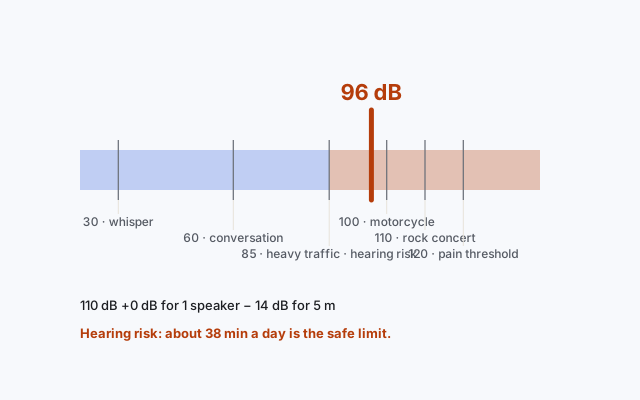
Decibels: why two speakers aren’t twice as loud
Sound is measured on a log scale. Double the speakers: +3 dB. Double the distance: −6 dB.
 Also try
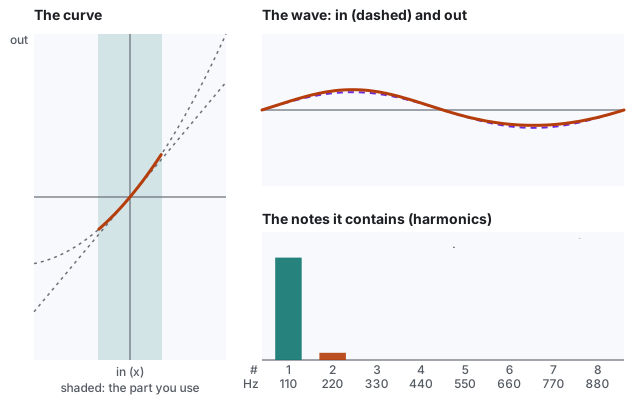
Why a distortion pedal changes the sound: polynomials make harmonics
Push a pure note through a curve like x − x³/3 and new notes appear. The cube is where the extra harmonics come from.
Questions people ask
What does −3 dB mean at the cutoff?
The signal there has dropped to about 71% of its voltage, half its power. Engineers use that point to describe where a filter starts working.
Why 6 dB per octave?
Well above the cutoff, the gain is roughly f_c divided by f. Doubling the frequency halves the gain, and 20 log₁₀ of ½ is about −6 dB.
Does a bigger capacitor make the tone darker?
Yes. A bigger capacitor or more resistance lowers the cutoff, so more of the treble is cut.
Updated : First published.