How do I know if an investment is worth it, and what is IRR?
Discount each year's cash by (1 + r) per year and add it up. That's net present value, and it's a polynomial in 1/(1 + r). If it's positive at the return you need, the investment beats your alternative. The rate that makes it exactly zero, the polynomial's root, is the internal rate of return.
- Net present value at your rate
- −$2,222.65
- Internal rate of return (IRR)
- 8.09%
- Rates where NPV = 0
- 1
- Year the money comes back
- 5
Challenge: With the cleanup-bill job, find a required return where it actually pays off.
Play
Load the food truck, then slide your required return up until the net present value hits zero.
Challenge: With the cleanup-bill job, find a required return where it actually pays off. The box under the picture turns green when you get it.
Stuck? Pick one of the examples from the “Try an example” menu, or press “New example.”
Understand
A dollar next year is worth less than a dollar today, because today's dollar could be earning . So divide each year's cash by and add:
Call and it's just a polynomial, The internal rate of return is where the curve crosses zero, its root. A polynomial can have several roots, so an investment can have several IRRs.
Use
Every input has a unit menu, so you can type values in the units you already have. Results follow your units.
Show the work
- Money later is worth less today: divide year t by (1 + r)^t
\text{NPV} = -40{,}000 + \frac{8000}{(1 + 0.1)^{1}} + \frac{8000}{(1 + 0.1)^{2}} + \frac{8000}{(1 + 0.1)^{3}} + \frac{8000}{(1 + 0.1)^{4}} + \frac{20{,}000}{(1 + 0.1)^{5}} - Add it up
\text{NPV} = -2223 - Write x = 1/(1 + r), and NPV is a polynomial in x
\text{NPV} = -40{,}000 +8000x +8000x^{2} +8000x^{3} +8000x^{4} +20{,}000x^{5},\quad x = 0.9091 - Sign changes in the cash flows (Descartes’ rule: at most this many positive-rate roots)
1 - IRR: the roots, where NPV = 0
r = 8.089\%
Export
Set what goes in and comes out each year, and the return you need.
- Taxes, inflation, and risk are left out, and future amounts are estimates.
For learning and estimation. Verify with applicable codes, standards, and a qualified professional before using in design, construction, or safety-critical work.
Cheat card
| Symbol | Meaning | Unit |
|---|---|---|
| cash in (+) or out (−) in year t | $ | |
| the return you need each year | % | |
| discount factor, 1/(1 + r) |
- Positive NPV at your rate means it beats your next-best option.
- If the IRR is above your required return, a normal investment is worth doing.
- Cash that changes direction more than once can give more than one IRR, so check the NPV curve.
Where it’s used
- Finance & Business
Analysts rank projects, buildings, and companies by NPV and IRR. - Finance & Business
Mining and drilling projects with cleanup costs are the classic case of multiple IRRs. - Money & Shopping
Compare a side business, a rental, or solar panels against simply saving the money.
Related exhibits
 Start here
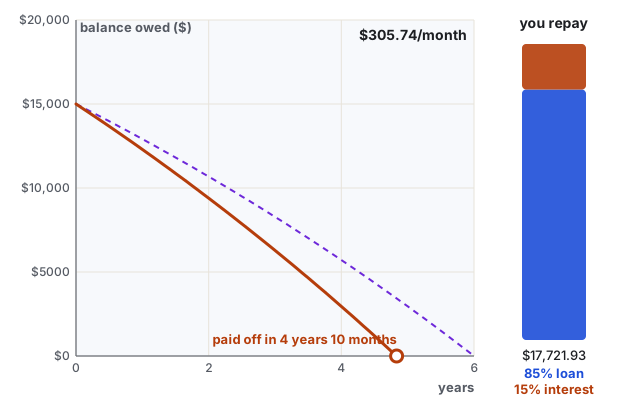
Loan payments: what a mortgage really costs
One formula sets every car, student, and home loan payment. See where the interest goes.
 Start here
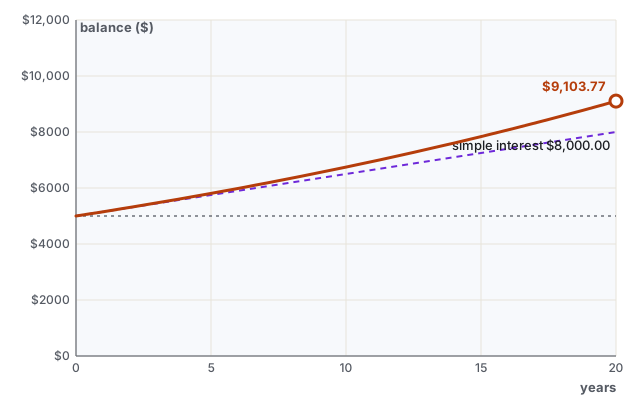
Compound interest: money that grows on itself
Interest earns interest. Exponents explain why saving early wins.
 Go further
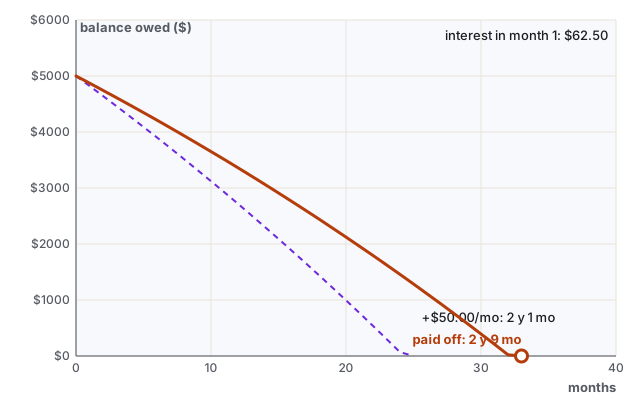
Credit card payoff: how many months until it’s gone?
A logarithm answers “how long?” See why minimum payments take forever.
 Also try
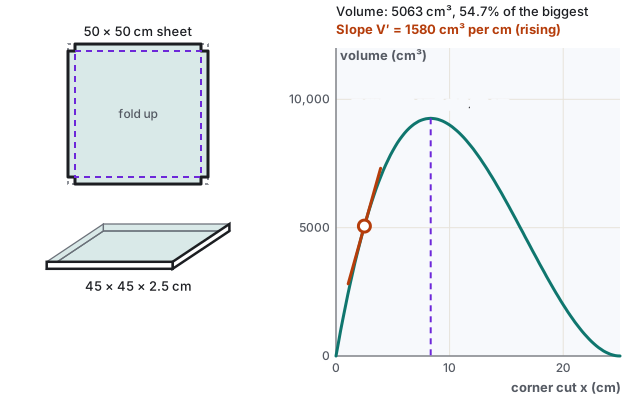
The biggest box from a sheet of cardboard: optimization
Cut a square from each corner and fold up the sides. Too small a cut makes a flat tray, too big a skinny tower. The derivative finds the best cut.
Questions people ask
What is IRR?
The yearly rate of return that makes an investment exactly break even in today's money. It lets you compare investments of different sizes and timings.
What's the difference between NPV and IRR?
NPV is a dollar amount at the return you choose. IRR is the rate where NPV is zero. NPV tells you how much you gain, and IRR tells you how fast.
How can an investment have two IRRs?
NPV is a polynomial, and a polynomial can cross zero more than once. That happens when the cash changes direction twice, like a big cleanup bill at the end.