How big should the corner cuts be to fold the biggest box?
Cut a square of side x from each corner and fold up the sides. The volume is V = x(L − 2x)(W − 2x). Small cuts make a flat tray, and big cuts a narrow tower. The best cut is where the slope V′(x) is zero. For letter paper that's about 4 cm, for a box of about 1,083 cm³.
- Box volume
- 5060 mL
- Best corner cut
- 8.33 cm
- Biggest possible volume
- 9260 mL
- Share of the biggest volume
- 54.7%
Challenge: Get within 1% of the biggest possible volume.
Play
Slide the corner cut and watch the box fold up and the dot ride the volume curve. Then change the sheet.
Challenge: Get within 1% of the biggest possible volume. The box under the picture turns green when you get it.
Stuck? Pick one of the examples from the “Try an example” menu, or press “New example.”
Understand
Cut an by square from each corner of an sheet and fold up the sides. The box is tall, long, and wide:
A tiny cut gives a flat tray with almost no volume. A cut near half the short side leaves almost no bottom. Somewhere between is the biggest box, at the top of the curve, where the slope is zero. Multiply out , take the derivative, and set it to zero:
That's a quadratic. The quadratic formula gives two roots, and the smaller one is the best cut. The short line through the dot is the tangent, the slope at your cut. It lies flat at the top.
Use
Every input has a unit menu, so you can type values in the units you already have. Results follow your units.
Show the work
- Volume = height × length × width of the folded box
V = 2.5\,(50 - 2 \cdot 2.5)(50 - 2 \cdot 2.5) = 5063\ \text{cm}^3 - Multiply out: a cubic in x
V(x) = 4x^3 - 200x^2 + 2500x - The top of the curve is where the slope is zero
V'(x) = 12x^2 - 400x + 2500 = 0 - Quadratic formula: take the smaller root (the larger one is at or past half the short side, where there’s no box)
x = \frac{(L + W) - \sqrt{L^2 - LW + W^2}}{6} = 8.333\ \text{cm}\quad (\text{not } 25) - Biggest volume
V(8.333) = 9259\ \text{cm}^3
Export
Set the corner cut, then the sheet's length and width. The drawings on the left are to scale.
- The drawing treats the sheet as paper-thin. Thick cardboard makes the inside of the box a little smaller.
- A cut of half the short side or more leaves no bottom, so there's no box.
For learning and estimation. Verify with applicable codes, standards, and a qualified professional before using in design, construction, or safety-critical work.
Cheat card
| Symbol | Meaning | Unit |
|---|---|---|
| sheet length | cm | |
| sheet width | cm | |
| side of each corner square (the box height) | cm | |
| box volume | cm³ |
- For a square sheet, cut one-sixth of the side.
- For letter paper (11 × 8.5 in), the best cut is about 1.59 in.
- The top of the curve is flat, so being a little off costs almost nothing. On letter paper, a 4.0 cm cut gets 99.997% of the best.
Where it’s used
- Mechanical
Packaging engineers balance material, volume, and shipping size when they design cartons and trays. - Art & Design
Paper-craft box makers pick the fold depth to suit what goes inside, not always the most volume. - Hobbies & Crafts
A classic classroom build: fold boxes with different cuts from the same paper and fill them with rice to compare. - Home Projects
Fold a tray for screws or seedlings from a flattened cereal box.
Related exhibits
 Start here
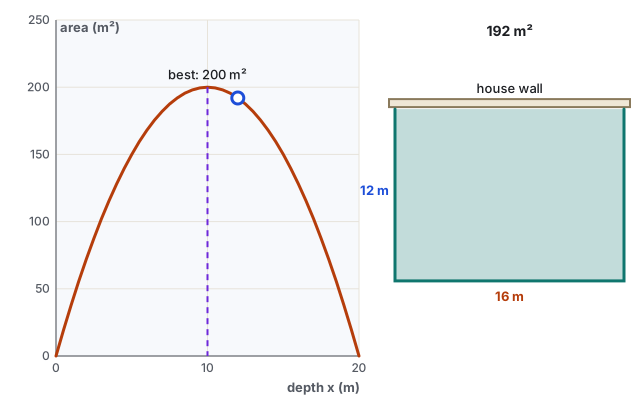
The biggest garden from a fixed fence
Same fence, different shapes. A quadratic finds the one with the most room.
 Start here
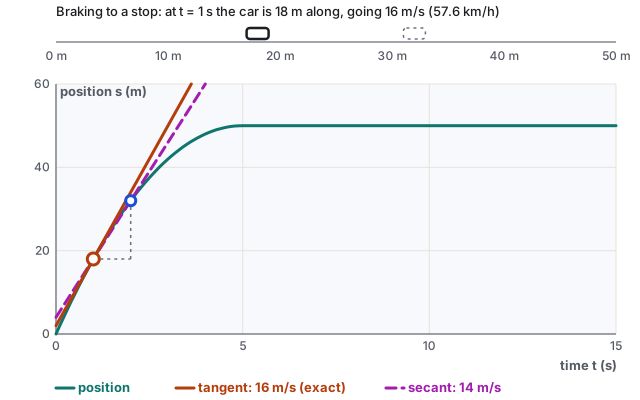
Speed from a position graph: the derivative
The steepness of a position graph is the speed. Shrink a secant line down to a tangent, and you have the derivative.
 Also try
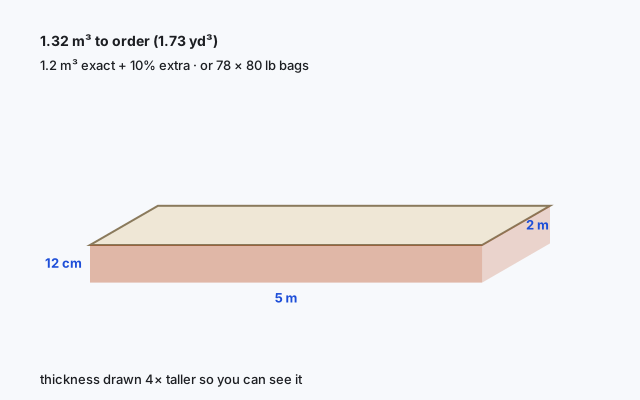
How much concrete for a slab?
Length × width × depth, plus a little extra. Get it right and you won’t run short mid-pour.
 Also try
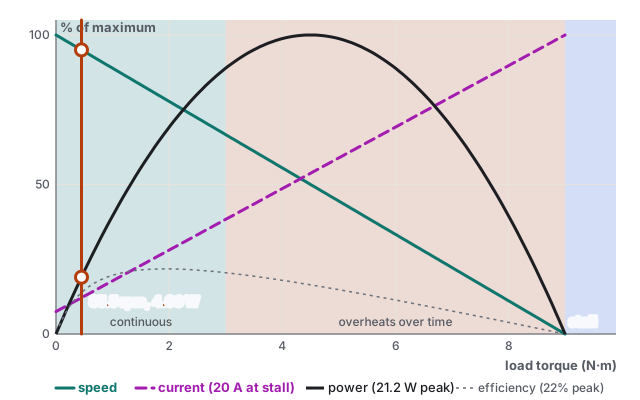
DC motor torque–speed curve: where it runs, peaks, and stalls
Load a DC motor and its speed falls in a straight line to stall. Power peaks at half speed, and efficiency peaks at light load.
 Also try
Distance from a speed graph: area under the curve
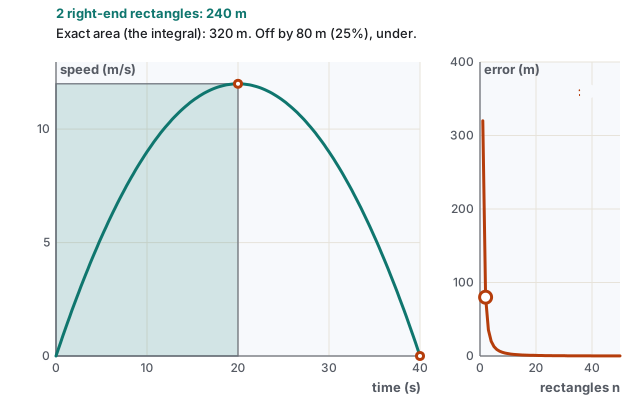
Speed times time is distance, one thin rectangle at a time. Add more rectangles and the total closes in on the exact area: the integral.
Questions people ask
Why is the biggest box where the derivative is zero?
Just before the best cut, the volume is still rising, so V′ is positive. Just after, it's falling, so V′ is negative. At the very top the curve is flat for an instant, and V′ = 0.
V′ = 0 has two answers. Why take the smaller one?
The larger one is at or past half the short side, where the corner squares meet and there's no box left. For letter paper the two roots are 4.03 cm and 12.47 cm, but the sheet is only 21.6 cm wide, so cuts must stay under 10.8 cm.
Why is a pizza box so shallow?
It's built to fit a pizza, not to hold the most. On a 60 × 40 cm blank, 4 cm sides hold 6,656 cm³, about 79% of the 8,450 cm³ you'd get from a 7.85 cm cut.