Why should a hammock hang at 30 degrees?
Your weight and the two strap pulls are force arrows that must add to zero. Only the upward part of each strap holds you, and at 30° that part is exactly half the strap's pull, so each strap carries your full weight. Hang it flat at 10° and each strap pulls almost three times your weight.
- Left strap tension
- 490 lbf
- Right strap tension
- 546 lbf
- Sideways pull on each tree
- 473 lbf
- Biggest strap pull ÷ your weight
- ×2.73
Bouncing and dropping in spike the load for a moment. Check that your straps, hardware, and trees are rated well above these numbers.
Challenge: Hold 250 lb or more with neither strap pulling more than your weight, and one strap at 35° or less.
Play
Start with the 30° rule, then flatten the straps and watch the pull grow. Try the lopsided hang.
Challenge: Hold 250 lb or more with neither strap pulling more than your weight, and one strap at 35° or less. The box under the picture turns green when you get it.
Stuck? Pick one of the examples from the “Try an example” menu, or press “New example.”
Understand
The hammock isn't moving, so the three forces on it, two strap pulls and your weight, must add up to zero. As arrows placed tip to tail, they close into a triangle.
Split each strap's pull into sideways and upward parts. The sideways parts cancel, and the upward parts must add up to your weight:
At 30°, , so each strap pulls exactly your weight.
Use
Every input has a unit menu, so you can type values in the units you already have. Results follow your units.
Show the work
- Nothing is moving, so the three force arrows add to zero
\vec T_1 + \vec T_2 + \vec W = \vec 0 - Sideways parts cancel
T_1\cos\theta_1 = T_2\cos\theta_2 - Upward parts hold the weight
T_1\sin\theta_1 + T_2\sin\theta_2 = W - Solve the two equations
T_1 = \frac{400\cos 30^\circ}{\sin(15^\circ + 30^\circ)} = 489.9\ \text{lb} - And the other strap
T_2 = \frac{400\cos 15^\circ}{\sin(15^\circ + 30^\circ)} = 546.4\ \text{lb} - Same angle on both sides simplifies to
T = \frac{W}{2\sin\theta}\quad (30^\circ:\ \tfrac{W}{2 \times 0.5} = W)
Export
Set each strap's angle above level and the weight.
- The dynamic factor covers bouncing, swinging, or dropping in, which spike the load for a moment. Dropping in hard can briefly double it or more.
For learning and estimation. Verify with applicable codes, standards, and a qualified professional before using in design, construction, or safety-critical work.
Cheat card
| Symbol | Meaning | Unit |
|---|---|---|
| weight in the hammock | lb | |
| strap tensions | lb | |
| strap angle above level | ° |
- At 30°, each strap pulls your full weight. Flatter means more.
- In a lopsided hang, the steeper strap carries more.
- The sideways pull on the trees is the same on both sides.
Where it’s used
- Physics
Any hanging object, from a traffic light to a bridge cable, balances force vectors this way. - Civil & Construction
Engineers size cables and anchors from these tensions, with a big safety margin. - Hobbies & Crafts
Set up a hammock or a slackline without overloading the straps or the trees.
Related exhibits
 Start here
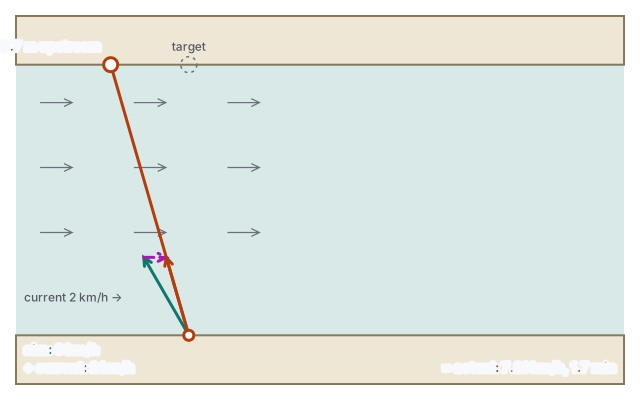
Crossing a river: where you aim vs. where you end up
Your speed and the current add as arrows. Aim straight across and you drift; aim upstream and you can land right on target.
 Start here
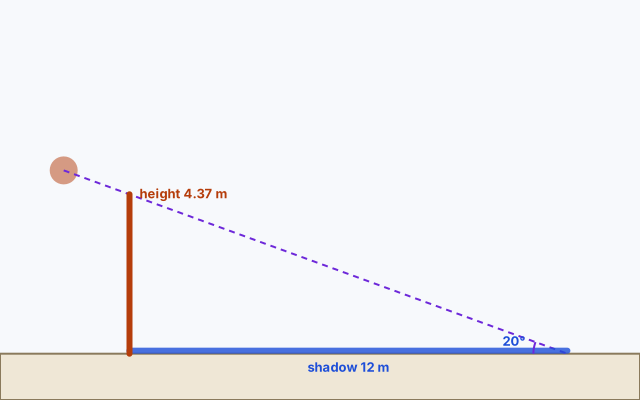
How tall is that tree? Measure its shadow
One shadow and the sun’s angle give you the height, no climbing needed.
 Go further
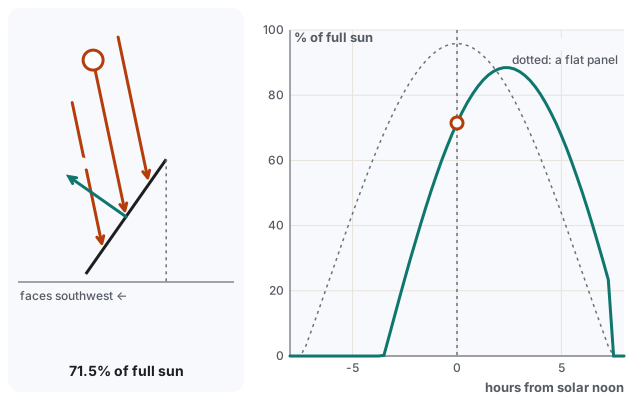
Solar panel tilt: how much sunlight it catches
Point one arrow at the sun and one straight out of the panel. Their dot product is the share of full sunlight the panel gets.
 Also try
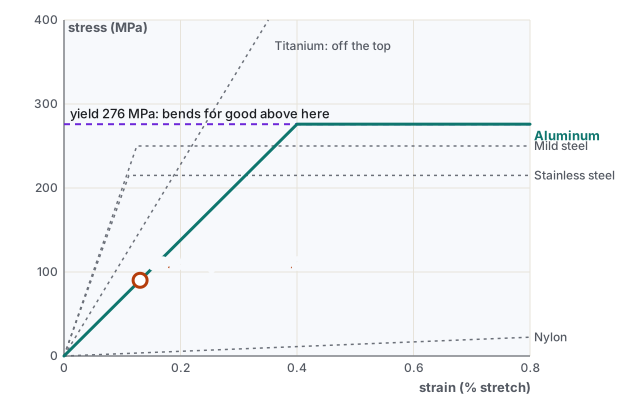
Stress and strain: how much does a rod stretch under a load?
Stress is force per area. Divide by the material’s stiffness and you get the stretch, until it yields and stays bent.
Questions people ask
Why does a tight hammock pull so hard?
Only the upward part of each strap holds you up. A nearly flat strap has a tiny upward part, so the whole pull has to be huge to add up to your weight.
Which strap works harder in a lopsided hang?
The steeper one. The sideways pulls must cancel, and a steep strap needs more total pull to match the flatter strap's sideways part.
Does this apply to clotheslines and slacklines?
Yes. A small sag in the middle means very high tension at the ends, which is why tight lines need strong anchors.