Why do you drift downstream when you paddle straight across a river?
Your velocity through the water and the current's velocity add as arrows. Paddling straight across at 6 km/h in a 3 km/h current, you really move at a slant and land 50 meters downstream on a 100-meter river. Aim 30° upstream and the current's push is cancelled, so you land right on target.
- Where you land, downstream of your target
- -57.7 m
- Time to cross
- 104 s
- Speed over the ground
- 7.21 km/h
- Aim that lands straight across
- 14.5°
Challenge: Land within 2 m of the target in a current at least 70% as fast as you.
More settings
Play
Start with the kayak aimed straight across, then slide the aim upstream until you hit the target.
Challenge: Land within 2 m of the target in a current at least 70% as fast as you. The box under the picture turns green when you get it.
Stuck? Pick one of the examples from the “Try an example” menu, or press “New example.”
Understand
Velocities are vectors: arrows with a size and a direction. Your speed through the water points where you aim, and the current points downstream. What you actually do is their sum:
The arrows at the start show it: your aim, plus the current, gives the actual path. Only the across part of that arrow gets you to the other bank, and the downstream part sets how far you drift.
Use
Every input has a unit menu, so you can type values in the units you already have. Results follow your units.
Show the work
- Your velocity through the water, split into across and downstream parts
\vec v_{\text{you}} = (b\cos\theta,\ -b\sin\theta) = (6.93,\ -4)\ \text{km/h} - Add the current (all downstream)
\vec v = (8\cos 30^\circ,\ 2 - 8\sin 30^\circ) = (6.93,\ -2)\ \text{km/h} - Only the across part gets you over
t = \frac{w}{v_x} = \frac{200\ \text{m}}{1.92\ \text{m/s}} = 104\ \text{s} - Meanwhile the downstream part carries you along
\text{drift} = v_y\,t = -57.7\ \text{m} - To land straight across, cancel the current
\sin\theta = \frac{c}{b} = 0.25 \Rightarrow \theta = 14.5^\circ
Export
Slide your aim, speed, and the current. "More settings" changes the river's width.
- This treats the current as the same everywhere. Real rivers flow faster in the middle than near the banks.
For learning and estimation. Verify with applicable codes, standards, and a qualified professional before using in design, construction, or safety-critical work.
Cheat card
| Symbol | Meaning | Unit |
|---|---|---|
| your speed through the water | km/h | |
| current speed | km/h | |
| river width | m | |
| aim, upstream of straight across | ° |
- Pointing straight across always crosses fastest, but you drift.
- Landing straight across takes longer, because some of your effort fights the current.
- If the current is faster than you, no aim lands straight across.
Where it’s used
- Aerospace
Pilots do the same math with wind, called a wind correction angle. - Physics
Relative velocity problems, from boats to raindrops on a moving car, all add arrows. - Driving & Travel
Kayakers and ferry captains aim upstream to land where they mean to.
Related exhibits
 Start here
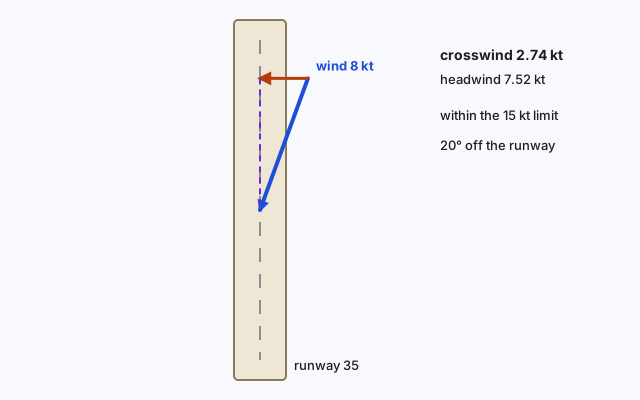
Crosswind landing: splitting the wind into two parts
Pilots break the wind into “along the runway” and “across it.” That’s vector math at 60 knots.
 Start here
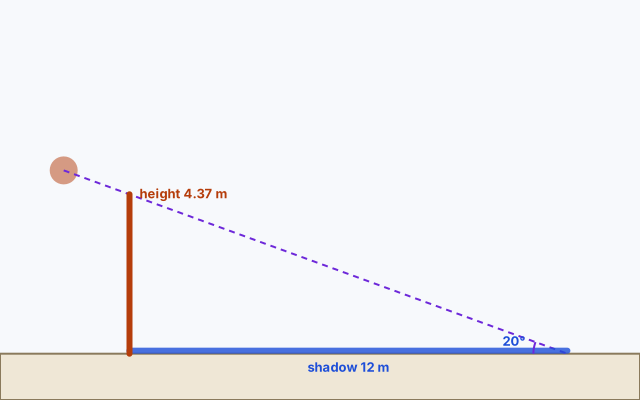
How tall is that tree? Measure its shadow
One shadow and the sun’s angle give you the height, no climbing needed.
 Go further
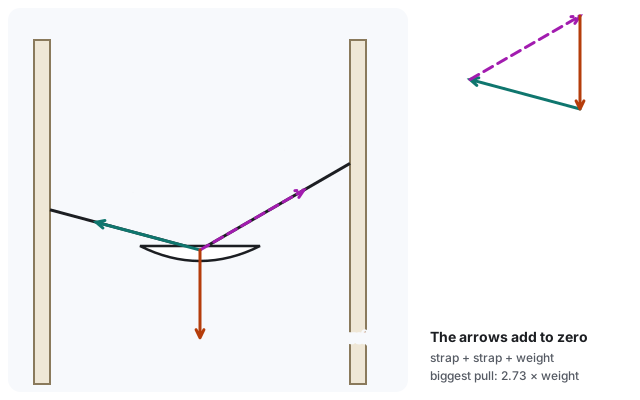
Hanging a hammock: why the 30° rule works
Your weight and the two strap pulls are arrows that must add to zero. Hang it tight and flat, and each strap pulls with several times your weight.
 Also try
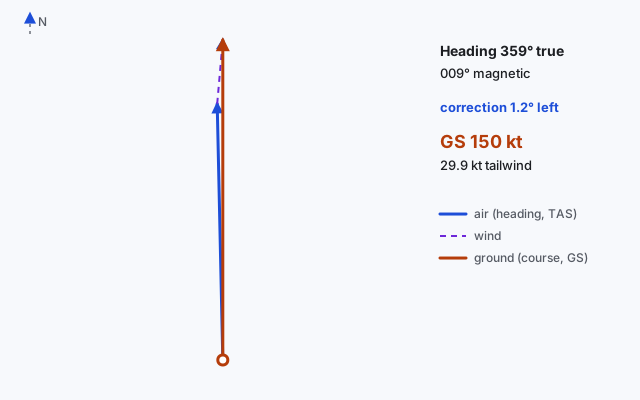
E6B wind triangle: heading and groundspeed
Point the nose into the wind just enough to track your course. Three vectors, one triangle.
Questions people ask
What is the fastest way to cross a river?
Point straight at the far bank. Only the across part of your speed gets you over, and pointing straight across makes it as big as possible. You'll just land downstream.
How do I land directly across from where I started?
Aim upstream at the angle whose sine is the current's speed divided by yours. Then your upstream push exactly cancels the current.
What if the current is faster than I can swim?
You can't land straight across. Don't fight it head-on. Float on your back with your feet pointed downstream, and work across it at an angle toward the bank.