How much will a steel rod stretch under a load?
Stress is the force divided by the cross-section area. Strain is the stress divided by the material's stiffness, Young's modulus. Multiply strain by the length to get the stretch. A 12 mm steel rod holding 500 kg stretches about 0.4 mm over 2 meters, far below the stress where steel bends for good.
- Stress
- 90.2 MPa
- Stretch
- 3.92 mm
- Strain
- 0.131%
- Safety factor (yield ÷ stress)
- ×3.06
Lifting and rigging rules usually call for a safety factor of 4 to 5 or more, and rated hardware already includes it. Use rated gear for real lifts.
Challenge: Hold 1,000 kg on a rod 12 mm or thinner with a safety factor of at least 4.
More settings
Play
Hang 500 kg on a 12 mm steel rod, then switch to aluminum and nylon.
Challenge: Hold 1,000 kg on a rod 12 mm or thinner with a safety factor of at least 4. The box under the picture turns green when you get it.
Stuck? Pick one of the examples from the “Try an example” menu, or press “New example.”
Understand
Pulling on a rod spreads the force over its cross-section. That's stress: . The material answers with strain, a stretch in proportion to the stress:
That's Hooke's law for materials. , Young's modulus, is the material's stiffness, the slope of each line. Steel is steep, aluminum is a third as steep, and nylon barely rises.
Each line bends over at the yield strength. Below it, the rod springs back. Above it, it stays stretched.
Use
Every input has a unit menu, so you can type values in the units you already have. Results follow your units.
Show the work
- Weight becomes force
F = mg = 260 \times 9.807 = 2550\ \text{N} - Cross-section area of the rod
A = \frac{\pi d^2}{4} = 28.27\ \mathrm{mm^2} - Stress: force per area
\sigma = \frac{2550}{\pi (0.006)^2/4} = 90.18\ \text{MPa} - Strain: Hooke’s law for materials, ε = σ/E
\varepsilon = \frac{90.18\ \text{MPa}}{69\ \text{GPa}} = 0.1307\% - Stretch
\Delta L = \varepsilon L = 0.001307 \times 3\ \text{m} = 3.921\ \text{mm} - Safety factor against yielding
\frac{276}{90.18} = 3.061
Export
Set the load, material, and diameter. "More settings" changes the length.
- Material values are typical for one common grade. Real parts vary with grade and treatment.
- This is a straight pull on a solid rod. Bending, threads, and welds concentrate stress and need their own checks.
For learning and estimation. Verify with applicable codes, standards, and a qualified professional before using in design, construction, or safety-critical work.
Cheat card
| Symbol | Meaning | Unit |
|---|---|---|
| stress | MPa | |
| strain (stretch ÷ length) | ||
| Young's modulus (stiffness) | GPa | |
| yield strength | MPa |
- Doubling the diameter quarters the stress, because area grows with the square.
- Stiffness (E) sets the stretch. Strength (yield) sets when it bends for good. They're different.
- Aluminum is about a third as stiff as steel, so it stretches about three times as much.
Where it’s used
- Civil & Construction
Engineers size tie rods, hangers, and bolts so the stress stays well under yield. - Mechanical
Bolts are tightened to a set stretch, which clamps parts with a known force. - Home Projects
Check a hanging rod, a garage hoist bracket, or a guy wire before you trust it.
Related exhibits
 Start here
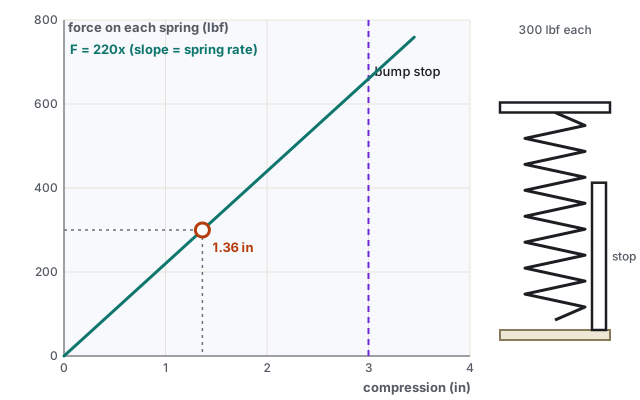
Hooke’s law: how far does the car sag when you load it?
A spring squeezes in a straight line with the load: twice the weight, twice the sag, until it hits the stops.
 Start here
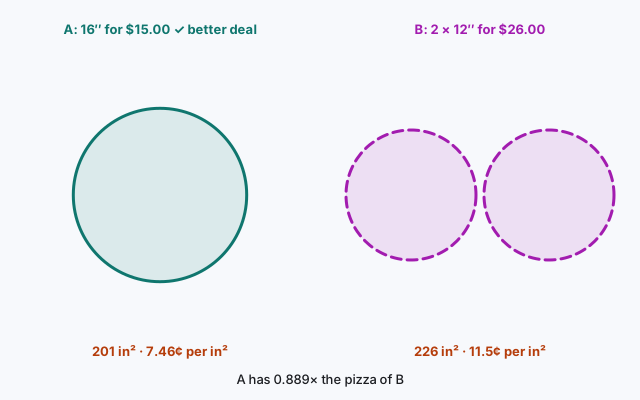
Pizza value: one large or two mediums?
Area grows with the square of the size. That changes which pizza is the deal.
 Also try
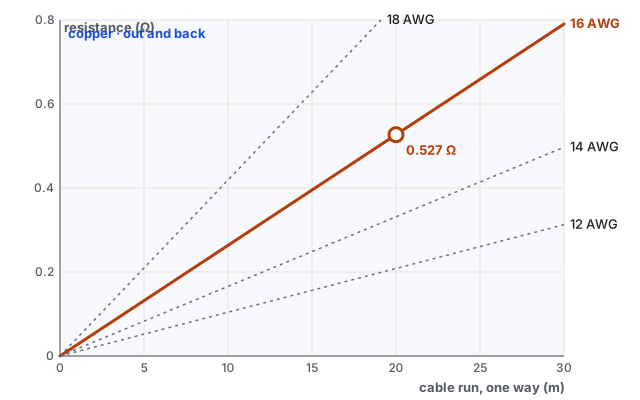
Wire resistance: longer and thinner resist more
Resistance grows with length and shrinks with thickness. Pick the wire that keeps it low.
Questions people ask
What's the difference between stress and strain?
Stress is how hard the material is being pulled, as force per area. Strain is how much it stretches, as a fraction of its length. Young's modulus links them.
What is yield strength?
The stress where the material stops springing back. Above it, the rod stretches permanently and may go on to break.
Is a steel cable the same as a steel rod?
No. Wire rope is many twisted strands, so it stretches more than a solid rod and is rated differently. Use the manufacturer's working load limit for cables.