Why do I need to know how many amps an appliance draws?
Current decides whether a circuit is safe. An appliance's watts divided by the supply voltage gives its amps, and that number must stay below the breaker's rating, ideally under 80 percent for things that run for hours. Knowing the amps also tells you how thick the wire must be and how much voltage it will lose.
- Current
- 435 mA
- Power
- 100 W
- Supply voltage
- 230 V
Challenge: Find a load between 75% and 80% of the breaker — as much as you can safely run for hours.
More settings
Play
Pick an appliance's wattage and your voltage. Watch the dot move toward the breaker line.
Challenge: Find a load between 75% and 80% of the breaker — as much as you can safely run for hours. The box under the picture turns green when you get it.
Stuck? Pick one of the examples from the “Try an example” menu, or press “New example.”
Understand
Power is voltage times current, . Rearranged for current:
At a fixed voltage, current grows in a straight line with power. The orange line on the graph is that relationship, and the dot is your appliance. The dashed lines mark the breaker's rating and the 80% level for continuous loads.
Use
Every input has a unit menu, so you can type values in the units you already have. Results follow your units.
Show the work
- Power = voltage × current
P = VI ;\Rightarrow; I = \frac{P}{V} - With your numbers
I = \frac{100\,\mathrm{W}}{230\,\mathrm{V}} = 0.4348\,\mathrm{A} - 80% breaker check
0.8 \times 16\,\mathrm{A} = 12.8\,\mathrm{A}
Export
Read the watts from the appliance label, and use your supply voltage (120 V or 240 V in North America, 230 V in most other places, 12 V for vehicles).
- For several appliances on one circuit, add their currents.
- Link the current into the voltage-drop exhibit to check the wire.
For learning and estimation. Verify with applicable codes, standards, and a qualified professional before using in design, construction, or safety-critical work.
Cheat card
| Symbol | Meaning | Unit |
|---|---|---|
| current | A | |
| power from the label | W | |
| supply voltage | V |
- The same appliance draws half the current on 240 V that it draws on 120 V.
- Motors and compressors draw several times more current for a moment when they start.
- Several appliances on one circuit add their currents.
Where it’s used
- Electrical & Electronics
Electricians total the current of every load on a circuit to size breakers and wire. - Trades
RV and solar installers size inverters and fuses from watts and battery voltage. - Home Projects
It explains why a space heater and a microwave on one kitchen circuit trip the breaker.
Related exhibits
 Start here
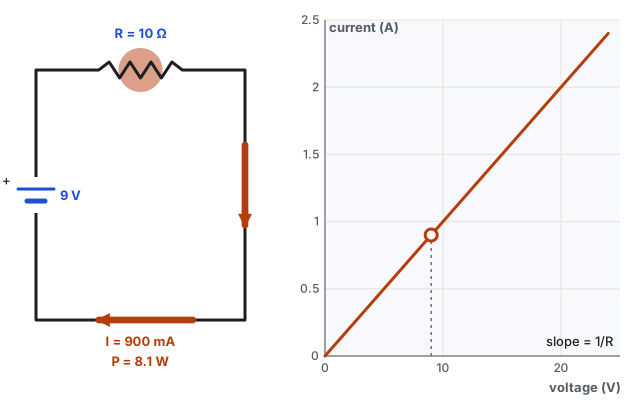
Ohm’s law: how much current flows?
Push harder (volts) or squeeze tighter (ohms), and watch the current change.
 Go further
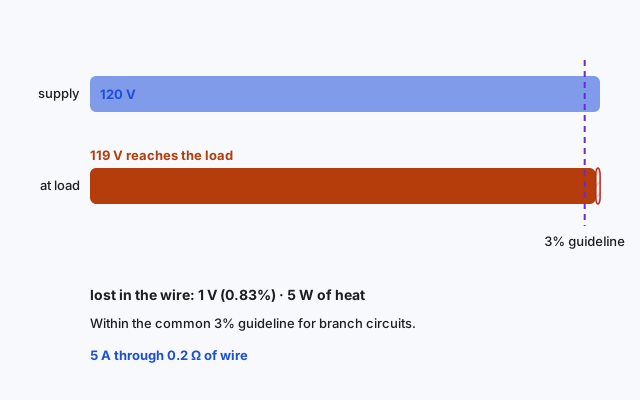
Voltage drop: what the wire takes before the load gets it
Current times wire resistance is voltage you never get to use.
 Go further
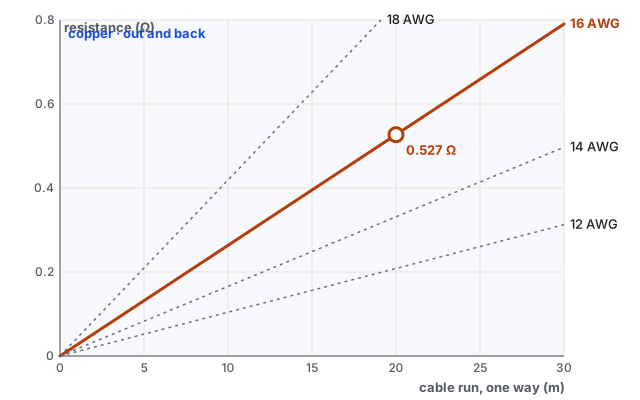
Wire resistance: longer and thinner resist more
Resistance grows with length and shrinks with thickness. Pick the wire that keeps it low.
- Also try
Ohm’s law: how much current flows?
Push harder (volts) or squeeze tighter (ohms), and watch the current change.
Questions people ask
How do I convert watts to amps?
Divide the watts by the voltage. A 1,500 W heater on 120 V draws 1500 ÷ 120 = 12.5 A.
Why the 80% rule?
Breakers and wire are sized for their full rating in short bursts. For loads running three hours or more, electrical codes limit the current to 80% of the breaker rating to keep things cool.
Does a 240 V appliance use less power?
No, it uses the same watts. It just draws half the current, which lets it use thinner wire.