Why do I need Ohm's law to check voltage drop in a wire?
Wire has resistance, so current flowing through it loses some voltage before it reaches the load. Ohm's law gives that loss: current times the wire's resistance. Too much drop dims lights, slows motors, and wastes power as heat. Electricians usually keep the drop under about 3 percent of the supply.
- Voltage drop
- 1 V
- Drop (% of supply)
- 0.833%
- Power lost as heat
- 5 W
- Voltage at the load
- 119 V
Challenge: Keep the drop within 3%. Done!
Play
Raise the current or the wire resistance. Watch the hatched part of the bar — voltage lost in the wire — grow.
Challenge: Keep the drop within 3%. The box under the picture turns green when you get it.
Stuck? Pick one of the examples from the “Try an example” menu, or press “New example.”
Understand
The wire is just another resistor in the circuit, in series with the load. Ohm's law applies to it too:
The top bar is the supply. The bottom bar is what reaches the load. The hatched part is lost in the wire. The dashed line marks the common 3% guideline.
Heat in the wire grows with the square of the current, , so a heavy load on thin wire gets expensive and warm fast.
Use
Every input has a unit menu, so you can type values in the units you already have. Results follow your units.
Show the work
- Ohm’s law on the wire
\Delta V = IR = 5 \times 0.2 = 1\,\mathrm{V} - As a percent of supply
\frac{1}{120} \times 100 = 0.8333\% - Heat in the wire
P = I^2R = (5)^2 \times 0.2 = 5\,\mathrm{W}
Export
Enter the current (or link it from the appliance-current exhibit) and the wire resistance (or link it from the wire-resistance exhibit).
- Use the resistance of both conductors, out and back.
- Motors want less drop than heaters. Some equipment needs 2% or less.
For learning and estimation. Verify with applicable codes, standards, and a qualified professional before using in design, construction, or safety-critical work.
Cheat card
| Symbol | Meaning | Unit |
|---|---|---|
| voltage lost in the wire | V | |
| current | A | |
| resistance of both conductors | Ω | |
| supply voltage | V |
- Low-voltage systems (12 V) feel voltage drop far more than 120 V circuits.
- Heat loss grows with the square of current. Double the current, four times the heat.
- Fixes are thicker wire, shorter runs, or a higher supply voltage.
Where it’s used
- Electrical & Electronics
Electricians check voltage drop on long branch circuits and feeders, often to a 3% or 5% limit. - Trades
Solar and RV installers size battery cables so 12 V systems don't lose half their voltage. - Home Projects
It's why a tool on a long, thin extension cord runs weak and the cord gets warm.
Related exhibits
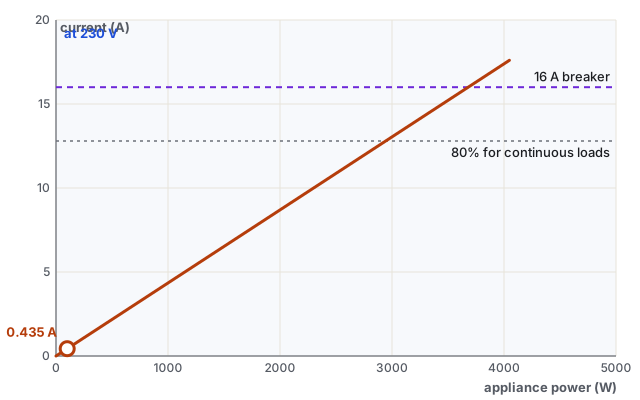 Start here
How many amps does it draw?
Watts divided by volts gives amps. That decides the breaker and the wire.
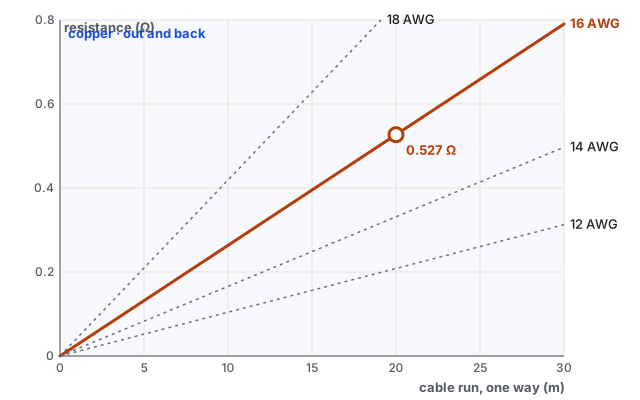 Start here
Wire resistance: longer and thinner resist more
Resistance grows with length and shrinks with thickness. Pick the wire that keeps it low.
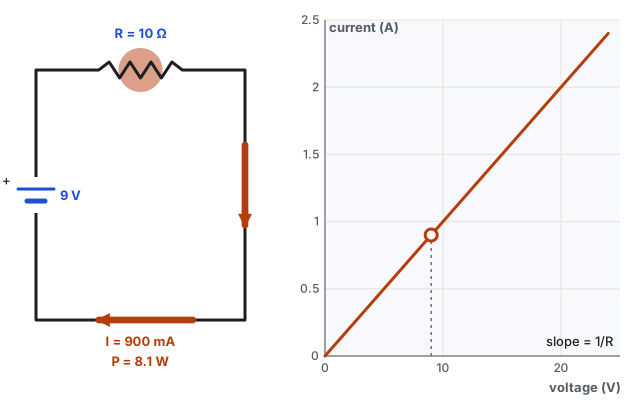 Also try
Ohm’s law: how much current flows?
Push harder (volts) or squeeze tighter (ohms), and watch the current change.
Questions people ask
How do I calculate voltage drop?
Multiply the current by the resistance of both wires. 12.5 A through 0.16 Ω drops 2 V.
How much voltage drop is acceptable?
A common guideline is 3% for a branch circuit and 5% total from the service to the load. Check your local code.
Where does the lost voltage go?
It becomes heat in the wire, I²R watts of it. That's why undersized wire runs warm.