How does PageRank decide which pages rank higher?
Every link is a vote, and a page splits its own importance evenly among the pages it links to. Start everyone equal, pass the votes around again and again, and the shares settle. That settled share is PageRank. One link from an important site like the local news is worth far more than one from a site nobody links to.
- Your bakery’s share of the rank
- 12.9%
- Your bakery’s place (of 5)
- 4
- Change on the last round
- 0.00111%
Challenge: Make your bakery the top-ranked page of the five.
More settings
Play
Start with no links, then add the coupon site, then the local news. Compare the jumps.
Challenge: Make your bakery the top-ranked page of the five. The box under the picture turns green when you get it.
Stuck? Pick one of the examples from the “Try an example” menu, or press “New example.”
Understand
Imagine a surfer clicking links forever. Most of the time they follow a link from the page they're on, and sometimes they jump to a random page. PageRank is the share of time they spend on each page.
Each round, a page passes its share, split evenly, to the pages it links to:
That's a matrix times a vector, done over and over until it stops changing. The chart on the right shows your bakery's share settling.
Use
Every input has a unit menu, so you can type values in the units you already have. Results follow your units.
Show the work
- Start: every page gets an equal share
r_i = \tfrac{1}{5} = 20\% - Each round, a page splits its share evenly among its outgoing links
r_i \leftarrow \frac{1 - d}{n} + d\sum_{j \to i} \frac{r_j}{L_j},\quad d = 0.85 - As a matrix: multiply the rank vector by the link matrix, again and again
\mathbf{r} \leftarrow \frac{1 - d}{n}\mathbf{1} + d\,M\mathbf{r} - For your bakery
r_{\text{bakery}} = \frac{1 - 0.85}{5} + 0.85\sum_{j \to \text{bakery}} \frac{r_j}{L_j} - After 20 rounds
r_{\text{bakery}} = 12.88\%,\ \text{settling at } 12.88\%
Export
Switch on links to your bakery and watch the circles resize. "More settings" changes the damping and how many rounds to run.
- This is a five-page toy web. Real search ranking uses many more signals than links.
For learning and estimation. Verify with applicable codes, standards, and a qualified professional before using in design, construction, or safety-critical work.
Cheat card
| Symbol | Meaning | Unit |
|---|---|---|
| rank of page i (shares add to 1) | ||
| damping: chance of following a link | ||
| number of links out of page j | ||
| number of pages |
- A link from a page with few outgoing links passes on more.
- Linking out shares your rank. It isn't lost to the web, but your own share can dip.
- The settled ranks are an eigenvector of the link matrix.
Where it’s used
- Computer Science
Google’s first ranking algorithm ranked the whole web this way. - Finance & Business
The same idea ranks influence in citation networks and supply chains. - Money & Shopping
For a small business site, one link from a respected local page beats many from low-quality ones.
Related exhibits
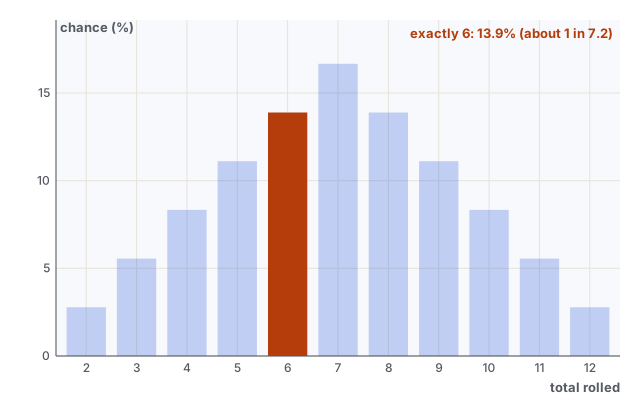 Start here
Dice odds: what are my chances of rolling it?
Why 7 shows up so often with two dice, and what that means for your next move.
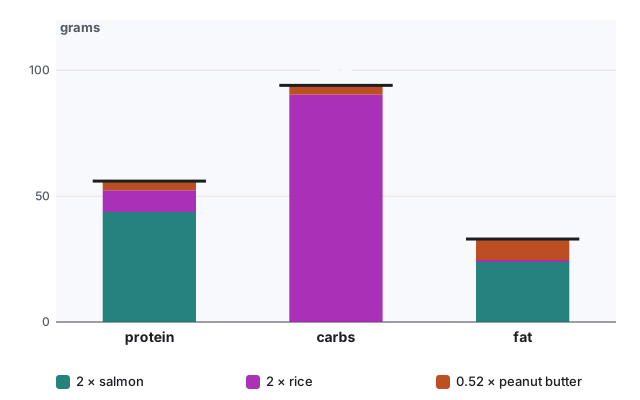 Start here
Hitting your macros: how much of three foods?
Protein, carbs, and fat are three equations, and three foods are three unknowns. A matrix solves all of them at once.
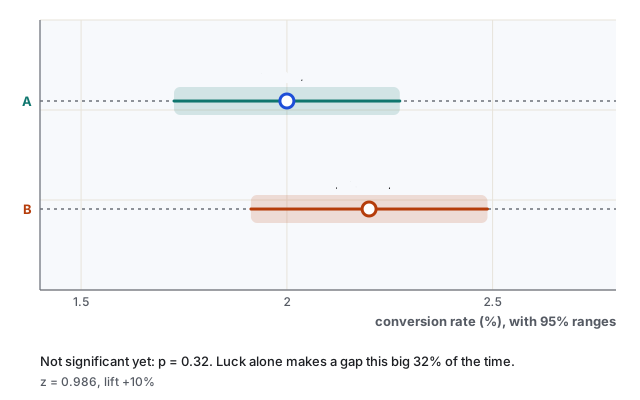 Also try
A/B test: is version B really better, or just lucky?
A higher conversion rate might be chance. The z-test turns the gap and the sample size into a p-value.
Questions people ask
What is PageRank?
A score for each page equal to the share of time a random surfer would spend there. They follow links most of the time and jump to a random page the rest.
Is this how Google ranks pages today?
Only partly. PageRank was the original idea, and links still matter, but modern search uses many more signals, like content, relevance, and page experience.
What is the damping factor?
The chance the surfer follows a link instead of jumping somewhere random. The original paper used 0.85. It also keeps pages with no links from trapping all the rank.