What is aliasing in digital audio, and why do CDs use 44.1 kHz?
Digital audio stores a sound as samples, snapshots taken thousands of times a second. A tone needs more than two samples per cycle to be captured. Anything faster folds back as a false, lower tone called an alias. CDs take 44,100 samples a second, so everything up to 22,050 Hz survives, just past the top of human hearing.
- What comes out
- 1100 Hz
- Nyquist limit (half the sample rate)
- 5510 Hz
- Samples per cycle of the tone
- ×10
Challenge: Find a tone above the limit that comes out as 1,000 Hz.
Play
Pick the telephone rate and press "Sweep the input up past the limit." The pitch climbs, then turns around and falls.
Challenge: Find a tone above the limit that comes out as 1,000 Hz. The box under the picture turns green when you get it.
Stuck? Pick one of the examples from the “Try an example” menu, or press “New example.”
Understand
Sampling keeps the wave only at . Adding a whole number of cycles between samples changes nothing the samples can see:
So every tone is indistinguishable from one inside to , the Nyquist limit. In the top graph the samples (dots) of a fast gray tone trace a slower orange wave. That's the alias. The bottom graph is the folding rule: the output rises with the input up to the limit, then folds back down, over and over.
Use
Every input has a unit menu, so you can type values in the units you already have. Results follow your units.
Show the work
- Sampling keeps only the values at t = n/fₛ. Adding any whole number of cycles per sample changes nothing
\sin\!\left(2\pi f \tfrac{n}{f_s}\right) = \sin\!\left(2\pi (f - k f_s) \tfrac{n}{f_s}\right) - So the tone that comes out is the nearest one inside 0 to fₛ/2
f_{alias} = \lvert 1103 - 0 \times 11{,}030 \rvert = 1103\ \text{Hz} - The limit: you need more than 2 samples per cycle
\frac{f_s}{2} = \frac{11{,}030}{2} = 5513\ \text{Hz}
Export
Pick a sample rate and slide the tone. The sound buttons play the alias, the original tone when you could hear it, and a sweep that climbs past the limit so you hear the pitch turn around.
- The demos play the aliased pitch directly, the way you'd hear it from a system with no filter.
For learning and estimation. Verify with applicable codes, standards, and a qualified professional before using in design, construction, or safety-critical work.
Cheat card
| Symbol | Meaning | Unit |
|---|---|---|
| sample rate | Hz | |
| tone going in | Hz |
- Above the limit, the output runs backward. Raise the input and the alias goes down.
- A tone exactly at the sample rate aliases to 0 Hz. Every sample catches the same point of the wave.
- The wagon wheels that spin backward in old movies are the same effect, with frames instead of samples.
Where it’s used
- Music & Sound
Recorders filter out everything above the Nyquist limit before sampling, so aliases never get in. - Computer Science
Phone calls sample at 8 kHz, which is why voices sound thin: everything above 4 kHz is cut. - Music
Cheap digital distortion can sound harsh because its new harmonics pass the limit and fold back as clashing tones.
Related exhibits
 Start here
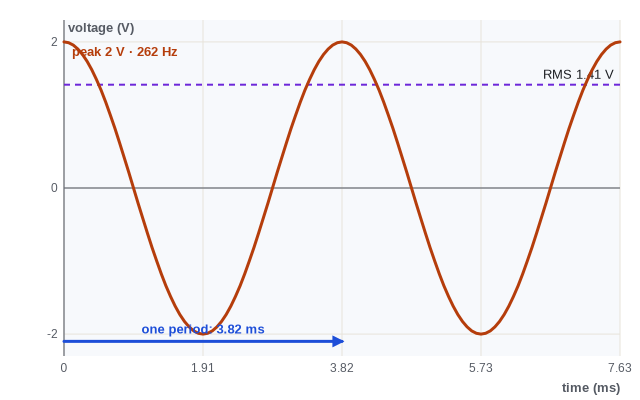
Sine waves: wall power and musical notes
The outlet and a tuning fork follow the same curve: amplitude, frequency, and phase.
 Go further
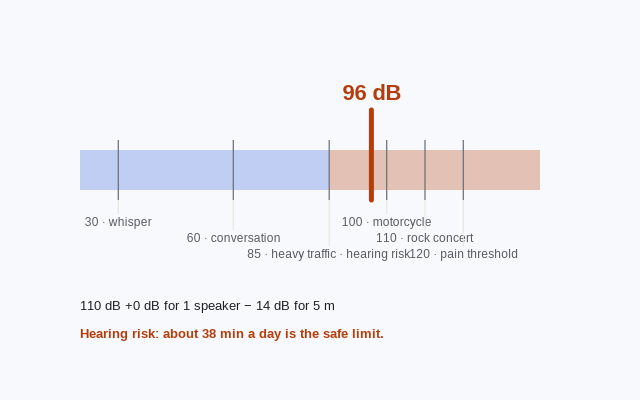
Decibels: why two speakers aren’t twice as loud
Sound is measured on a log scale. Double the speakers: +3 dB. Double the distance: −6 dB.
 Also try
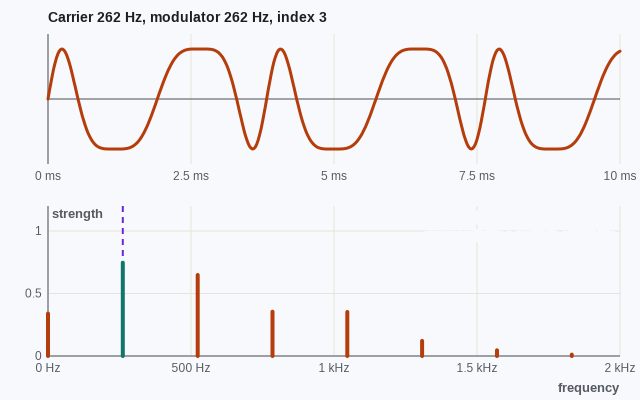
FM synthesis: bells and brass from two sine waves
Wiggle one sine wave’s timing with another and a whole spectrum appears. The ratio decides bell or brass; the index decides how bright.
 Also try
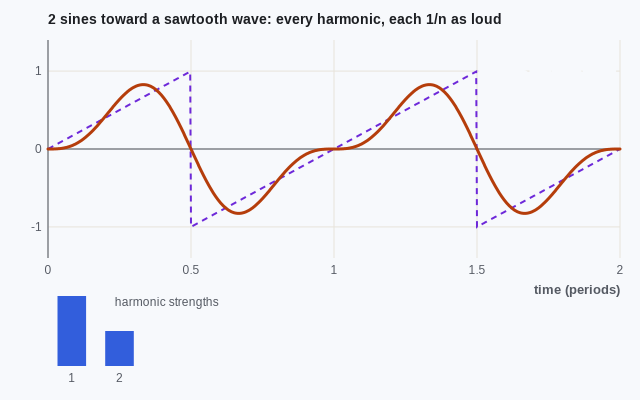
Building a square wave out of sine waves
Add sines at 1, 3, 5, 7 … times the pitch, each a little quieter, and a square wave appears. That’s how synths and your ear think about timbre.
Questions people ask
Why 44.1 kHz and not 40 kHz?
People hear up to about 20 kHz, and the filter that blocks aliases needs a little room to roll off. 44.1 kHz puts the limit at 22.05 kHz. The exact number came from early digital recorders that stored audio on video tape.
What is the Nyquist frequency?
Half the sample rate, the highest tone a system can record correctly. Anything above it folds back below it.
Do higher sample rates sound better?
For listening, 44.1 kHz already covers human hearing. Higher rates help inside studio software, where effects create harmonics that would otherwise alias.
Updated : First published.