How does FM synthesis make bell and brass sounds from sine waves?
FM synthesis uses one sine wave to push another's timing back and forth. That splits the note into many frequencies, spaced by the modulator's frequency. When the two frequencies are a whole-number ratio, the new lines are harmonics and the result sounds pitched, like brass. Odd ratios give clashing lines that sound like bells.
- Sidebands you can hear (above 1%)
- 8
- Sideband spacing (the modulator)
- 262 Hz
- Bandwidth (Carson’s rule)
- 2090 Hz
Challenge: Make an inharmonic sound with at least 10 audible lines.
Play
Try the bell preset, then press "Struck, fading like a bell." Slide the ratio toward 1 and hear it turn into a pitched note.
Challenge: Make an inharmonic sound with at least 10 audible lines. The box under the picture turns green when you get it.
Stuck? Pick one of the examples from the “Try an example” menu, or press “New example.”
Understand
Put a sine wave inside the timing of another sine wave:
The trigonometry works out to a whole set of sines at , each as strong as the Bessel function . The spectrum graph shows those lines. When is a whole number, every line is a harmonic of one note. When it isn't, the lines clash, and you hear a bell.
Use
Every input has a unit menu, so you can type values in the units you already have. Results follow your units.
Show the work
- One sine wave pushes the other’s timing back and forth
y = \sin\!\left(2\pi \cdot 261.6\,t + 3 \sin 2\pi \cdot 261.6\,t\right) - That splits the note into lines at the carrier plus or minus whole multiples of the modulator
f = 261.6 \pm k \times 261.6\ \text{Hz} - Each line’s strength is a Bessel function of the index
J_0(3) = -0.26,\ J_1(3) = 0.339,\ J_2(3) = 0.486,\ J_3(3) = 0.309 - Carson’s rule for how wide the sound spreads
2(\beta + 1) f_m = 2(3 + 1) \times 261.6 = 2093\ \text{Hz}
Export
Pick a carrier note, then slide the ratio and the index. The sound buttons play a held note, a struck note that fades like a bell, and the index rising from 0 so you can hear the sidebands appear.
- Hardware FM synths change the index over the life of each note. These demos hold it fixed so you can hear one setting at a time.
For learning and estimation. Verify with applicable codes, standards, and a qualified professional before using in design, construction, or safety-critical work.
Cheat card
| Symbol | Meaning | Unit |
|---|---|---|
| carrier, the note you hear | Hz | |
| modulator | Hz | |
| modulation index, how hard it pushes |
- The ratio picks the recipe of harmonics. The index picks how many of them you hear.
- Ratio 1 gives every harmonic, like a sawtooth. Ratio 2 gives odd ones only, like a clarinet.
- Real FM patches sweep the index down as a note fades, so the sound starts bright and mellows, just like a struck bell or a plucked string.
Where it’s used
- Music & Sound
The Yamaha DX7, the best-selling synth of the 1980s, made its electric pianos, basses, and bells this way. - Electrical & Electronics
FM radio uses the same math, with a carrier in the megahertz and the music as the modulator. - Music
The classic 1980s electric piano and countless video-game soundtracks are FM synthesis.
Related exhibits
 Start here
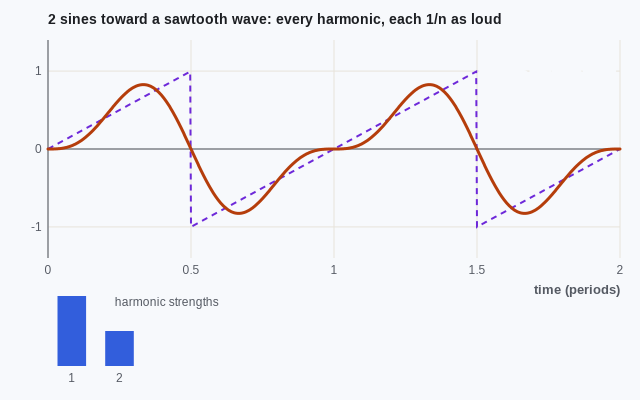
Building a square wave out of sine waves
Add sines at 1, 3, 5, 7 … times the pitch, each a little quieter, and a square wave appears. That’s how synths and your ear think about timbre.
 Go further
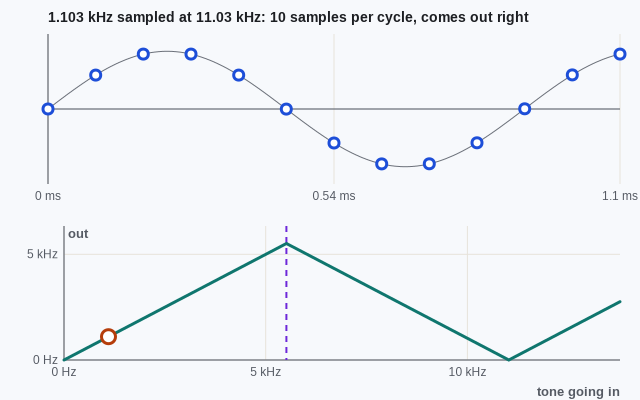
Aliasing: why CDs use 44.1 kHz
Sample a tone too slowly and the dots trace a different, lower wave. Anything above half the sample rate folds back as a wrong note.
 Also try
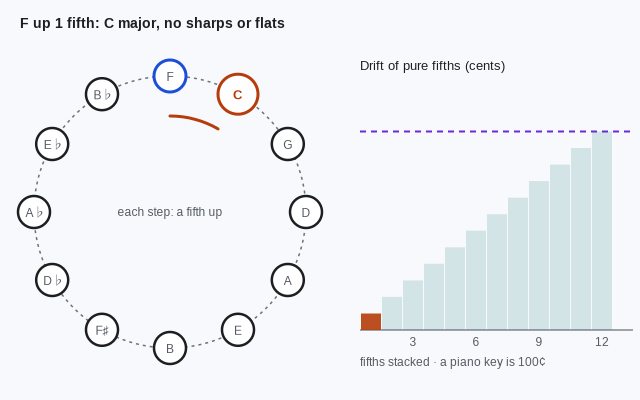
The circle of fifths that doesn’t quite close
Twelve fifths should bring you back home. With pure 3:2 fifths you overshoot by about a quarter of a semitone, and that gap is why the piano is tuned the way it is.
 Also try
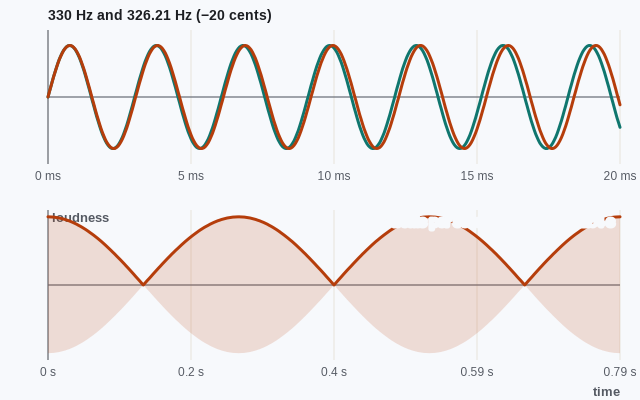
Beats and detune: hearing two notes go out of tune
Two almost-equal notes add into one that throbs. The throb rate is their difference in hertz, which is how you tune by ear and how a supersaw gets wide.
Questions people ask
What does the modulation index do?
It sets how far the carrier's timing gets pushed. At 0 you hear a pure sine. As it grows, energy spreads into more and more sidebands, so the sound gets brighter.
Why do odd ratios sound like bells?
The sidebands land at frequencies that aren't whole multiples of one fundamental. Real bells and gongs vibrate in modes like that, so our ears hear the clash as metal.
What are Bessel functions?
Special functions that show up whenever something wobbles in a circle-like way. Here they tell exactly how strong each sideband is for a given index.
Updated : First published.