What are the odds of winning the lottery, and is a ticket worth it?
Powerball's jackpot odds are 1 in 292,201,338: ways to choose 5 of 69 numbers, times 26 bonus balls. A ticket's expected value is that chance times what you'd actually keep, after the lump sum, taxes, and splitting with other winners. It's almost always far less than the $2 ticket.
- Odds of the jackpot (1 in …)
- 14,000,000
- Jackpot value of one ticket
- $0.09
- Return on the ticket price
- 8.7%
- Jackpot needed to be worth the price
- $22,999,642.48
This counts the jackpot only. Smaller prizes add a little value, and your actual tax depends on your state and the rest of your income.
Challenge: Find a Powerball drawing where the jackpot alone is worth the ticket price.
More settings
Play
Load the $500 million drawing, then raise the jackpot. Watch what the crowd of other tickets does to it.
Challenge: Find a Powerball drawing where the jackpot alone is worth the ticket price. The box under the picture turns green when you get it.
Stuck? Pick one of the examples from the “Try an example” menu, or press “New example.”
Understand
The odds come from counting. Choosing 5 of 69 numbers, when order doesn't matter, is a combination: ways. Times 26 bonus balls gives 292,201,338 possible tickets.
A ticket's expected value is the chance times what you'd keep: the lump sum, after taxes, and after splitting with anyone else who picked the same numbers. The line shows that value against the advertised jackpot, next to the ticket price.
Use
Every input has a unit menu, so you can type values in the units you already have. Results follow your units.
Show the work
- Ways to choose 6 numbers from 49 (order doesn’t matter)
\binom{49}{6} = 13{,}980{,}000 - No bonus ball
N = \binom{49}{6} = 13{,}980{,}000 - Expected number of other winning tickets
\lambda = \frac{1{,}000{,}000}{13{,}980{,}000} = 0.0715 - Share you’d keep on average if you win (splitting)
s = \frac{1 - e^{-\lambda}}{\lambda} = 0.965 - Expected value: chance × what you’d actually take home
\text{EV} = \frac{1}{13{,}980{,}000} \times 2{,}000{,}000 \times 1 \times 0.63 \times 0.965 = \$0.087
Export
Pick a game and a jackpot. "More settings" changes the lump-sum share and taxes.
- The jackpot odds are exact for these game rules. The lump-sum share and tax rates are typical, not specific to your state.
For learning and estimation. Verify with applicable codes, standards, and a qualified professional before using in design, construction, or safety-critical work.
Cheat card
| Symbol | Meaning | Unit |
|---|---|---|
| number of possible tickets (1 in N odds) | ||
| advertised jackpot | $ | |
| lump-sum share | ||
| tax rate | ||
| share kept after splitting |
- Order doesn't matter for the main numbers, so use combinations, not permutations.
- Bigger jackpots draw more tickets, so the chance of splitting grows too.
- Expected value says what a ticket is worth on average, not what will happen to you.
Where it’s used
- Finance & Business
Insurers and casinos price everything by expected value. - Finance & Business
The splitting formula comes from the Poisson distribution, used for rare events. - Money & Shopping
Compare $2 a week on tickets with $2 a week in savings.
Related exhibits
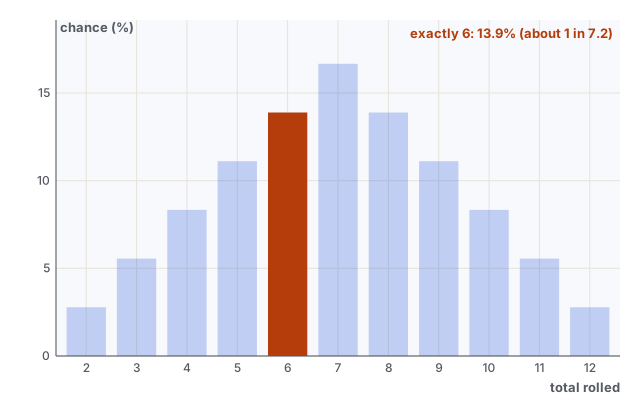 Start here
Dice odds: what are my chances of rolling it?
Why 7 shows up so often with two dice, and what that means for your next move.
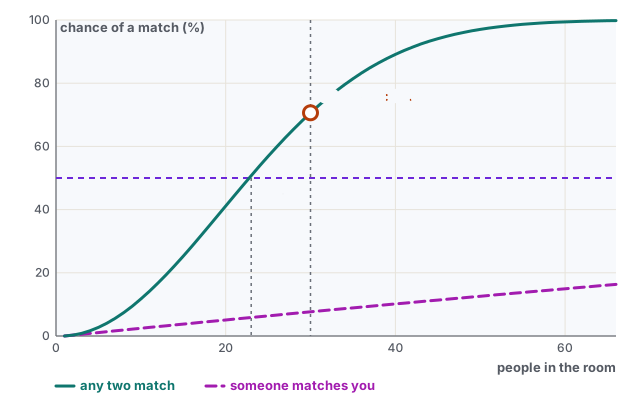 Start here
The birthday problem: 23 people is a coin flip
In a room of 23, it’s better than even that two share a birthday. Every pair is a chance, and pairs add up fast.
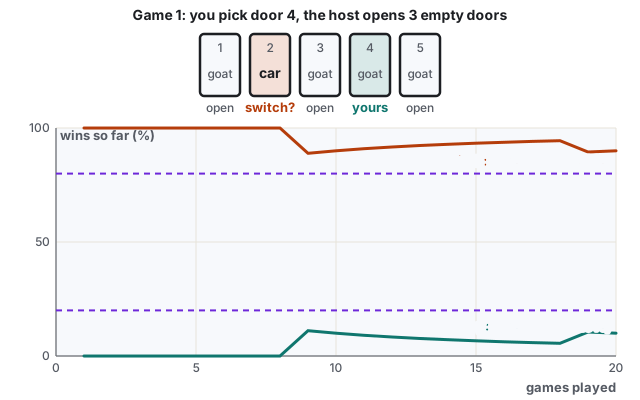 Go further
Monty Hall: should you switch doors?
Pick a door, watch the host open an empty one, then decide. Switching wins two times out of three, and here you can watch it happen.
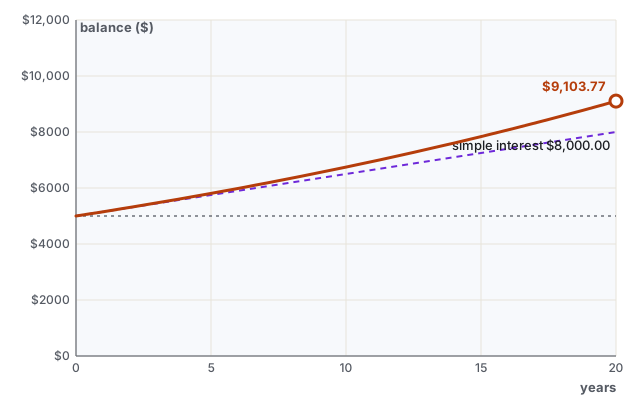 Also try
Compound interest: money that grows on itself
Interest earns interest. Exponents explain why saving early wins.
Questions people ask
How are lottery odds calculated?
Count every possible ticket. For Powerball that's C(69, 5) = 11,238,513 ways to pick five numbers, times 26 bonus balls, which is 292,201,338.
Is buying a lottery ticket ever worth it?
Mathematically, almost never. Even huge jackpots shrink a lot after the lump sum, taxes, and the chance of sharing with other winners.
Does buying more tickets help?
Each extra ticket adds the same tiny chance. Ten tickets make you ten times as likely to win, which is still about 1 in 29 million for Powerball.