How many people do you need for two to share a birthday?
Just 23 for a better-than-even chance, and 70 for 99.9%. It feels too small because we picture someone matching our own birthday. But 23 people make 253 pairs, and every pair is a chance. It's easiest to find the chance that nobody matches, then subtract it from 1.
- Chance two people match
- 70.6%
- Chance someone matches you
- 7.65%
- Pairs of people
- 435
- People needed for a 50% chance
- 23
Challenge: Reach a 99% chance of a shared birthday with 60 people or fewer.
Play
Slide from 10 people up to 60 and watch the curve shoot up. Compare it with the chance someone matches you.
Challenge: Reach a 99% chance of a shared birthday with 60 people or fewer. The box under the picture turns green when you get it.
Stuck? Pick one of the examples from the “Try an example” menu, or press “New example.”
Understand
It's easier to find the chance that nobody matches. The second person must miss the first, the third must miss both, and so on:
Subtract it from 1 for the chance of a match. The curve crosses 50% at just 23 people, because 23 people make 253 pairs. The lower curve is the chance that someone matches you, which rises far more slowly.
Use
Every input has a unit menu, so you can type values in the units you already have. Results follow your units.
Show the work
- Easier to find the chance of NO match: each new person must miss everyone before
P(\text{no match}) = \frac{365}{365}\times\frac{364}{365}\times\cdots = 0.2937 - Then flip it
P = 1 - \frac{365}{365}\cdot\frac{364}{365}\cdots\frac{336}{365} = 70.63\% - Why so high: count the pairs
\binom{30}{2} = \frac{30\times29}{2} = 435\ \text{pairs} - Matching you specifically: only the others count
1 - \left(\frac{364}{365}\right)^{29} = 7.648\%
Export
Set the group size and what has to match.
- Every value is treated as equally likely.
For learning and estimation. Verify with applicable codes, standards, and a qualified professional before using in design, construction, or safety-critical work.
Cheat card
| Symbol | Meaning | Unit |
|---|---|---|
| people in the room | ||
| chance at least two match |
- Count the chance of no match, then flip it. That's easier than counting all the ways to match.
- Pairs grow like n², which is why the chance climbs so fast.
- Matching you in particular needs about 253 people for 50%.
Where it’s used
- Computer Science
Programmers use it to size ID codes and hashes so two items rarely get the same one. - Biology
The same math estimates how often DNA markers match by chance. - Sports & Games
On a soccer field with both teams and the referee, it’s about even odds that two share a birthday.
Related exhibits
 Start here
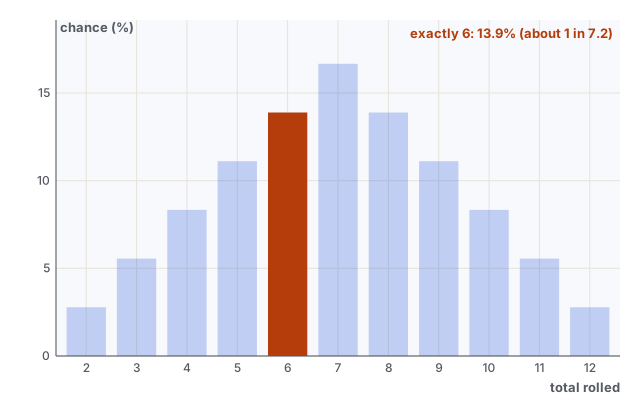
Dice odds: what are my chances of rolling it?
Why 7 shows up so often with two dice, and what that means for your next move.
 Start here
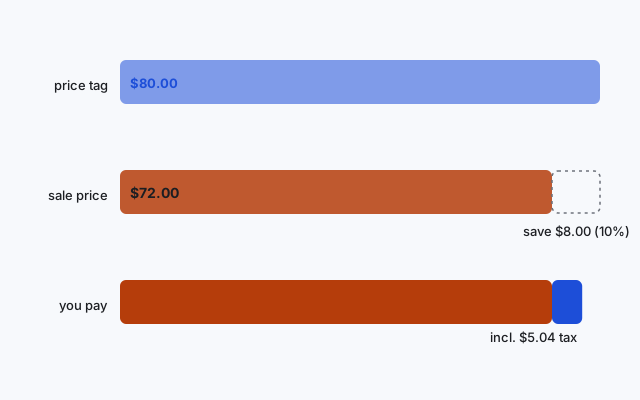
Sale price and tax: what you really pay
30% off, then tax on top. Percent math decides the number at the register.
 Go further
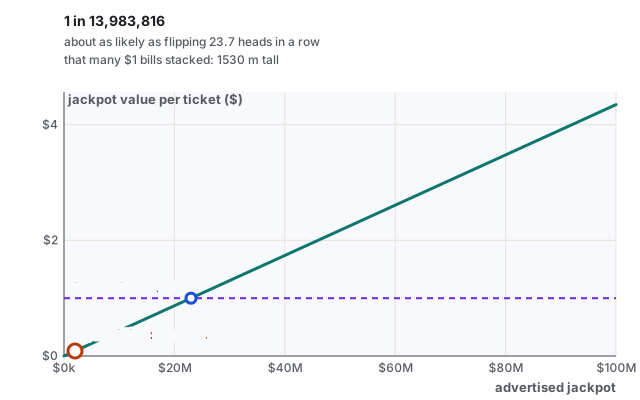
Lottery odds: what is a ticket really worth?
Powerball is 1 in 292 million. Multiply the chance by the prize, after the lump sum, taxes, and splitting, and see what $2 buys.
 Also try
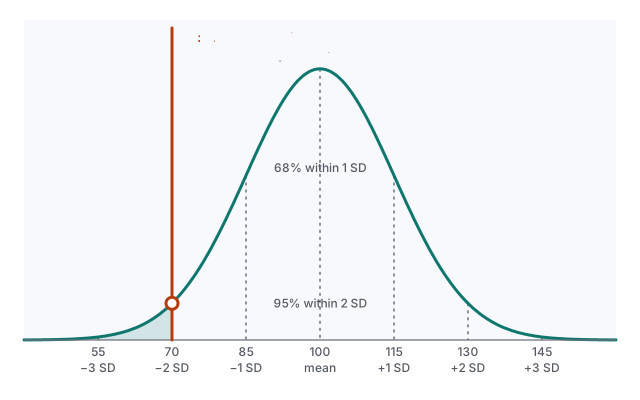
The bell curve: what percentile is that?
Count standard deviations from the average (the z-score), and the bell curve tells you what share falls below.
Questions people ask
Why is it called a paradox?
It isn't really one. It just surprises people, because we think about matching our own birthday instead of any pair in the room matching.
How many people guarantee a shared birthday?
366, ignoring leap days. With more people than days, two must share. That's the pigeonhole principle.
Does it work with real birthdays, which aren't spread evenly?
Yes, and uneven birthdays make a match slightly more likely, since some dates are more crowded.