In the Monty Hall problem, should you switch doors?
Yes. Switching wins 2 out of 3 times. Your first pick is right only 1 time in 3, and the host, who knows where the car is, always opens an empty door. So the other 2 times, the car is behind the door he left shut. Play a thousand games and the win rates settle at 67% and 33%.
- Chance switching wins
- 80%
- Chance staying wins
- 20%
- Switching wins in these games
- 90%
- Staying wins in these games
- 10%
Challenge: With 3 doors and 10 to 20 games, find a shuffle where staying beats switching. Luck can win a short run.
More settings
Play
Play 10 games, then 1,000. Then try 100 doors, where the answer becomes obvious.
Challenge: With 3 doors and 10 to 20 games, find a shuffle where staying beats switching. Luck can win a short run. The box under the picture turns green when you get it.
Stuck? Pick one of the examples from the “Try an example” menu, or press “New example.”
Understand
Your first pick is right 1 time in 3. The host knows where the car is and always opens an empty door. That reveal can't change whether your first pick was right, so staying still wins 1 time in 3.
The other 2 times in 3, the car was behind one of the doors you didn't pick. The host has opened the empty one, so it's behind the door he left shut. Switching wins those.
The lines show win rates settling as the games pile up.
Use
Every input has a unit menu, so you can type values in the units you already have. Results follow your units.
Show the work
- Your first pick is right 1 time in n
P(\text{first pick right}) = \frac{1}{5} = 20\% - The host knows where the car is and only opens empty doors, so he never changes that
\text{staying wins} \iff \text{your first pick was right} - Every other time, the car is behind the one door he left shut
P(\text{switch wins}) = \frac{5 - 1}{5} = 80\% - In the games played here
\text{switch } 18,\ \text{stay } 2\ \text{of } 20
Export
Set the doors and how many games to play. "More settings" reshuffles the games.
- Each game is a fresh random shuffle. The same shuffle number always plays the same games.
For learning and estimation. Verify with applicable codes, standards, and a qualified professional before using in design, construction, or safety-critical work.
Cheat card
| Symbol | Meaning | Unit |
|---|---|---|
| number of doors |
- The host's choice isn't random. He knows where the car is, and that's the whole trick.
- Staying wins only if your first pick was right.
- With 100 doors, picture the host opening 98 empty ones. Would you stay?
Where it’s used
- Computer Science
Simulations like this one check tricky probability by playing it out thousands of times. - Hobbies & Crafts
Settle the argument at the dinner table by playing 1,000 games. - Sports & Games
Any game where someone who knows more reveals information follows the same logic.
Related exhibits
 Start here
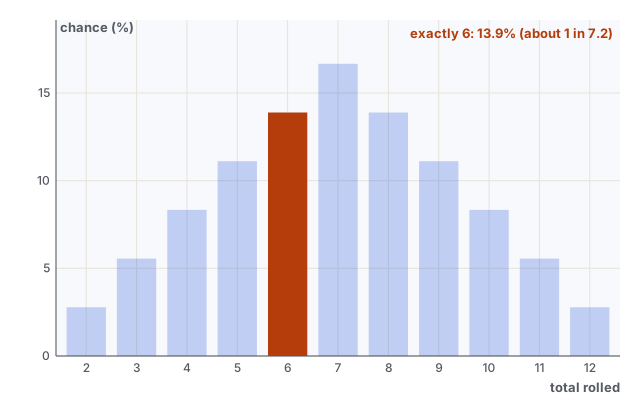
Dice odds: what are my chances of rolling it?
Why 7 shows up so often with two dice, and what that means for your next move.
 Go further
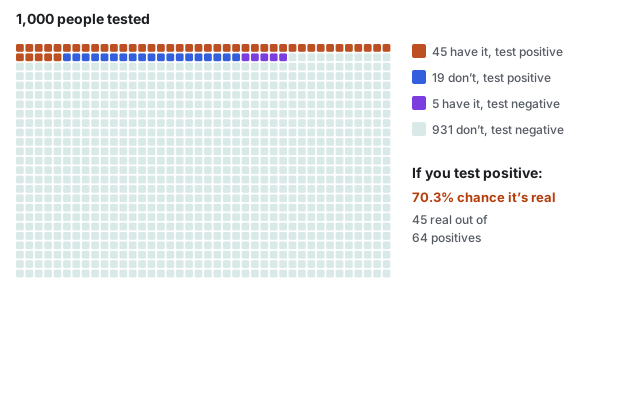
A 99% accurate test, and a positive is probably wrong
When something is rare, the few real cases are outnumbered by false alarms. Bayes’ rule counts both.
 Also try
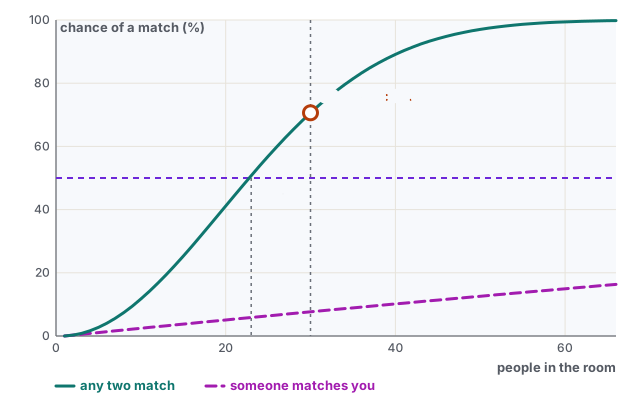
The birthday problem: 23 people is a coin flip
In a room of 23, it’s better than even that two share a birthday. Every pair is a chance, and pairs add up fast.
Questions people ask
Isn't it 50/50 once two doors are left?
No. The two doors aren't equally likely. Your door keeps its original 1-in-3 chance, because the host's reveal told you nothing new about it. The rest moves to the other door.
What if the host opened a door at random?
Then it changes. If he could accidentally reveal the car, switching and staying would each win half of the games where he didn't.
Why does 100 doors make it obvious?
Your first pick is right 1 time in 100. When the host opens 98 empty doors and leaves one shut, that door has the car the other 99 times.