How long does it take for insulation to pay for itself?
Heat saved each year is the area times heating degree days times 24, times the difference of 1 over the old R-value and 1 over the new one. Multiply by the price of delivered heat to get dollars, then divide the project cost by that. Attics with little insulation often pay back in a few years.
- Saved per year
- $105.79
- Pays for itself in (years)
- 7.56
- Heat saved per year
- 3.28 MMBtu
- Loss through that area cut by
- 50%
Using a typical price of $2.8 per gallon. Enter yours in "More settings" for a better answer.
Challenge: Find an upgrade that pays for itself in 3 years or less.
More settings
Play
Start from R-30 instead of R-11. See how much less the same project saves.
Challenge: Find an upgrade that pays for itself in 3 years or less. The box under the picture turns green when you get it.
Stuck? Pick one of the examples from the “Try an example” menu, or press “New example.”
Understand
Heat loss through a surface is proportional to . Over a whole season, the temperature difference adds up to the heating degree days (HDD), so the heat saved by insulating is
That difference of ratios is the key. shrinks fast at first and then slowly, so the first inches of insulation save the most.
The line climbs by the same savings every year. Where it crosses the project cost is the payback.
Use
Every input has a unit menu, so you can type values in the units you already have. Results follow your units.
Show the work
- Heat saved per year (BTU), then in millions
800 \times 6500 \times 24 \times \left(\frac{1}{19} - \frac{1}{38}\right) = 3.284\ \text{MMBtu} - Price of delivered heat: propane
\frac{\$2.8\ \text{per gallon}}{0.0915\ \text{MMBtu} \times 0.95} = \$32.21/\text{MMBtu} - Dollars saved per year
3.284 \times 32.21 = \$105.8 - Payback
\frac{\$800}{\$105.8/\text{yr}} = 7.562\ \text{years}
Export
Enter the R-value now and after, the area, the cost, and your climate. Pick your heating type and enter your price in "More settings," or leave it blank for a typical US price.
- This is simple payback. It ignores energy price changes and the money's other uses.
- Savings apply only to heat lost through that area. The rest of the house doesn't change.
For learning and estimation. Verify with applicable codes, standards, and a qualified professional before using in design, construction, or safety-critical work.
Cheat card
| Symbol | Meaning | Unit |
|---|---|---|
| area insulated | ft² | |
| heating degree days (°F·days per year) | ||
| R-value before and after |
- The savings depend on 1/R, so the first few inches matter most. R-11 → R-30 saves far more than R-30 → R-60.
- Seal air leaks before adding insulation. It's usually cheaper and helps just as much.
- Heat pumps deliver about 3 units of heat per unit of electricity, which shrinks the savings, and stretches the payback.
Where it’s used
- Finance & Business
Simple payback is the first test energy auditors use to rank upgrades. - Civil & Construction
Building codes set minimum R-values by climate zone using this same trade-off. - Home Projects
Decide whether topping up the attic is worth it before calling an installer.
Related exhibits
 Start here
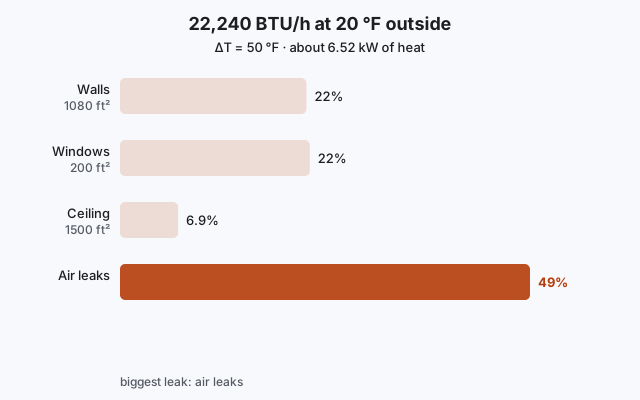
Home heat loss: where does the heat go?
Heat leaks through each surface in proportion to area and temperature difference, divided by R. Windows and drafts punch far above their size.
 Go further
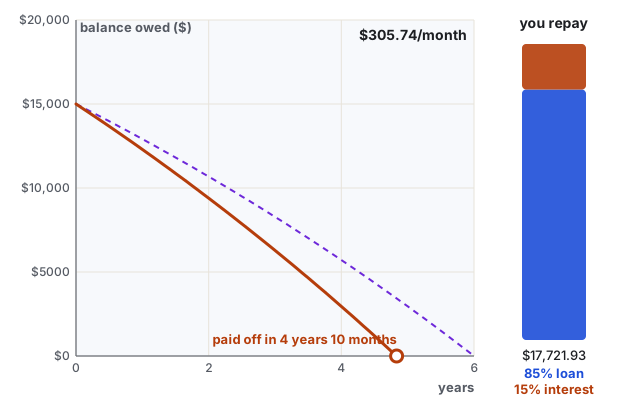
Loan payments: what a mortgage really costs
One formula sets every car, student, and home loan payment. See where the interest goes.
 Also try
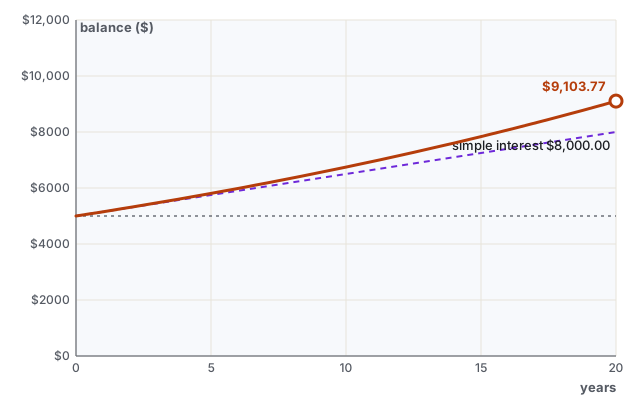
Compound interest: money that grows on itself
Interest earns interest. Exponents explain why saving early wins.
 Also try
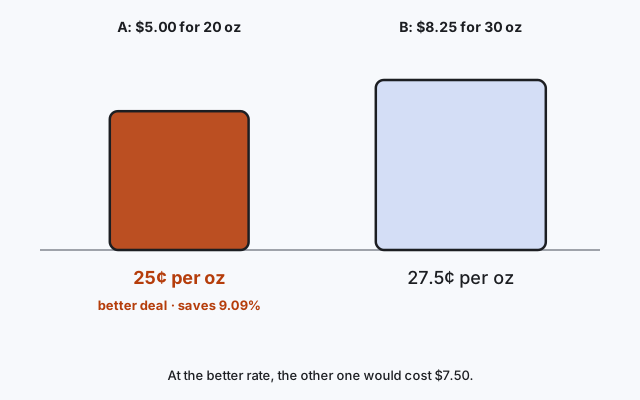
Unit price: is the big size really the better deal?
Divide price by size and the shelf tags stop lying. Bigger isn’t always cheaper.
Questions people ask
Is adding attic insulation worth it?
It usually is if you have less than about R-19 now. In a moderate climate with gas heat, going from R-11 to R-49 on a 1,500 ft² attic saves roughly $200 a year and pays back in under 10 years. Above R-30, each extra inch saves much less.
What are heating degree days?
A measure of how cold a year is. Each day, take 65 °F minus the average temperature (if it's below 65) and add them up. Cold places have 6,000 or more; mild ones about 2,000.
Why does going from R-30 to R-60 save so little?
Heat loss is proportional to 1/R. R-30 already stops most of the flow, 1/30 versus 1/11. Doubling to R-60 halves what's left, and what's left is small.