How many people does a poll need for a ±3% margin of error?
About 1,000. The margin of error is z times the square root of p(1 − p) divided by the number of people asked. At 95% confidence and a 50-50 split, 1,068 people gives ±3 points. Because of the square root, four times as many people only halves the margin.
- Margin of error (±)
- 2.96%
- Low end
- 32%
- High end
- 38%
- People needed for ±3%
- 972
The margin of error only covers the luck of who got picked. Who answers, how the question is worded, and who actually votes can add more.
Challenge: Get the margin to ±2 points or less while asking no more than 2,500 people.
More settings
Play
Start with the national poll, then try the quick online survey and the big poll.
Challenge: Get the margin to ±2 points or less while asking no more than 2,500 people. The box under the picture turns green when you get it.
Stuck? Pick one of the examples from the “Try an example” menu, or press “New example.”
Understand
A poll's share wobbles depending on who happens to be asked. The typical wobble is the standard error, . Multiply by (1.96 for 95% confidence) to get the margin of error:
The curve shows the square root at work. The margin drops fast at first, then flattens. The bar at the top shows the range, and whether it crosses 50%.
Use
Every input has a unit menu, so you can type values in the units you already have. Results follow your units.
Show the work
- Standard error: the typical wobble of a sample share
\text{SE} = \sqrt{\frac{p(1 - p)}{n}} = 0.01508 - Margin of error at 95% confidence (z = 1.96)
\text{MOE} = 1.96\sqrt{\frac{0.35(1 - 0.35)}{1000}} = 2.956\ \text{points} - Range
35\% \pm 2.956 = 32.04\%\ \text{to}\ 37.96\% - Sample size for ±3 points: solve for n
n = \frac{z^2 p(1 - p)}{0.03^2} = 972
Export
Set how many people were asked and the share who said yes. "More settings" changes the confidence level.
- This is for a simple random sample. Real polls weight their results, which usually widens the margin a little.
For learning and estimation. Verify with applicable codes, standards, and a qualified professional before using in design, construction, or safety-critical work.
Cheat card
| Symbol | Meaning | Unit |
|---|---|---|
| people asked | ||
| share answering yes | ||
| 1.645 (90%), 1.96 (95%), 2.576 (99%) |
- A 50-50 split gives the biggest margin, so pollsters plan for it.
- Halving the margin takes four times the people.
- The size of the whole population barely matters once it's much bigger than the sample.
Where it’s used
- Computer Science
Product teams size user surveys and experiments with this formula. - Medicine & Health
Researchers plan how many patients a study needs to estimate a rate precisely. - Money & Shopping
Read a poll headline and know whether a 2-point lead actually means anything.
Related exhibits
 Start here
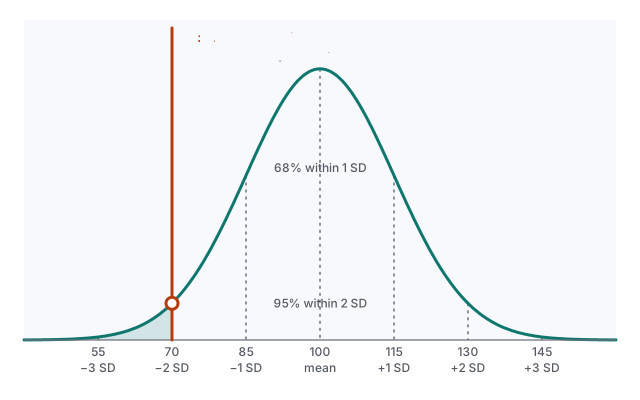
The bell curve: what percentile is that?
Count standard deviations from the average (the z-score), and the bell curve tells you what share falls below.
 Start here
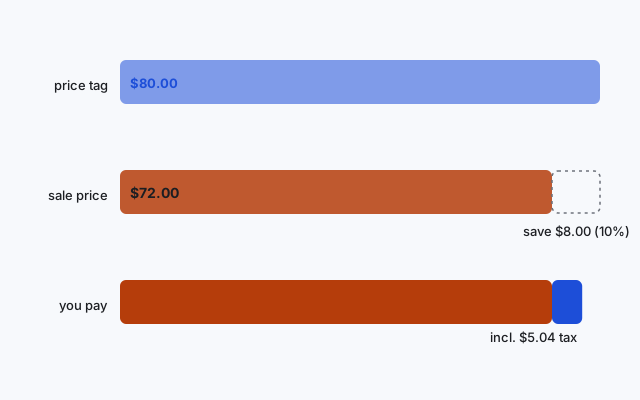
Sale price and tax: what you really pay
30% off, then tax on top. Percent math decides the number at the register.
 Go further
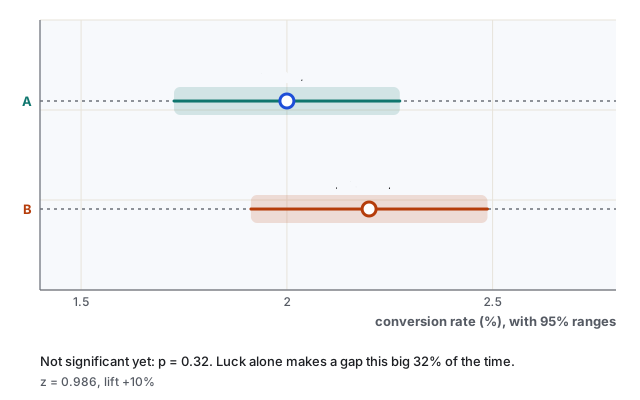
A/B test: is version B really better, or just lucky?
A higher conversion rate might be chance. The z-test turns the gap and the sample size into a p-value.
 Also try
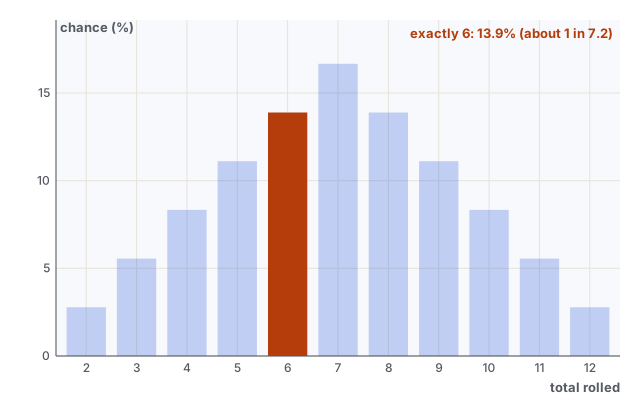
Dice odds: what are my chances of rolling it?
Why 7 shows up so often with two dice, and what that means for your next move.
Questions people ask
What does "margin of error ±3%" mean?
If the poll were repeated many times, about 95% of the ranges built this way would contain the true share. It measures the luck of who got picked.
Why do polls use about 1,000 people?
It gives about ±3 points, and getting to ±2 would take more than twice as many. The extra cost buys little precision.
Does a bigger country need a bigger poll?
Barely. The margin depends on how many people you ask, not on the population size, as long as the population is much larger than the sample.