How do you get speed from a position graph?
Speed is the slope of the position graph. A secant line joins two moments and gives the average speed between them. Slide the second moment closer, and the secant turns into the tangent line. Its slope, the limit of (s(t + h) − s(t))/h as h shrinks to 0, is the derivative: the speed at that instant.
- Position s(t)
- 18 m
- Secant slope (average speed over h)
- 14 m/s
- Exact derivative s′(t) (speed now)
- 16 m/s
- Gap between them
- 2 m/s
Challenge: On the highway merge, find the moment the car reaches 25 m/s (90 km/h), within 0.1 m/s.
Play
Pick a trip and slide the time. Then shrink h and watch the secant swing onto the tangent.
Challenge: On the highway merge, find the moment the car reaches 25 m/s (90 km/h), within 0.1 m/s. The box under the picture turns green when you get it.
Stuck? Pick one of the examples from the “Try an example” menu, or press “New example.”
Understand
A position graph shows how far along the road the car is at each moment. Its slope is the speed. When the graph is a straight line, that's rise over run. When it curves, the slope changes from moment to moment.
Pick two moments, and , and join them with a secant line. Its slope is the average speed between them:
Now shrink . The second point slides toward the first, and the secant swings onto the tangent line, the line that just touches the curve at . The slope it settles on is the derivative, the speed at that instant:
When accelerating from a stop, at s the secants give 12.5, 11.25, then 10.125 m/s for = 2, 1, then 0.1 s. They close in on 10 m/s, the tangent's slope.
Use
Every input has a unit menu, so you can type values in the units you already have. Results follow your units.
Show the work
- Position during the speed change (first 5 s)
s(t) = 20t - 2t^2 - Position now
s(1) = 18\ \text{m} - Position h later
s(1 + 1) = 32\ \text{m} - Secant slope: rise over run, the average speed over h
\frac{s(t + h) - s(t)}{h} = \frac{32 - 18}{1} = 14\ \text{m/s} - Let h → 0: the derivative, from the power rule
s'(t) = 20 - 4t,\quad s'(1) = 16\ \text{m/s} - Gap between the secant and the tangent
|14 - 16| = 2\ \text{m/s}
Export
Pick a trip, set the time with the first slider, and set with the second. The road at the top shows the car to scale, with an outline where it will be seconds later.
- Each trip is a smooth formula for the first few seconds, then a steady speed. Braking stops the car at 5 s. The other trips hold their final speed after 10 s.
- Set all the way to 0 to see why the limit is needed.
For learning and estimation. Verify with applicable codes, standards, and a qualified professional before using in design, construction, or safety-critical work.
Cheat card
| Symbol | Meaning | Unit |
|---|---|---|
| position at time t | m | |
| time | s | |
| step between the two moments | s | |
| speed at time t (the derivative) | m/s |
- A steeper graph means a faster car. A flat graph means the car is stopped.
- When the car speeds up, the graph bends upward and the secant is steeper than the tangent.
- With steady acceleration, the gap is exactly half the acceleration times h. Halve h and you halve the gap.
Where it’s used
- Physics
Velocity is the derivative of position, and acceleration is the derivative of velocity. - Mechanical
Motor and robot controllers estimate speed by dividing a small change in position by a small time step: a secant with a tiny h. - Driving & Travel
Your average speed for a trip is a secant slope. The number on the speedometer is a tangent slope.
Related exhibits
 Start here
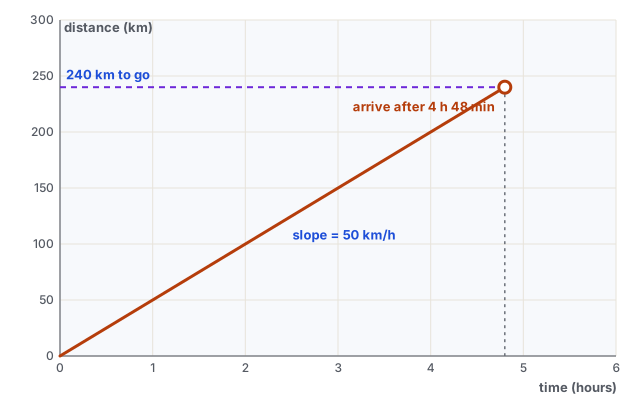
Speed, distance, time: how long is the drive?
Distance is speed times time. Rearrange it and you know when you’ll arrive.
 Start here
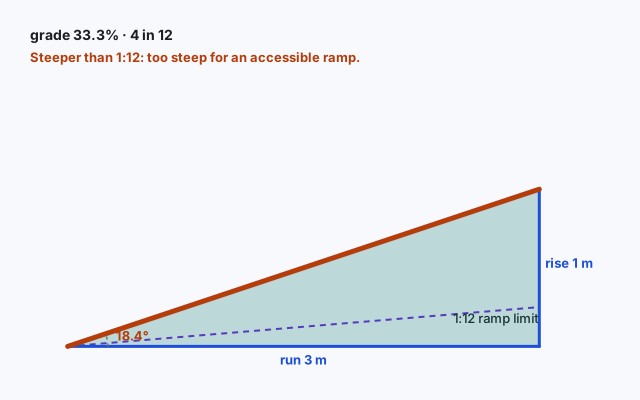
Roof pitch and ramp slope: rise over run
Slope is one number that decides whether a roof sheds water or a ramp is safe to roll up.
 Start here
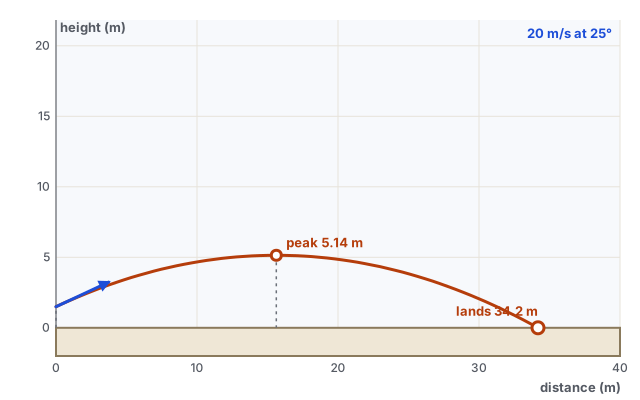
Throwing a ball: the quadratic arc
Every throw, jump, and fountain draws a parabola.
 Go further
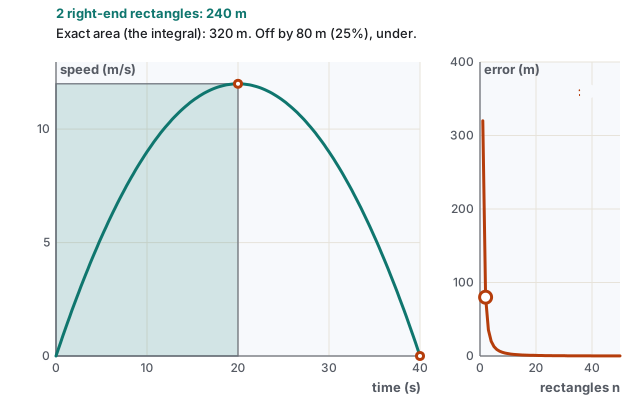
Distance from a speed graph: area under the curve
Speed times time is distance, one thin rectangle at a time. Add more rectangles and the total closes in on the exact area: the integral.
 Go further
The biggest box from a sheet of cardboard: optimization
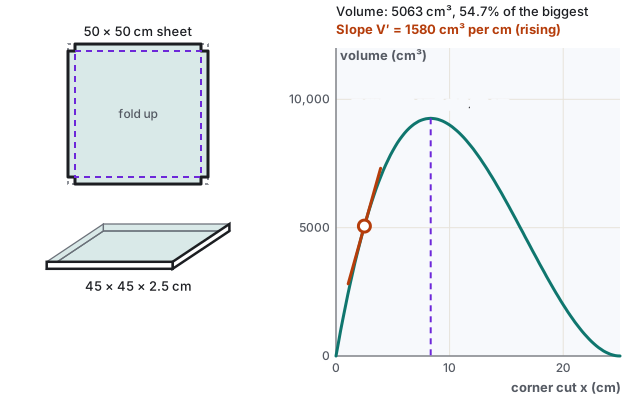
Cut a square from each corner and fold up the sides. Too small a cut makes a flat tray, too big a skinny tower. The derivative finds the best cut.
Questions people ask
What's the difference between average speed and speed at an instant?
Average speed is distance over a stretch of time, the slope of a secant line. Speed at an instant is what the speedometer shows right now, the slope of the tangent line. That's the derivative.
Why not just set h to 0?
Then the change in position is 0 and the time is 0, and 0 ÷ 0 has no value. The limit asks what the secant slope closes in on as h gets tiny, without ever being zero.
How does the power rule give the speed?
When accelerating from a stop, s = 1.25t². The power rule gives s′ = 2 × 1.25t = 2.5t. At t = 4 s that's 10 m/s, the same number the secants close in on: 12.5, then 11.25, then 10.125 m/s as h goes from 2 to 1 to 0.1 s.