What is a DC motor's torque-speed curve?
At a fixed voltage, a brushed DC motor slows in a straight line as the load grows, from no-load speed down to zero at stall torque. Current rises in a straight line too. Power, torque times speed, is a parabola that peaks at half the stall torque. Peak efficiency comes at a much lighter load.
- Speed at this load
- 85.5 rpm
- Mechanical power out
- 4.03 W
- Current drawn
- 2.43 A
- Efficiency
- 13.8%
- Peak power (at half stall torque)
- 21.2 W
Challenge: Stay inside the continuous rating while getting at least half the motor's peak power.
More settings
Play
Pick the cordless drill, then sweep the load from 0% to past stall.
Challenge: Stay inside the continuous rating while getting at least half the motor's peak power. The box under the picture turns green when you get it.
Stuck? Pick one of the examples from the “Try an example” menu, or press “New example.”
Understand
Load a brushed DC motor at a fixed voltage and its speed falls in a straight line:
Current rises in a straight line from its no-load value to its stall value. Power is torque times speed, so it's a parabola, zero at both ends and highest at . Efficiency peaks at a light load, far left of peak power.
All four curves share one scale, as a percent of their maximums. The first shaded zone is where the motor can run all day. The next one overheats it over time.
Use
Every input has a unit menu, so you can type values in the units you already have. Results follow your units.
Show the work
- Speed falls in a straight line from no-load to stall
n = 90\left(1 - \frac{0.45}{9}\right) = 85.5\ \text{rpm} - Current rises in a straight line with torque
I = I_0 + (I_s - I_0)\frac{T}{T_s} = 1.5 + 18.5 \times 0.05 = 2.425\ \text{A} - Power = torque × angular speed, a parabola in T
P = T\,\omega = 0.45 \times \frac{2\pi \times 85.5}{60} = 4.029\ \text{W} - The parabola peaks halfway, at T = Tₛ/2 and n = n₀/2
P_{\max} = \frac{T_s\,\omega_0}{4} = 21.21\ \text{W} - Efficiency: power out ÷ power in
\eta = \frac{P}{VI} = \frac{4.029}{12 \times 2.425} = 13.85\%
Export
Pick a motor, then move the load. The motor numbers are in the boxes below, so you can type in your own datasheet.
- Real motors deviate a little from the straight line. Friction, heating, and battery sag all shave off torque.
- Many controllers limit current, which caps torque below stall. That's left out here.
For learning and estimation. Verify with applicable codes, standards, and a qualified professional before using in design, construction, or safety-critical work.
Cheat card
| Symbol | Meaning | Unit |
|---|---|---|
| stall torque | N·m | |
| no-load speed | rpm | |
| stall current | A | |
| continuous torque rating | N·m |
- Two datasheet numbers draw the whole speed line, stall torque and no-load speed.
- Running at peak power usually overheats a motor. Most designs run near peak efficiency.
- A gearbox trades speed for torque. It moves the operating point left on this chart.
Where it’s used
- Electrical & Electronics
Engineers pick motors and gear ratios so the working load sits near peak efficiency. - Mechanical
Robot and actuator designers check that the load stays inside the continuous zone. - Hobbies & Crafts
RC cars, robots, and drills all live on this line. A stalled motor gets hot fast.
Related exhibits
 Start here
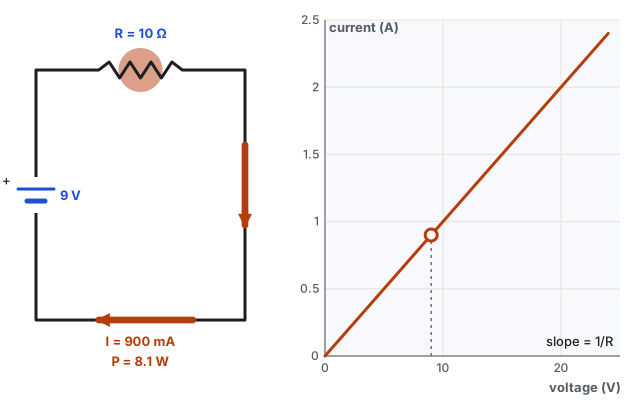
Ohm’s law: how much current flows?
Push harder (volts) or squeeze tighter (ohms), and watch the current change.
 Start here
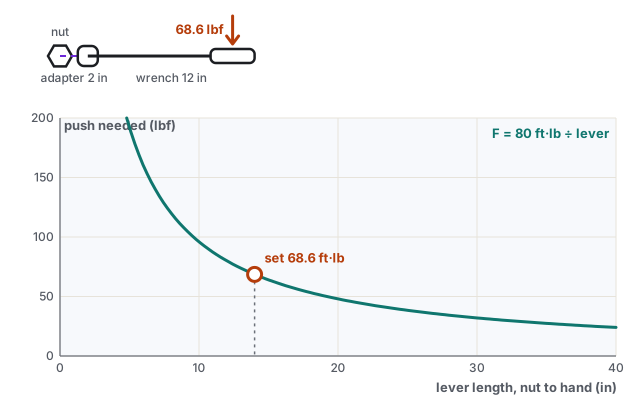
Torque: how hard to pull the wrench, and what an adapter changes
Torque is force times distance. A longer handle takes less push, and an adapter that adds length means you must set the wrench lower.
 Also try
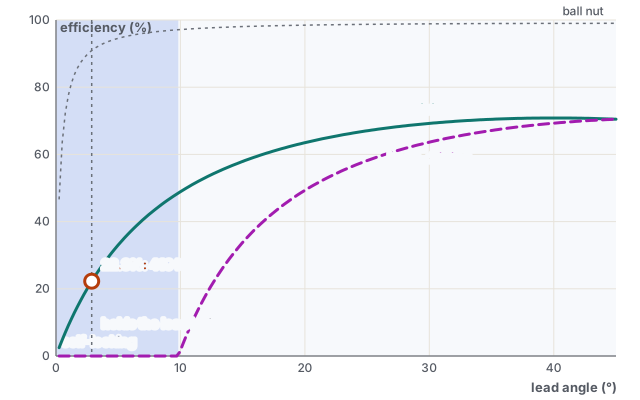
Lead screw vs. ball screw: turning torque into a push
A screw trades turns for force: F = 2π × efficiency × torque ÷ lead. Friction decides whether it also holds the load with the power off.
 Also try
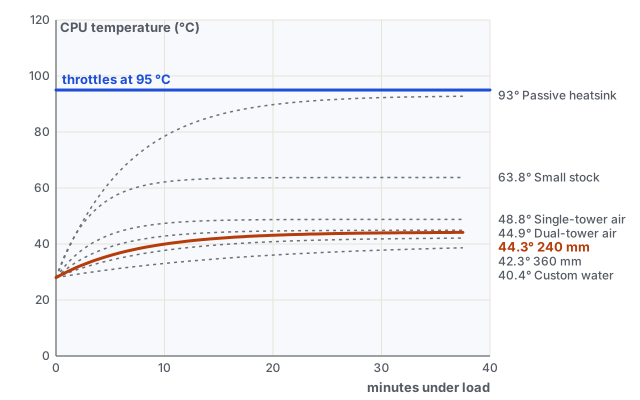
PC cooling: passive, air, or water?
Heat flows through the cooler like current through a resistor: temperature rise = watts × °C/W. Water adds mass, so it heats up slower.
Questions people ask
What is stall torque?
The torque that stops the motor completely. It draws its highest current there and turns it all into heat, so stalling for long can burn out the windings.
Where does a DC motor make the most power?
At half its stall torque and half its no-load speed. Power is torque times speed, and the product of a falling line peaks in the middle.
Why is the continuous rating so much lower than stall?
Heat. Losses grow with the square of current, and the motor can only shed so much. Above its continuous rating it overheats, often within minutes.