How does a rocket engine keep its throat from melting?
The flame is over 3,000 °C, hotter than any metal can take. The Bartz equation estimates how fast heat moves from the gas into the wall. It grows with chamber pressure to the 0.8 power and peaks at the throat. Regenerative cooling runs cold fuel through channels in the wall to carry that heat away.
- Heat flux at the throat
- 26.5 MW/m²
- Hot-side wall temperature
- 227 °C
- Coolant-side wall temperature
- 138 °C
- Gas-side coefficient (Bartz)
- 9.49 kW/(m²·K)
- Total heat into the coolant
- 10.4 MW
Bartz is a design estimate: it can overpredict throat heating by up to about 2×, and the gas properties here are rough fixed values. Real engines are sized with combustion codes, CFD, and hot-fire tests.
Challenge: Run 300 bar or more with no film cooling and keep the wall under its limit.
More settings
Play
Start with the 300 bar methane engine, then switch the liner to stainless steel. Then try turning film cooling off.
Challenge: Run 300 bar or more with no film cooling and keep the wall under its limit. The box under the picture turns green when you get it.
Stuck? Pick one of the examples from the “Try an example” menu, or press “New example.”
Understand
The flame in a rocket engine is hotter than the melting point of every structural metal. The wall survives because heat can't jump straight in. It has to cross a thin layer of slower gas along the wall, and the Bartz equation estimates how easily it does:
It's mostly powers. Chamber pressure to the 0.8 means high-pressure engines like SpaceX's Raptor (about 300 bar) are much harder to cool. The term makes heating peak at the throat, as the curve shows.
Then the heat crosses three resistances in series: the gas film (), the metal wall (), and the coolant (). It's Ohm's law for heat, the same math as a CPU cooler. The panel on the right shows the temperature falling across each one.
Use
Every input has a unit menu, so you can type values in the units you already have. Results follow your units.
Show the work
- Gas properties from γ and molar mass
c_p = \frac{R}{\mathcal{M}}\frac{\gamma}{\gamma - 1} = 1979\ \tfrac{\text{J}}{\text{kg K}},\quad \mathrm{Pr} = \frac{4\gamma}{9\gamma - 5} = 0.8161 - Bartz at the throat (A_t/A = 1; σ corrects for the cooler gas near the wall)
h_g = \frac{0.026}{0.16^{0.2}}\left(\frac{(0.000105)^{0.2}\,1979}{0.8161^{0.6}}\right)\left(\frac{4{,}000{,}000}{1790}\right)^{0.8}\left(1.333\right)^{0.1}(1)^{0.9}\,(1.437) = 9.486\ \mathrm{kW/(m^2\,K)} - Gas temperature the wall sees (after film cooling)
T_{aw} = 3023\ ^\circ\mathrm{C} - Ohm’s law for heat: three resistances in series (gas film, wall, coolant)
q = \frac{T_{aw} - T_c}{\frac{1}{h_g} + \frac{t}{k} + \frac{1}{h_c}} = \frac{3023 - (50)}{0.0001121} = 26.52\ \mathrm{MW/m^2} - Wall temperatures
T_{wg} = T_{aw} - \frac{q}{h_g} = 226.8\ ^\circ\mathrm{C},\quad T_{wc} = T_c + \frac{q}{h_c} = 138.4\ ^\circ\mathrm{C} - Why the throat is hottest: at 4× the throat area, heating falls to
\left(\tfrac{1}{4}\right)^{0.9} = 0.2872\ \text{of the throat value}
Export
Pick the propellants, chamber pressure, throat size, and liner. "More settings" changes the wall thickness, how hard the coolant works, its temperature, and film cooling.
- The gas properties are rough fixed values for each propellant pair. The nozzle shape is illustrative.
- Temperatures are at the throat. The coolant warms as it flows, which this leaves out.
For learning and estimation. Verify with applicable codes, standards, and a qualified professional before using in design, construction, or safety-critical work.
Cheat card
| Symbol | Meaning | Unit |
|---|---|---|
| gas-side heat transfer coefficient | W/(m²·K) | |
| chamber pressure | Pa | |
| throat diameter | m | |
| characteristic velocity of the propellants | m/s | |
| throat area ÷ local area | ||
| heat flux into the wall | W/m² | |
| wall conductivity | W/(m·K) | |
| coolant-side heat transfer coefficient | W/(m²·K) |
- Doubling chamber pressure multiplies the heating by 2^0.8 ≈ 1.74.
- A bigger engine heats a little less per square meter (D_t^−0.2), but it has far more wall to cool.
- The wall is three thermal resistances in series, the same math as a CPU cooler. Copper's high conductivity makes its share tiny.
Where it’s used
- Aerospace
Engine designers start throat cooling estimates with Bartz, then refine with CFD and hot-fire tests. - Mechanical
The same series-resistance math sizes heat exchangers, turbine blade cooling, and power electronics. - Hobbies & Crafts
Amateur rocketry groups building liquid engines use Bartz to size their cooling channels.
Related exhibits
 Start here
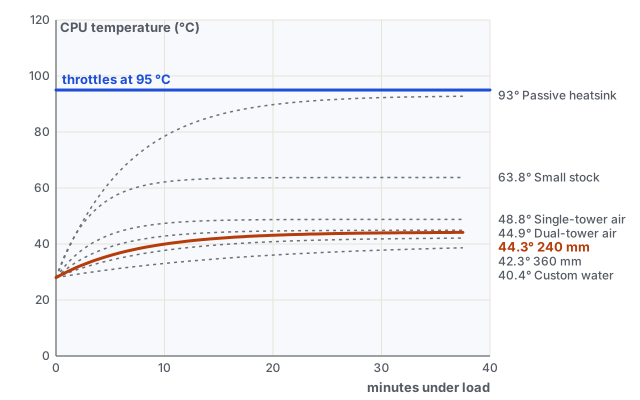
PC cooling: passive, air, or water?
Heat flows through the cooler like current through a resistor: temperature rise = watts × °C/W. Water adds mass, so it heats up slower.
 Start here
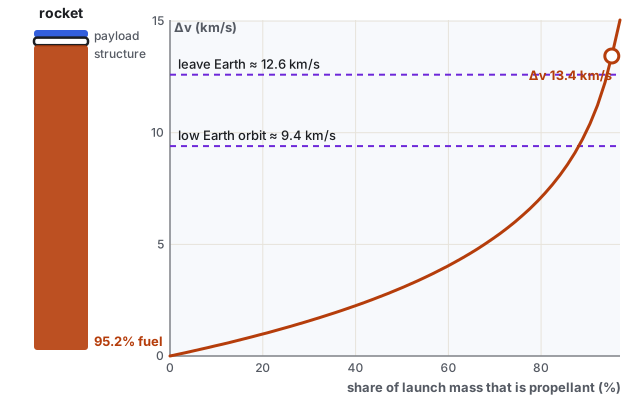
The rocket equation: why rockets are almost all fuel
Speed grows with the logarithm of the fuel. Double the tank and you get far less than double the speed.
 Also try
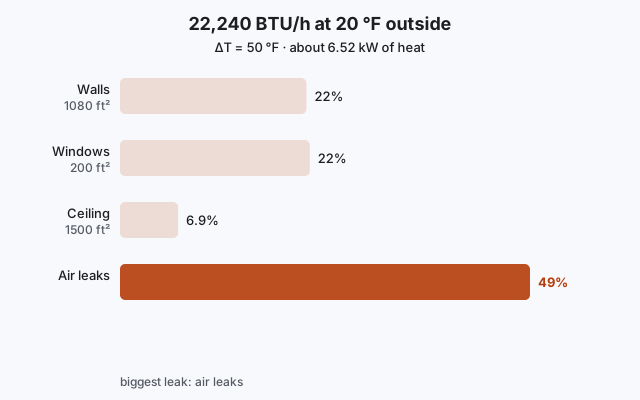
Home heat loss: where does the heat go?
Heat leaks through each surface in proportion to area and temperature difference, divided by R. Windows and drafts punch far above their size.
Questions people ask
What is regenerative cooling?
The fuel (or oxidizer) flows through channels in the chamber and nozzle wall on its way to the injector. It soaks up the heat, then burns, so the energy isn't wasted. That's why it's called regenerative.
What does the Bartz equation calculate?
The heat transfer coefficient between the hot gas and the wall, in W/(m²·K). Multiply by the temperature difference to get the heat flux. It's an empirical fit from 1957, still used for first estimates.
Why is the throat the hottest part?
The gas is densest and fastest there, and the flow is squeezed through the smallest area. Bartz captures this with the (A_t/A)^0.9 term, which is 1 at the throat and drops quickly in the nozzle.
Are these SpaceX Raptor's real numbers?
No. Only the roughly 300 bar chamber pressure is public. The throat size, wall design, and coolant flow here are illustrative, chosen to show how an engine at that pressure can work.