How do you figure out what key a capo puts you in?
Number the twelve notes like a clock, with C as 0 and B as 11. A capo raises every note one semitone per fret, so add the capo fret to the chord's number and wrap past 11 back to 0. A G chord is 7; with a capo on 3 it becomes 10, which is B♭.
- Semitones moved
- 4
- Capo fret for the key you need
- 11
Challenge: Play in E♭ using G-shape chords. Where does the capo go?
More settings
Play
Pick a chord shape and slide the capo. Press "Back and forth" to hear the same shape move.
Challenge: Play in E♭ using G-shape chords. Where does the capo go? The box under the picture turns green when you get it.
Stuck? Pick one of the examples from the “Try an example” menu, or press “New example.”
Understand
Music has twelve notes, and after B the pattern starts again at C, one octave up. Number them like a clock, C = 0 through B = 11, and moving notes becomes modular arithmetic:
A capo on fret raises every string semitones. A transposing instrument shifts what's written by a fixed amount: a B♭ trumpet sounds 2 semitones lower than written. On the clock, the blue note is where you start, the arrow is the move, and orange is where you land.
Use
Every input has a unit menu, so you can type values in the units you already have. Results follow your units.
Show the work
- Number the notes like a clock: C = 0, C♯ = 1, … B = 11
\text{C shape root C} = 0 - Each capo fret raises every string one semitone
(0 + 4) \bmod 12 = 4 - Read the answer off the clock
4 = \text{E} - Working backward: the capo you need for a key
\text{capo} = (\text{key} - \text{shape}) \bmod 12 = (11 - 0) \bmod 12 = 11
Export
Pick a chord shape and a capo fret, or switch to a transposing instrument and pick the written note. "More settings" works backward: choose the key you need, and it tells you the capo fret.
- The clock gives the note name only. A capo also changes which octave a chord sits in.
For learning and estimation. Verify with applicable codes, standards, and a qualified professional before using in design, construction, or safety-critical work.
Cheat card
| Symbol | Meaning | Unit |
|---|---|---|
| 0, 1, …, 11 | ||
| B♭ −2, E♭ −9, F −7 | semitones |
- Mod 12 means divide by 12 and keep the remainder. 7 + 8 = 15, and 15 mod 12 = 3, so G shapes with capo 8 are in E♭.
- Minor shapes move the same way. Am with capo 2 is Bm.
- Going down works too. Subtract and add 12 if you go below 0.
Where it’s used
- Music & Sound
Band directors write separate parts for B♭, E♭, and F instruments so everyone sounds in the same key. - Music
Guitarists use a capo to play a song in a singer's key with the open chord shapes they know. - Music
Transposing a song for a singer is adding the same number to every chord, mod 12.
Related exhibits
 Start here
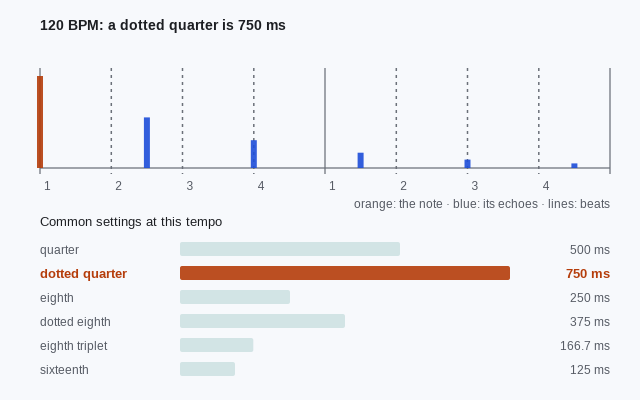
Delay times that lock to the beat: BPM to milliseconds
One beat lasts 60,000 ÷ BPM milliseconds. Every echo setting is a fraction of that beat.
 Go further
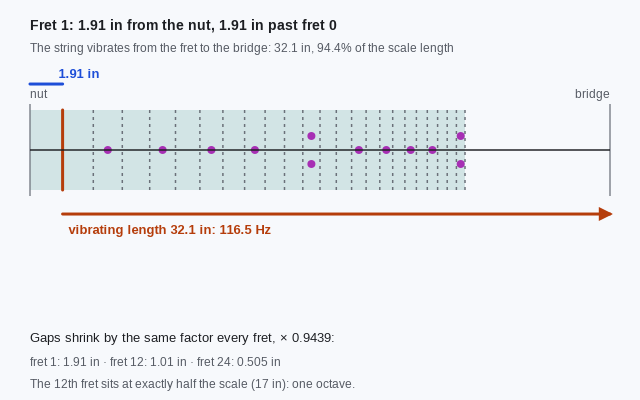
Why frets get closer together: an exponent on the fretboard
Every fret raises the pitch by the same ratio, 2^(1/12), so each one shortens the string by the same fraction. The gaps shrink on the way up.
 Also try
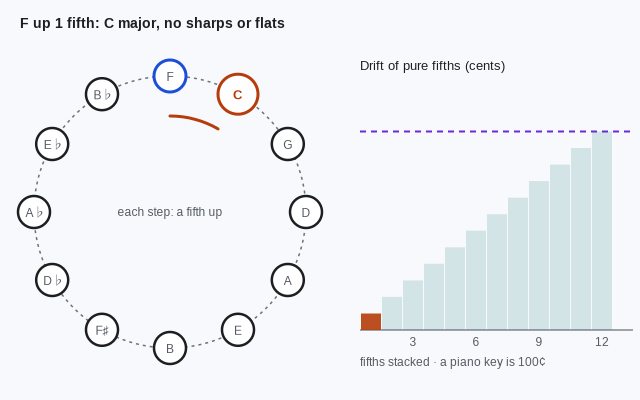
The circle of fifths that doesn’t quite close
Twelve fifths should bring you back home. With pure 3:2 fifths you overshoot by about a quarter of a semitone, and that gap is why the piano is tuned the way it is.
 Also try
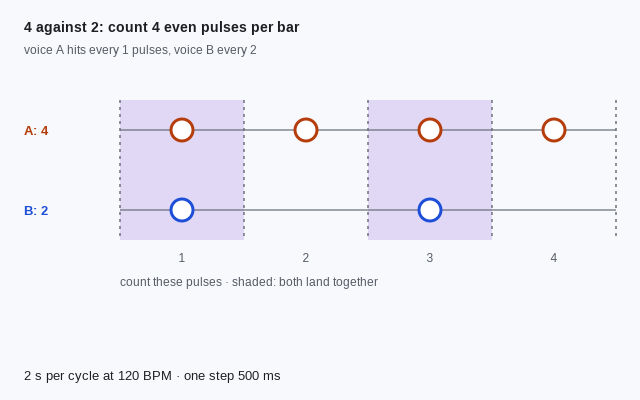
Polyrhythms: when 3 against 4 lines up again
Two patterns meet again after the least common multiple. Count that grid and any polyrhythm becomes playable.
Questions people ask
What key is capo 3 with G chords?
B♭. G is note 7 on the 12-note clock, and 7 + 3 = 10, which is B♭.
Why does a B♭ trumpet sound different from what's written?
It's built so its plain fingering sounds B♭ while the music says C. Every written note sounds two semitones lower, so the parts are written two semitones higher to match the band.
What is modular arithmetic?
Arithmetic that wraps around, like a clock. On a 12-hour clock 10 o'clock plus 5 hours is 3 o'clock. Notes work the same way because they repeat every 12 semitones.
Updated : First published.