Why do guitar frets get closer together as you go up the neck?
Each fret has to raise the pitch by the same ratio, the twelfth root of two. Pitch goes up as the vibrating string gets shorter, so every fret removes the same fraction of what's left, about 5.6 percent. A fraction of a shrinking length is a shrinking gap, so the frets crowd together, and the 12th fret lands exactly halfway.
- Nut to this fret
- 1.91 in
- Gap from the fret before
- 1.91 in
- Note at this fret
- 117 Hz
Challenge: Find the fret that sits three quarters of the way from the nut to the bridge.
More settings
Play
Slide the fret up and watch the gaps shrink. Press "Climb to fret" to hear each step.
Challenge: Find the fret that sits three quarters of the way from the nut to the bridge. The box under the picture turns green when you get it.
Stuck? Pick one of the examples from the “Try an example” menu, or press “New example.”
Understand
A string's pitch is inversely proportional to its vibrating length. Each fret must raise the pitch by one equal semitone, a factor of , so it must leave of the string vibrating. After frets that's of the scale length, so
Each gap is the same fraction of a shorter and shorter length, so the gaps shrink by every fret. That's an exponential, and it's why the frets crowd together up the neck.
Use
Every input has a unit menu, so you can type values in the units you already have. Results follow your units.
Show the work
- Each fret raises the pitch one equal step, a factor of 2^(1/12). Pitch is inversely proportional to the vibrating length
\frac{f_n}{f_0} = 2^{1/12} = \frac{L}{L - d_n} - So the string left vibrating is
L - d_{1} = 34 \times 2^{-1/12} = 32.09\ \text{in} - And the fret sits at
d_{1} = 34\left(1 - 2^{-1/12}\right) = 1.908\ \text{in} - The luthier’s shortcut: each gap is the remaining length ÷ 17.817
\frac{34}{17.817} = 1.908\ \text{in}
Export
Set the scale length (switch to mm if you like) and slide the fret. The sound buttons climb the frets, compare the open string with your fret, and play the open-string octave.
- Real necks are compensated: the bridge saddles sit a little past the scale length so fretted notes play in tune.
For learning and estimation. Verify with applicable codes, standards, and a qualified professional before using in design, construction, or safety-critical work.
Cheat card
| Symbol | Meaning | Unit |
|---|---|---|
| scale length, nut to bridge | in | |
| fret number | ||
| nut to fret n | in |
- The 12th fret is at half the scale length, and the 24th at three quarters. Each octave halves what's left.
- Every gap is 0.9439 times the one before it. Multiplying by the same number each step is an exponential.
- Real guitars set the saddle a little past the scale length to make up for the string stretching when you press it.
Where it’s used
- Mechanical
Luthiers cut fret slots from a table of these positions, or with a rule-of-18 template. - Music
Guitarists find harmonics at the 12th, 7th, and 5th frets, at 1/2, 1/3, and 1/4 of the string. - Hobbies & Crafts
Builders of cigar-box guitars and ukuleles use the same formula for any scale length.
Related exhibits
 Start here
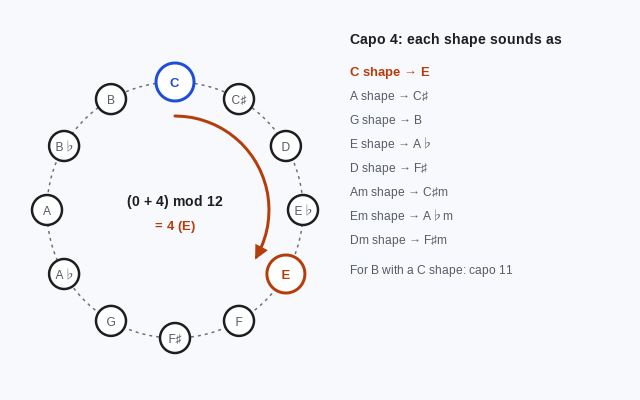
Capos and transposing: music runs on a 12-hour clock
After B comes C again, so moving up 5 semitones from A lands on D. A capo, a key change, and a B♭ trumpet all use the same clock math.
 Go further
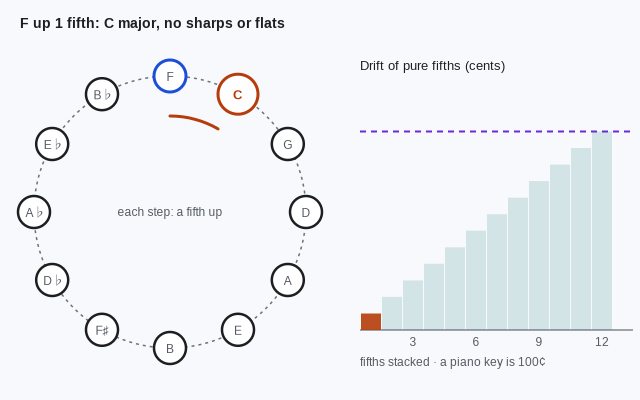
The circle of fifths that doesn’t quite close
Twelve fifths should bring you back home. With pure 3:2 fifths you overshoot by about a quarter of a semitone, and that gap is why the piano is tuned the way it is.
 Also try
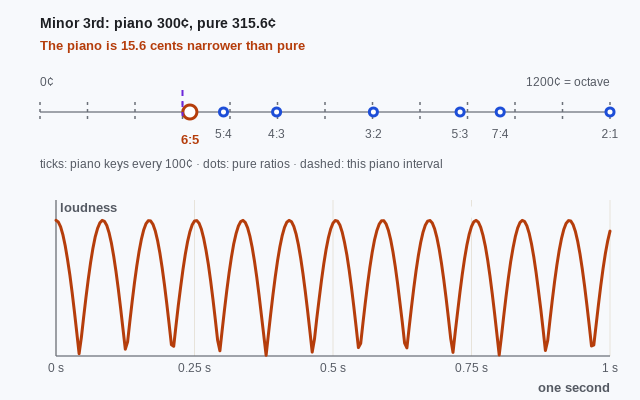
Equal temperament vs. pure intervals: why a piano’s 3rds shimmer
A piano splits the octave into 12 equal ratios. Pure intervals are whole-number ratios. The gap is small, and you can hear it as beats.
 Also try
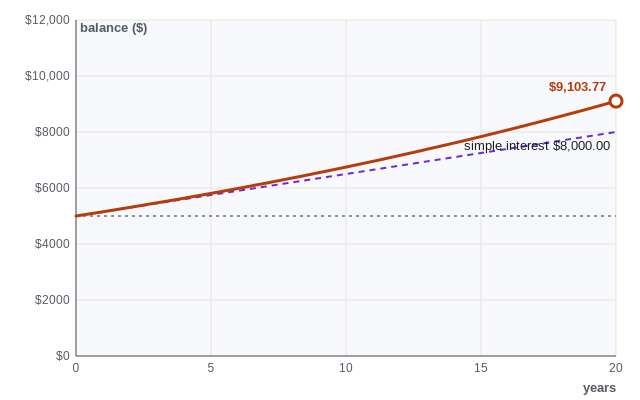
Compound interest: money that grows on itself
Interest earns interest. Exponents explain why saving early wins.
Questions people ask
Why is the 12th fret exactly halfway?
Twelve frets is one octave, which doubles the frequency. Doubling the frequency takes half the string length, so the 12th fret sits at the midpoint.
What is the rule of 18?
An old luthier's shortcut. Divide the remaining string length by about 18 (17.817 to be exact) to find the next fret. It works because each fret removes the same 5.6% of what's left.
Do longer scale lengths change the notes?
No. The frets keep the same ratios, so they just spread out. A longer scale holds more string tension at the same pitch, which is part of why a Fender-style neck feels snappier than a Gibson-style one.
Updated : First published.