Why doesn't the circle of fifths close perfectly?
Twelve fifths visit every key and return home, seven octaves up. But a pure fifth is the ratio 3 to 2, and twelve of them multiply to about 129.7, while seven octaves are exactly 128. That overshoot, about a quarter of a semitone, is the Pythagorean comma. Pianos hide it by narrowing every fifth slightly.
- Pure fifths run sharp by
- 1.96 ¢
- Sharps (+) or flats (−) in that major key
- 0
- Pure stack, folded into one octave
- ×1.5
Challenge: Go all the way around the circle.
Play
Slide all the way to 12 fifths, then press "12 pure fifths vs. where you started" and listen for the wobble.
Challenge: Go all the way around the circle. The box under the picture turns green when you get it.
Stuck? Pick one of the examples from the “Try an example” menu, or press “New example.”
Understand
A fifth is 7 semitones, and 7 and 12 share no factor, so stepping up by fifths visits all twelve notes before repeating. That's arithmetic mod 12: .
But a pure fifth is a ratio, , and ratios multiply. Compare twelve of them with seven octaves on a log scale:
The bars show that gap building up, 1.955 cents per fifth, until it reaches the comma at the twelfth step.
Use
Every input has a unit menu, so you can type values in the units you already have. Results follow your units.
Show the work
- A fifth is 7 semitones, so k fifths up is 7k semitones, wrapped at 12
(5 + 7 \times 1) \bmod 12 = 0 - A pure fifth is the ratio 3:2. In cents (a log scale)
1200 \log_2 \tfrac{3}{2} = 701.955\ \text{vs. the piano’s}\ 700 - The gap adds up with every fifth
1 \times 1.955 = 1.955\ \text{cents} - All the way around: 12 pure fifths against 7 octaves
\frac{(3/2)^{12}}{2^{7}} = \frac{129.746}{128} = 1.01364 = 23.46\ \text{cents}
Export
Pick a starting key and step around the circle. You'll see each key and its key signature. The sound buttons climb the pure fifths, compare the pure stack with the piano note, and compare a pure fifth with a piano fifth.
- Twelve fifths really end up seven octaves up. The demo folds every note back into one octave so you can compare them.
For learning and estimation. Verify with applicable codes, standards, and a qualified professional before using in design, construction, or safety-critical work.
Cheat card
| Symbol | Meaning | Unit |
|---|---|---|
| fifths up | ||
| a pure fifth |
- Each step clockwise adds one sharp to the key signature. Counterclockwise adds one flat.
- Neighbors on the circle share six of seven notes, so they're the smoothest keys to change to.
- Four pure fifths up makes a major third 22 cents too wide. That's why older tunings that kept fifths pure had sour thirds.
Where it’s used
- Music & Sound
Piano tuners narrow every fifth by about 2 cents so the 23-cent comma disappears. - Music
Songwriters use the circle to find closely related keys and the chords that lead naturally to each other. - Music
Players of fretless instruments and choirs can tune fifths pure, and their chords ring differently from a piano.
Related exhibits
 Start here
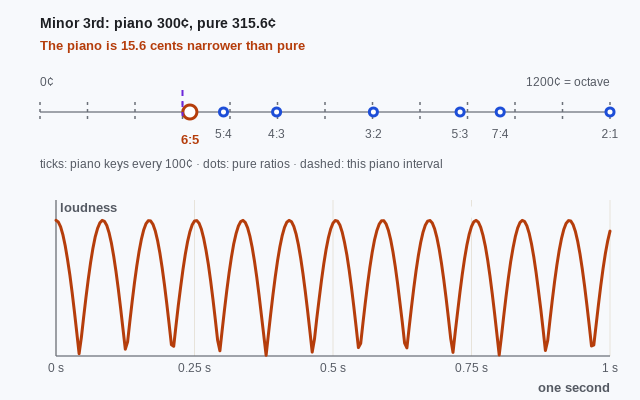
Equal temperament vs. pure intervals: why a piano’s 3rds shimmer
A piano splits the octave into 12 equal ratios. Pure intervals are whole-number ratios. The gap is small, and you can hear it as beats.
 Go further
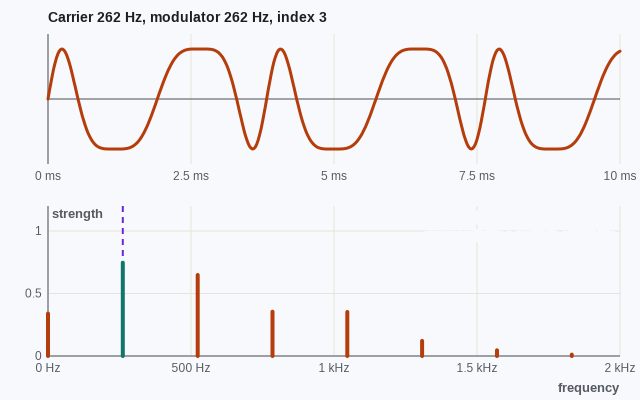
FM synthesis: bells and brass from two sine waves
Wiggle one sine wave’s timing with another and a whole spectrum appears. The ratio decides bell or brass; the index decides how bright.
 Also try
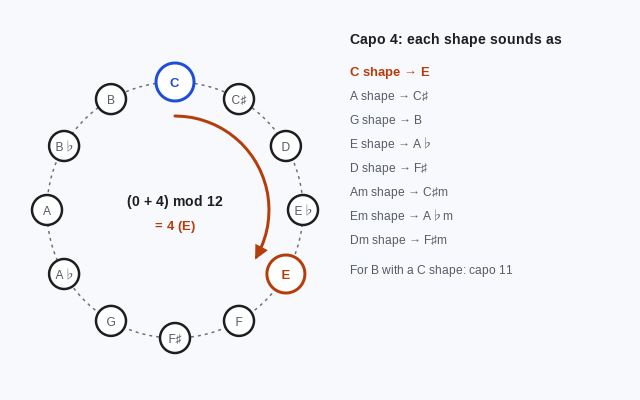
Capos and transposing: music runs on a 12-hour clock
After B comes C again, so moving up 5 semitones from A lands on D. A capo, a key change, and a B♭ trumpet all use the same clock math.
 Also try
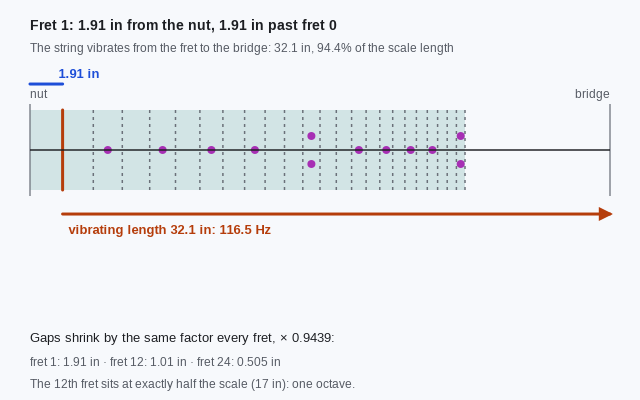
Why frets get closer together: an exponent on the fretboard
Every fret raises the pitch by the same ratio, 2^(1/12), so each one shortens the string by the same fraction. The gaps shrink on the way up.
Questions people ask
What is the circle of fifths?
All twelve keys arranged so each is a fifth above the one before. Going clockwise adds a sharp to the key signature each step, and after twelve steps you're back to the start.
What is the Pythagorean comma?
The small gap, a ratio of about 1.0136 or 23.5 cents, between twelve pure fifths and seven octaves. It means pure fifths can't all fit on a keyboard that repeats every octave.
How does a piano deal with it?
Equal temperament narrows each fifth from 701.96 cents to 700, spreading the comma evenly over all twelve. Every key sounds the same, and no fifth is far enough off to notice.
Updated : First published.