How does a crank turn rotation into a piston's back-and-forth motion?
The crank pin moves in a circle, and the connecting rod pushes the piston along a straight line. Trigonometry and Pythagoras give the piston's position: x = r cos θ + √(l² − r² sin² θ). A finite rod makes the piston reach half stroke before 90°, so it lingers near the bottom.
- Piston down from the top
- 82.2 mm
- Piston speed at this angle
- 6.94 m/s
- Peak piston speed
- 21.5 m/s
- Mean piston speed
- 12.9 m/s
- Crank angle at half stroke
- 79.7°
Challenge: Get the half-stroke angle within 1° of 90° using a rod no longer than 400 mm.
More settings
Play
Slide the crank angle around a full turn. Then switch between the short-rod and long-rod presets.
Challenge: Get the half-stroke angle within 1° of 90° using a rod no longer than 400 mm. The box under the picture turns green when you get it.
Stuck? Pick one of the examples from the “Try an example” menu, or press “New example.”
Understand
The crank pin rides on a circle: . The rod is the hypotenuse of a right triangle, so Pythagoras gives where it meets the piston:
The graph compares the piston's travel with a pure sine wave (dashed). The shorter the rod, the more it bends away. The piston hurries through the top half and lingers in the bottom.
Use
Every input has a unit menu, so you can type values in the units you already have. Results follow your units.
Show the work
- Crank pin: a point on a circle of radius r (half the stroke)
(r\cos\theta,\ r\sin\theta),\quad r = 43\ \text{mm} - The rod is the hypotenuse: Pythagoras finds how far along the wrist pin sits
x = r\cos\theta + \sqrt{l^2 - r^2\sin^2\theta} - Distance down from the top (x is largest at the top, r + l)
s = 43 + 120 - \left(43\cos 150^\circ + \sqrt{120^2 - 43^2\sin^2 150^\circ}\right) = 82.18\ \text{mm} - Mean piston speed: two strokes per turn
\bar v = 2 \times 0.086\ \text{m} \times \frac{4500}{60} = 12.9\ \text{m/s}
Export
Turn the crank angle, then change the stroke and rod length. "More settings" sets the speed.
- This is geometry only. Forces, balance, and combustion are left out.
- The drawing is to scale, with the cylinder lying on its side.
For learning and estimation. Verify with applicable codes, standards, and a qualified professional before using in design, construction, or safety-critical work.
Cheat card
| Symbol | Meaning | Unit |
|---|---|---|
| crank radius (half the stroke) | mm | |
| connecting rod length | mm | |
| crank angle from top | ° | |
| piston distance down from the top | mm |
- With an endless rod, s = r(1 − cos θ), a pure sine wave.
- The rod ratio l/r sets how far from a sine it is. Engines are usually about 3 to 4.
- Peak piston speed comes before 90°, not at it.
Where it’s used
- Mechanical
Engine designers pick the rod ratio to balance engine height, vibration, and piston side load. - Physics
The crank-slider is the classic example of rotary motion becoming reciprocating motion, and back again. - Driving & Travel
Every piston in a car engine follows this curve thousands of times a minute.
Related exhibits
 Start here
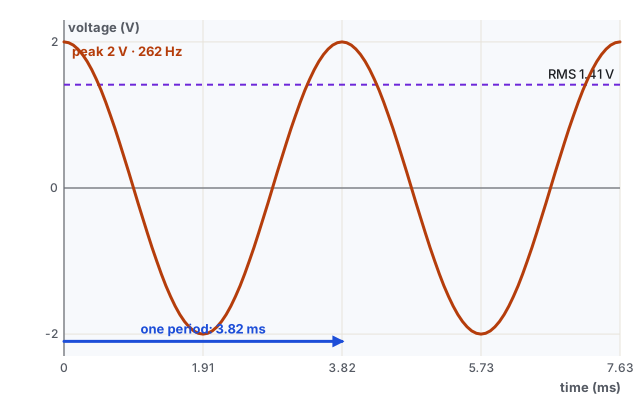
Sine waves: wall power and musical notes
The outlet and a tuning fork follow the same curve: amplitude, frequency, and phase.
 Start here
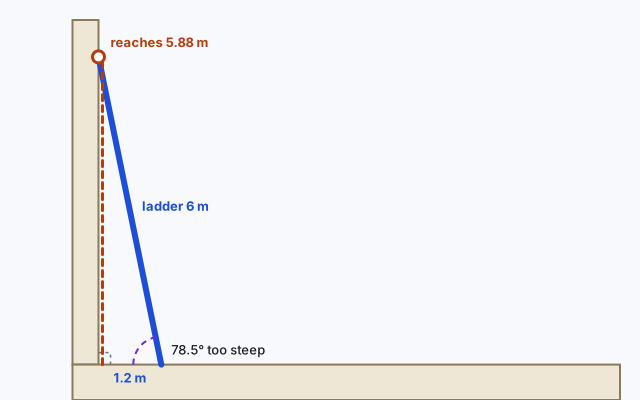
Ladder against a wall: how high will it reach?
A ladder, a wall, and the ground make a right triangle. Pythagoras does the rest.
 Go further
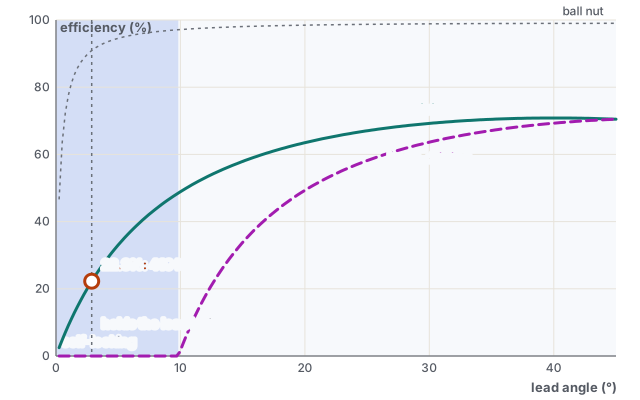
Lead screw vs. ball screw: turning torque into a push
A screw trades turns for force: F = 2π × efficiency × torque ÷ lead. Friction decides whether it also holds the load with the power off.
 Also try
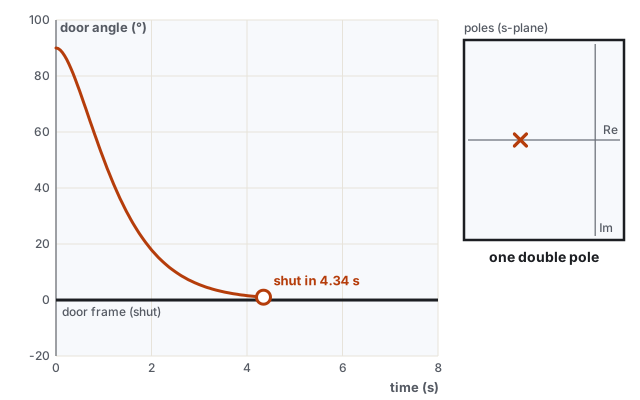
Door closer: slam, bounce, or glide
One damping knob turns a slam into a glide. Where two dots (the poles) sit tells you which.
Questions people ask
What is the rod ratio?
The connecting rod length divided by the crank radius. A higher ratio makes the piston move more like a pure sine wave and pushes less on the cylinder wall.
What is mean piston speed?
The average speed of the piston over a turn, 2 × stroke × revolutions per second. Most production car engines stay under about 25 m/s.
Why doesn't the piston reach halfway at 90°?
At 90° the rod is tilted, which pulls the piston a little farther down than a sine wave would. So it passes half stroke before 90° and spends longer in the bottom half.