How much force does a lead screw make from a motor's torque?
One turn of the screw moves the nut one lead, so force equals 2π times torque times efficiency, divided by the lead. A greased sliding nut is about 30 to 70 percent efficient, a ball nut about 90. If friction beats the thread's slope, the screw holds its load with the power off.
- Push from this torque
- 419 N
- Efficiency (raising)
- 22.3%
- Back-drive efficiency (0 = holds by itself)
- 0%
- Nut speed
- 20 mm/s
- Lead angle
- 2.87°
Sliding-nut friction changes a lot with grease, wear, and speed, so the real force can be a third higher or lower.
Challenge: Lift 100 kg or more with 1 N·m or less, on a screw that holds the load by itself.
More settings
Play
Put the same stepper on the T8 printer screw, then on the ball screw. Then compare the 2 mm and 8 mm leads.
Challenge: Lift 100 kg or more with 1 N·m or less, on a screw that holds the load by itself. The box under the picture turns green when you get it.
Stuck? Pick one of the examples from the “Try an example” menu, or press “New example.”
Understand
A screw is a ramp wrapped around a rod. One full turn does of work and moves the nut one lead , so an ideal screw pushes . Friction takes a share:
The efficiency depends on the thread's slope (the lead angle ) and the friction angle . The graph plots both curves. Left of , the shaded zone, the load can't spin the screw backward. It self-locks.
Use
Every input has a unit menu, so you can type values in the units you already have. Results follow your units.
Show the work
- Lead angle: unroll one turn of thread into a ramp
\lambda = \arctan\frac{L}{\pi d} = \arctan\frac{2}{\pi \times 12.7} = 2.87^\circ - Friction angle (the thread’s slant adds friction)
\varphi = \arctan\frac{\mu}{\cos\alpha} = \arctan\frac{0.15}{\cos 30^\circ} = 9.826^\circ - Efficiency pushing the load
\eta = \frac{\tan\lambda}{\tan(\lambda + \varphi)} = 22.25\% - Force: one turn of torque (2πT of work) moves the nut one lead
F = \frac{2\pi \times \eta \times 0.6}{0.002} = 419.4\ \text{N} - Self-locking check
\varphi = 9.826^\circ \ge \lambda = 2.87^\circ \;\Rightarrow\; \text{it holds by itself}
Export
Pick a screw, a nut, and the torque. "More settings" adds a load to lift and the screw speed.
- The friction values are typical. Real friction changes with lubrication, wear, and speed.
- A ball nut's thread shape is modeled as flat, with rolling friction. That's close enough to show the difference.
For learning and estimation. Verify with applicable codes, standards, and a qualified professional before using in design, construction, or safety-critical work.
Cheat card
| Symbol | Meaning | Unit |
|---|---|---|
| torque on the screw | N·m | |
| lead: travel per turn | m | |
| efficiency | ||
| lead angle (thread slope) | ° | |
| friction angle, arctan(μ/cos α) | ° |
- Halving the lead doubles the force and halves the speed.
- Lead is not pitch on a multi-start screw. A 4-start T8 has a 2 mm pitch but an 8 mm lead.
- A self-locking screw is always under 50% efficient. Holding the load costs you efficiency.
Where it’s used
- Mechanical
Machine designers size lead screws and ball screws for CNC axes, presses, and actuators. - Computer Science
3D printers use fine lead screws on the Z axis so the bed holds its height when the motor is off. - Driving & Travel
A car jack uses a fine, high-friction screw, so the car stays up when you let go of the handle.
Related exhibits
 Start here
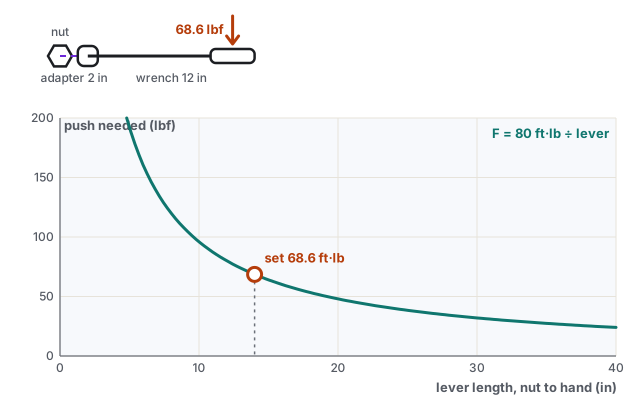
Torque: how hard to pull the wrench, and what an adapter changes
Torque is force times distance. A longer handle takes less push, and an adapter that adds length means you must set the wrench lower.
 Start here
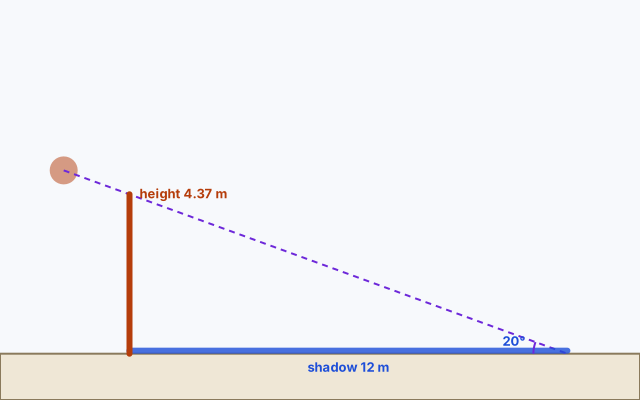
How tall is that tree? Measure its shadow
One shadow and the sun’s angle give you the height, no climbing needed.
 Go further
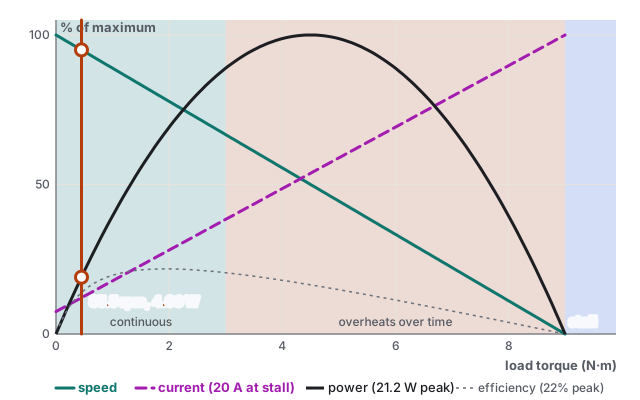
DC motor torque–speed curve: where it runs, peaks, and stalls
Load a DC motor and its speed falls in a straight line to stall. Power peaks at half speed, and efficiency peaks at light load.
 Also try
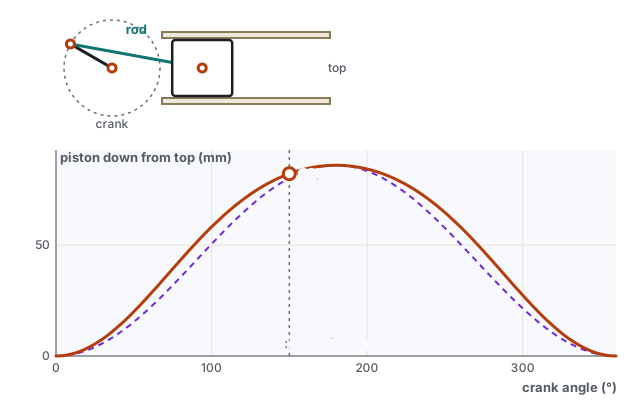
Crank and piston: turning rotation into back-and-forth
A crank turns a circle into a straight-line stroke. The connecting rod bends the motion away from a pure sine wave.
Questions people ask
What is the difference between a lead screw and a ball screw?
A lead screw's nut slides on the threads, so friction eats much of the torque. A ball screw's nut rolls on steel balls and is about 90% efficient, but it can spin backward under load.
What does self-locking mean?
The load can't turn the screw backward, because thread friction is steeper than the thread's slope. The screw holds its position with no brake or power.
What's the difference between pitch and lead?
Pitch is the distance between neighboring threads. Lead is how far the nut moves in one turn. They're equal on a single-start screw, and lead = pitch × starts on a multi-start one.